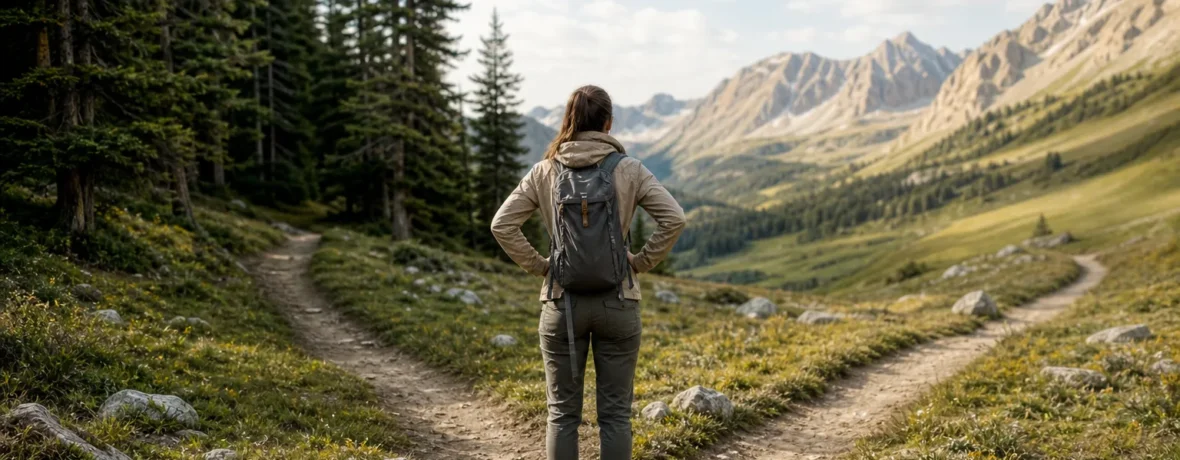
Why do hikers say hike your own hike? Because no one else can choose your pace, gear, route, risk tolerance, or reason for being out there. The short version: make your own decisions, respect the land and other people, and own the results—yes to independence, no to using freedom as an excuse.
What is the HYOH meaning?
The short answer: it means hike in the way that fits your body, goals, ethics, and conditions.
“Hike your own hike” is one of those trail phrases that sounds simple until someone uses it to justify nonsense. At its best, it is a healthy shove away from comparison. Your friend wants to crush 22 miles [35 km] before dinner. You want to stop at the lake, dry your socks, and eat peanut butter with a spoon. Fine. Both can be good hikes.
At its worst, the phrase becomes a shield. “I left trash, but hike your own hike.” No. “I camped where the sign said not to, but hike your own hike.” Also no. Personal style ends where damage, danger, and disregard begin.
That is the line. Hike your own hike is not anti-rule. It is anti-peer-pressure.
Why do hikers say hike your own hike?
Hikers say it because comparison can ruin a perfectly good trip.
Trail culture runs on stories. Pack weights. Big-mile days. Ultralight flexes. Summit shots. “I never filter there.” “I did that climb in half the time.” None of that helps when your knees hurt, the sky is building thunderheads, or your stomach hates the dinner you packed.
The phrase gives you permission to stop outsourcing your judgment. That matters on a day hike, a backpacking trip, and a thru-hike. You are the one walking in your shoes. You are the one carrying the pack. You are the one who has to live with the call you make at the junction.
But here is the opinion, plain and sharp: the best hikers do not use “hike your own hike” to avoid accountability. They use it to make better decisions.
That means checking current rules before you go, following posted closures, and practicing low-impact habits. The Leave No Trace 7 Principles give a clean framework for this: plan ahead, travel and camp on durable surfaces, dispose of waste properly, leave what you find, minimize campfire impacts, respect wildlife, and be considerate of others.
Is hike your own hike the same as doing whatever you want?
No. It is freedom inside responsibility.
The trail is not your private gym, church, racetrack, therapy office, or content studio. It can feel like all of those things. That does not make it yours alone.
Here is the useful split:
| Good “hike your own hike” | Bad “hike your own hike” | Better choice |
|---|---|---|
| Taking a shorter day because your body needs it | Ignoring a closure because your itinerary says go | Change the plan |
| Carrying heavier comfort gear because you sleep better | Playing music through a speaker for everyone to hear | Use earbuds or enjoy the quiet |
| Skipping a summit in bad weather | Pressuring your group to continue past their limit | Turn around together |
| Choosing a slower pace | Camping on fragile vegetation | Use durable surfaces or established sites |
You can hike in sandals, boots, trail runners, or clownishly expensive shoes with a carbon plate if they work for you. You can carry a chair. You can eat cold ramen. You can bail early. You can take the blue-blazed side trail if local rules allow it and that is the hike you want.
What you cannot do is pretend your choices have no wake.
How do you actually hike your own hike?
You do it by making decisions before ego gets loud.
Use the phrase as a process, not a slogan. Here is a simple way to make it real:
- Name your goal. Are you hiking for miles, solitude, fitness, scenery, wildlife, or time with a friend? Pick one main goal before the trailhead.
- Set your non-negotiables. Decide what will make you turn around: lightning, running low on water, foot pain that changes your stride, a missed time cutoff, or a closed trail.
- Choose gear for your hike, not someone else’s photo. A 9-pound [4.1 kg] base weight is not magic if you are cold all night. A 45-pound [20.4 kg] pack is not noble if it wrecks your trip.
- Check the rules where you are going. Permits, fire bans, food storage, dogs, camping zones, and group size vary by land manager and season.
- Listen to the day you are having. Wind, heat, snow, smoke, fatigue, water sources, and group morale get votes.
- Leave room for other people’s hikes. Yield well, keep noise down, share campsites gracefully, and do not turn every viewpoint into a photo shoot.
On long trails, permits are part of that responsibility. For example, the Pacific Crest Trail Association’s long-distance permit information explains that hikers using a PCT long-distance permit must follow permit terms and applicable land-management rules. On the Appalachian Trail, the Appalachian Trail Conservancy’s FAQ directs hikers to treat or filter water unless a source is officially marked potable and to prepare for hazards before hiking.
That is not bureaucracy. That is the cost of having trails that still feel wild.
What does hike your own hike look like on trail?
It looks quieter than most people think.
It is not a slogan stitched to a hat. It is the hiker who lets the faster group go because today is not a chase day. It is the couple that turns around 0.7 miles [1.1 km] from the summit because thunder is building. It is the solo hiker who takes a zero day without apology. It is the beginner who says, “I do not know,” and asks the ranger instead of guessing.
It is also the experienced hiker who does not sneer at a newbie’s big pack. The ultralight crowd can be useful. It can also be insufferable. So can the old-school crowd. So can peakbaggers, thru-hikers, day hikers, runners, bushcrafters, and anyone who starts confusing their preference with the one true way.
Strong opinion: “Hike your own hike” should make you less judgmental, not less responsible.
What should be on your hike your own hike checklist?
Your checklist should cover safety, impact, and self-honesty.
- Route: map, mileage, elevation gain, bailout points, and expected daylight
- Conditions: weather, water availability, snow, smoke, heat, storms, and road access
- Rules: permits, closures, camping zones, fire restrictions, dog rules, and food storage
- Body: current fitness, injuries, sleep, hydration, and pace that you can actually hold
- Group: slowest hiker, turnaround time, communication plan, and separation rules
- Impact: trash plan, bathroom plan, campsite choice, noise, and wildlife distance
If that sounds less romantic than a sunrise ridge walk, good. The boring stuff protects the beautiful stuff.
When should you not hike your own hike?
You should not use the phrase when your choice puts others, the land, or rescuers at unfair risk.
There are days when the right move is not personal expression. It is restraint. A closed trail is closed. A fire ban is not a suggestion. A fragile meadow is not a campsite because your feet are tired. A group member who is scared, sick, overheated, or moving badly is not “holding everyone back.” That person is part of the hike.
If you want a clean rule, use this: hike your own hike until your hike starts costing other people.
That cost can be obvious, like litter or loud music. It can also be hidden, like cutting switchbacks and creating erosion, camping too close to water, or posting sensitive locations that cannot handle traffic. The National Park Service’s Leave No Trace guidance makes the same point in practical terms: outdoor choices affect soil, water, wildlife, and other visitors.
The trail does not need you to be perfect. It does need you to care.
Related reading
- Why National Parks Matter
- Why Do People Climb Mountains?
- Why Is It Called Trail Mix?
- Why Are They Called the Smoky Mountains?
FAQ
What does hike your own hike mean in simple words?
It means make the hike fit you instead of copying someone else. Your pace, gear, distance, and goals can be different, as long as you respect rules, people, and the land.
Is hike your own hike rude?
No, not when it is used well. It becomes rude when someone uses it to shut down safety concerns, ignore regulations, or excuse behavior that affects other hikers.
Does hike your own hike mean you can skip parts of a trail?
Sometimes, yes, depending on your goal and the rules for that trail. If you are claiming a formal thru-hike, fastest known time, or permitted itinerary, skipped sections may change what you can honestly say you did.
Can a group hike your own hike together?
Yes. A good group agrees on pace, breaks, turnaround times, and decision rules before trouble starts. The group’s hike should be built around the slowest or most vulnerable member, not the loudest one.
What is the biggest mistake people make with this phrase?
The biggest mistake is treating it like a free pass. The phrase is about self-direction, not selfishness.
What is a better way to say hike your own hike?
Try this: make the choices that fit your hike, then own the consequences. That version keeps the freedom and adds the responsibility.