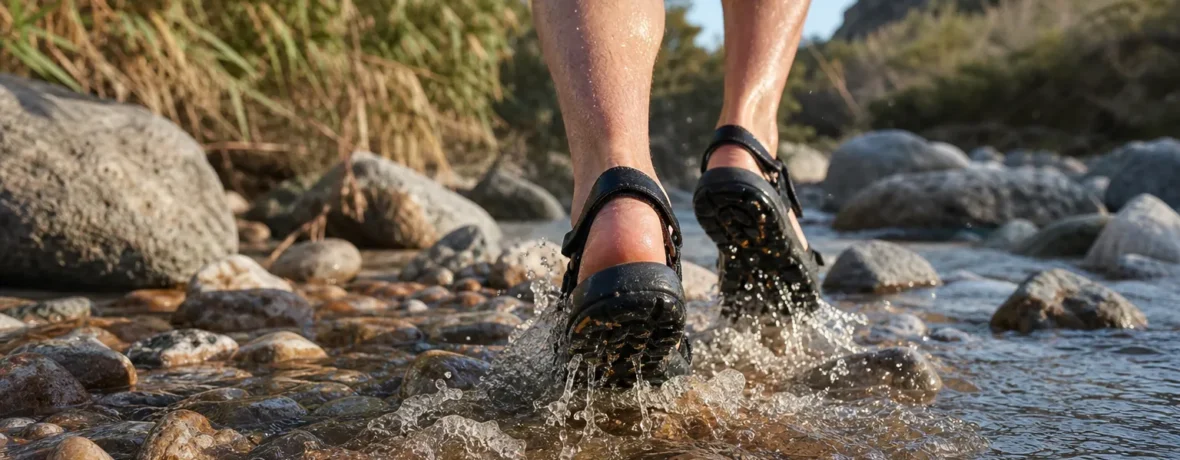
Yes. Chacos are good for short to moderate hikes on warm, wet, or smooth trails when they fit snugly and your feet are conditioned. Skip them for snow, loose scree, cactus country, heavy packs, or routes where toe protection matters.
Are Chacos good for hiking?
Yes, for the right trail.
Chacos work best when the hike is warm, the tread is predictable, and water is part of the plan. Creek crossings. River trails. Humid forest paths. Sandy approaches. Camp-to-lake walks. That is their home turf.
The classic Chaco setup gives you a firm footbed, adjustable webbing, open-air drying, and a rubber outsole with real tread. The men’s Z/1 Classic, for example, lists a ChacoGrip rubber outsole and 3.5 mm lug depth on Chaco’s official product page, as of November 2026. That is more trail-capable than a beach flip-flop, but it is not the same thing as a hiking shoe with a toe bumper and sidewall protection.
Think of Chacos as trail sandals with limits. They can be excellent. They can also punish you fast if the terrain is wrong.
Are hiking sandals better than hiking shoes?
No, they are better only in specific conditions.
Sandals win on breathability, water use, and fast drying. Shoes win on protection, edging, warmth, and stability on rough ground. If you are stepping over roots, kicking rocks, or side-hilling on loose dirt, a closed shoe gives your foot more structure.
| Trail condition | Chacos | Hiking shoes |
|---|---|---|
| Creek crossings | Strong choice | Good if designed to drain |
| Hot, dry trail | Cool and breathable | More protection, more heat |
| Loose rock or scree | Exposed toes and less side support | Better protection |
| Cold rain or snow | Poor choice | Better choice |
What makes Chacos different from regular sandals?
They are built more like outdoor gear than casual footwear.
The big differences are the wraparound strap system, contoured footbed, firm midsole, and grippy outsole. Chaco says its Z/1 Classic uses polyester jacquard webbing that wraps around the foot and through the midsole, plus a LUVSEAT PU midsole and non-marking ChacoGrip rubber outsole.
That firm footbed is the part people either love or hate. If your foot likes arch support, Chacos can feel secure all day. If you prefer soft foam, the first few hikes may feel stiff. Do not judge them from a 20-mile [32 km] day out of the box. That is how hot spots are born.
When should you hike in Chacos?
Wear them when the trail is warm, wet, and not too technical.
Good Chaco terrain includes:
- River trails with repeated crossings
- Beach hikes and lake approaches
- Warm forest trails with packed dirt
- Short desert walks without cactus, thorns, or sharp rock
- Camp shoes that can handle a real side hike
- Travel days where one pair needs to handle town, water, and trail
They also make sense if your feet overheat in shoes. Dry feet are happy feet, but soaked shoes can stay wet for hours. Chacos drain instantly and dry while you walk.
When should you not hike in Chacos?
Do not wear them when the trail wants to bite back.
Chacos expose your toes, the sides of your feet, and the top of your foot. That is fine on clean tread. It is a bad trade on routes with talus, sharp granite, thorny brush, cactus, deadfall, or cold mud.
Skip Chacos for:
- Snow, ice, or cold shoulder-season hikes
- Long scree descents
- Off-trail routes with hidden holes or sharp plants
- Heavy backpacking loads if your ankles fatigue easily
- Trails where you need traction on steep, muddy slopes
- Any hike where a stubbed toe could end the day
Also be honest about your feet. If you need orthotics, have recurring plantar pain, or roll your ankles often, sandals may not give you enough control.
Which Chacos are best for trail hiking?
The Z/1 and Z/2 styles are the usual trail picks.
The Z/1 has no toe loop, so it is easier to wear with socks and easier to slip on. The Z/2 has a toe loop, which can add forefoot control but may bother hikers who dislike anything between or over the toes.
For trail use, look for these features:
- A back strap, not a flip-flop design
- A secure buckle adjustment
- A treaded rubber outsole
- A footbed that matches your arch
- No pinching across the top of the foot
Chaco’s repair program is another real advantage. The company says Z Franchise products are repairable, and its ReChaco service can replace straps or treads. As of November 2026, Chaco lists resoles from $50 and strap replacement from $20 to $45, depending on the repair.
How should Chacos fit for hiking?
They should feel snug, not tight.
Your heel should sit inside the heel cup. Your toes should not hang over the front. The straps should hold your foot down without cutting into skin. A sloppy fit causes rubbing; an over-tight fit causes pressure points.
- Start with the heel seated fully in the sandal.
- Adjust the forefoot strap so your foot does not slide forward on descents.
- Leave enough room for natural swelling during a long hike.
- Walk downhill before committing; downhill movement reveals bad fit fast.
- Recheck the straps after 10 minutes, because webbing can settle as you move.
If the arch feels like it is in the wrong place, change sizes or models. Do not try to “tough it out.” A sandal that fights your foot at mile 1 will not become magic at mile 8 [13 km].
How do you hike in Chacos without blisters?
Break them in gradually.
The CDC’s hiking guidance recommends proper footwear for hiking and calls out blister prevention as part of trail preparation. With Chacos, the main blister zones are under the straps, around the buckle, and beneath the arch if the footbed does not match your foot.
Use this quick checklist before longer hikes:
- Wear them around town before taking them on trail.
- Start with 1-3 miles [1.6-4.8 km], not a full-day hike.
- Carry tape, blister pads, or moleskin.
- Clean sand and grit from under the straps after water crossings.
- Loosen straps if your feet swell.
- Use socks if the weather, bugs, or rubbing call for it.
Yes, socks with Chacos look goofy. No, the trail does not care. Socks can reduce rubbing, block sun, and add warmth on cool mornings.
When to see a doctor
Get medical care if pain, swelling, or injury symptoms are more than minor.
Do not use trail sandals to push through a foot or ankle injury. Mayo Clinic advises contacting a healthcare professional if you have ankle pain and swelling and think you may have a sprain; urgent care is needed for severe pain, obvious deformity, inability to bear weight, or signs of infection. Use that same common sense with foot injuries from sandal hiking.
Stop hiking and get help if you have numbness, spreading redness, deep cuts, a puncture wound, or pain that changes your stride. Sandals make small problems easy to spot. That is good. Act early.
Related reading
- Is Merino Wool Good for Summer Hiking?
- Are Timberlands Good for Hiking? An Honest Trail Test
- Are Trail Running Shoes Good for Hiking? Pros, Cons and When to Switch
- Can You Hike in Running Shoes? What Actually Changes on the Trail
FAQ
Can you wear Chacos on long hikes?
Yes, if your feet are conditioned and the terrain is friendly. For rough, rocky, cold, or heavily loaded hikes, closed shoes are usually the safer pick.
Are Chacos good for backpacking?
Sometimes, but they are better as camp shoes or water-crossing shoes for many backpackers. If you carry a heavy pack, your feet may need more structure and protection than sandals provide.
Do Chacos have good traction?
Yes, on many wet and dry surfaces. They still have limits on slick mud, algae-covered rock, loose gravel, and steep descents where a hiking shoe may grip and edge better.
Should I get Chaco Z/1 or Z/2 for hiking?
Choose Z/1 if you want simple straps and sock compatibility. Choose Z/2 if you like a toe loop and want more forefoot control.
Do you need to break in Chacos before hiking?
Yes. Wear them for short walks first so your skin adapts to the straps and your feet adjust to the firm footbed.
Are Chacos good for water hikes?
Yes, water hikes are one of their best uses. Just watch for slippery submerged rocks, and rinse out sand or grit before it rubs your skin raw.