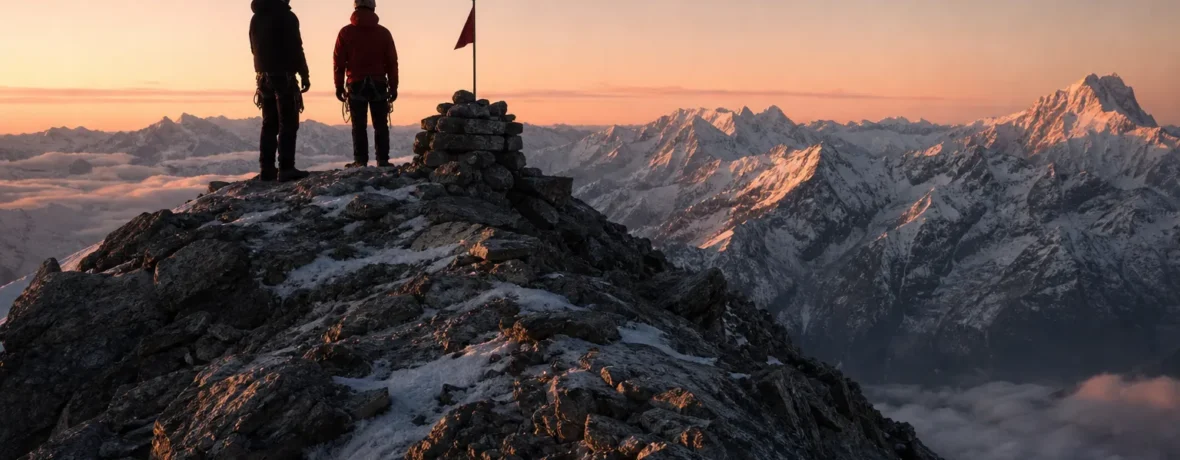
Why do people climb mountains? Because a mountain gives you a clean test: commit, suffer a little, solve problems, and see what you’re made of. The summit matters, but the stronger pull is agency—you choose a hard thing, move upward step by step, and come back changed.
Why do people climb mountains?
People climb mountains because hardship with a clear purpose feels honest.
That is the plain answer. Not noble. Not mystical. Honest. A mountain strips the day down to weather, grade, lungs, legs, judgment, and nerve. You can’t charm your way up a scree slope. You can’t negotiate with thin air. You go, or you don’t.
That is exactly why it grabs people.
Most modern life is mushy around the edges. Emails blur into errands. Work bleeds into home. Fitness gets tracked, optimized, and sold back to you with a subscription. A mountain is different. It offers a clean line. Start here. Go up there. Turn around if the mountain, your body, or the sky says no.
That last part matters. Climbing mountains is not just chasing summits. The good climber knows the summit is optional. Coming home is not.
So here is the column’s position: people climb mountains because they want contact with consequence. They want beauty, yes. They want stories, yes. They want a photo on the ridge with their jacket snapping in the wind, sure. But underneath all that is a sharper hunger. You want to feel awake inside your own life.
Is climbing mountains about the summit?
No, the summit is the symbol, not the whole reward.
The summit gives the day a point. It makes the suffering legible. It turns sweat, doubt, and cold fingers into a sentence you can understand: you started low and stood high.
But if the summit were the only thing, mountain people would be miserable most of the time. Weather turns climbers around. Snow bridges sag. Lightning builds. Knees complain. Partners run out of gas. Routes take longer than planned. A smart party may walk away 500 feet [152 meters] below the top and still have made the best decision of the day.
The summit matters because it focuses effort. The climb matters because it reveals character.
| What people say they want | What the mountain actually gives | What you should respect |
|---|---|---|
| A summit photo | A memory earned through effort | Weather, time, and descent |
| Adventure | Uncertainty with real stakes | Route-finding and group pace |
| Fitness | Full-body endurance and patience | Recovery, hydration, and food |
| Escape | Attention sharpened by terrain | Humility when plans change |
Why are mountains so meaningful to people?
Mountains feel meaningful because they make you small without making you worthless.
That is a rare sensation. A big peak does not care who you are, what you earn, what you drive, or how many people liked your last post. It just stands there. Rock, snow, trees, wind, exposure. You meet it on its terms.
That can sound harsh, but it is freeing. In the mountains, your attention gets pulled back to things that matter right now: the next switchback, the dark cloud forming over the ridge, the loose rock under your boot, the friend who has gone quiet behind you.
Meaning shows up because the noise drops away.
There is also beauty, and no serious answer should pretend otherwise. Alpenglow on a high face. A valley opening below you. A ridgeline cutting the sky clean in half. The first warm light after a cold start. You do not need to be sentimental to be moved by that. You only need to be awake.
What kind of person wants to climb a mountain?
The kind of person who wants a hard, simple problem may want to climb a mountain.
Not fearless people. That myth should be retired. Good climbers feel fear, then sort it. Is this useful fear, warning me to turn around? Or is this ordinary discomfort, asking me to keep breathing and take the next step?
Mountain climbing attracts different temperaments:
- The tester: You want to know what your body and mind can handle.
- The seeker: You want silence, scale, and a break from the flatness of routine.
- The craftsperson: You like skills: knots, pacing, layers, maps, snow travel, risk calls.
- The loyal partner: You enjoy moving as a team and sharing a demanding day.
- The collector: You like lists, peaks, maps, and the satisfaction of marking progress.
None of these motives is automatically better than the others. The trouble starts when ego outruns judgment. If you climb to prove that you are tough, the mountain may accept your application and grade it brutally.
How do you know if climbing mountains is for you?
You know it might be for you if the effort sounds as appealing as the view.
That is the filter. If you only want the view, take a scenic drive, ride a gondola, or hike an easy overlook trail. No shame there. But if you feel pulled toward the work itself—the long approach, the burning calves, the map check, the early alarm, the careful descent—then mountains may have their hooks in you.
Try it in stages:
- Start with steep day hikes. Pick maintained trails with clear mileage, obvious turnaround points, and modest exposure.
- Learn pacing. If you blast the first mile and crawl the last mile, the mountain has already taught you something.
- Carry the basics. Bring insulation, rain protection, water, food, headlamp, first-aid supplies, navigation, and a way to call for help where service exists.
- Go with better partners. A calm, prepared partner is worth more than a fast one.
- Practice turning around. Make the decision before you are desperate. That is not failure. That is mountain sense.
Is climbing mountains dangerous?
Yes, climbing mountains can be dangerous, and pretending otherwise is childish.
The risk changes with the peak, season, route, weather, altitude, snow conditions, remoteness, and your decisions. A summer hike up a rounded 4,000-foot [1,219-meter] peak is not the same as a glaciated volcano or a winter alpine route. Still, every mountain asks for respect.
Altitude is one clear example. The CDC high-altitude guidance says travelers going above 8,000 feet [2,438 meters] may be at risk for altitude illness; above 9,000 feet [2,743 meters], the CDC advises increasing sleeping elevation by no more than 1,600 feet [488 meters] per day, with an extra day for every 3,300 feet [1,006 meters] gained, as of November 2026.
The CDC Yellow Book on altitude illness describes acute mountain sickness symptoms as headache plus issues such as dizziness, fatigue, nausea, or vomiting. The Wilderness Medical Society altitude illness guidelines also treat descent as a key response for serious altitude illness.
Cold adds another layer. The Mayo Clinic hypothermia first-aid guidance says hypothermia happens when body temperature falls below 95°F [35°C] and calls for emergency help if you suspect it.
Here is the blunt checklist before you go higher:
- Do you know the route and the descent?
- Do you have a turnaround time?
- Do you have layers for wind, rain, and temperature drops?
- Do you have enough water and calories for delays?
- Does someone off-mountain know your plan?
- Can every person in the group say “turn around” without being mocked?
When to see a doctor
See a doctor before climbing high mountains if you have medical conditions, symptoms at altitude, or doubts about how your body handles exertion.
This is not a diagnosis column. It is common sense with boots on. If you have heart disease, lung disease, sleep apnea, diabetes, sickle cell trait, pregnancy, or a history of altitude illness, talk with a clinician familiar with high-altitude travel before you plan a high climb. The CDC gives similar advice for people with preexisting medical conditions traveling to elevation.
During or after a climb, get medical help quickly if someone has confusion, loss of coordination, severe shortness of breath, persistent chest symptoms, fainting, worsening symptoms at rest, or signs of hypothermia such as slurred speech, clumsiness, drowsiness, or confusion. If symptoms worsen at altitude, descent is not a philosophical debate. Go down and seek care.
What does climbing a mountain teach you?
Climbing a mountain teaches you that wanting something is not the same as earning it.
That lesson is old, useful, and badly needed. You can want the summit all day. The mountain still asks for preparation, judgment, patience, and humility. You may need to slow down. You may need to eat before you feel hungry. You may need to put on a shell before you get soaked. You may need to turn around while the top is still visible.
Mountains also teach scale. Your problems may not disappear, but they shrink into proportion when you are standing under a wall of stone older than any argument you brought from home.
The best reason to climb is not to conquer anything. That word has always sounded insecure. You do not conquer a mountain. You visit it, move across it for a little while, and leave before it decides to keep you.
So why do people climb mountains? Because the mountain gives back what modern life often takes away: attention, effort, consequence, wonder, and the deep satisfaction of doing something hard without needing to explain it to everyone.
Related reading
- Why Are They Called the Smoky Mountains?
- Why People Stack Rocks and Why It's a Problem
- Why Is It Colder in the Mountains?
- Why Do People Walk the Camino?
FAQ
Why do people risk their lives to climb mountains?
People risk climbing mountains because the reward feels intensely personal: challenge, beauty, identity, and proof under pressure. The risk should be managed, not romanticized, through training, conservative decisions, good partners, and a willingness to turn around.
Is mountain climbing good for mental health?
It can be, but it is not therapy by default. Time outside, physical effort, and focused attention can help many people feel clearer, but serious anxiety, depression, trauma, or panic symptoms deserve support from a qualified professional.
Do you need to be extremely fit to climb a mountain?
No, not for every mountain, but you do need fitness that matches the objective. A steep trail hike asks for endurance and pacing; a technical alpine climb may require rope skills, snow travel, strength, and experience.
What is the biggest mistake beginners make on mountains?
The biggest mistake is treating the summit as mandatory. Beginners often start too fast, carry too little, ignore weather, or delay the turnaround decision until they are already tired and exposed.
Why do people climb mountains if they might not reach the top?
Because the climb still counts. You gain skill, judgment, fitness, and self-knowledge even when weather, altitude, or timing keeps you below the summit.