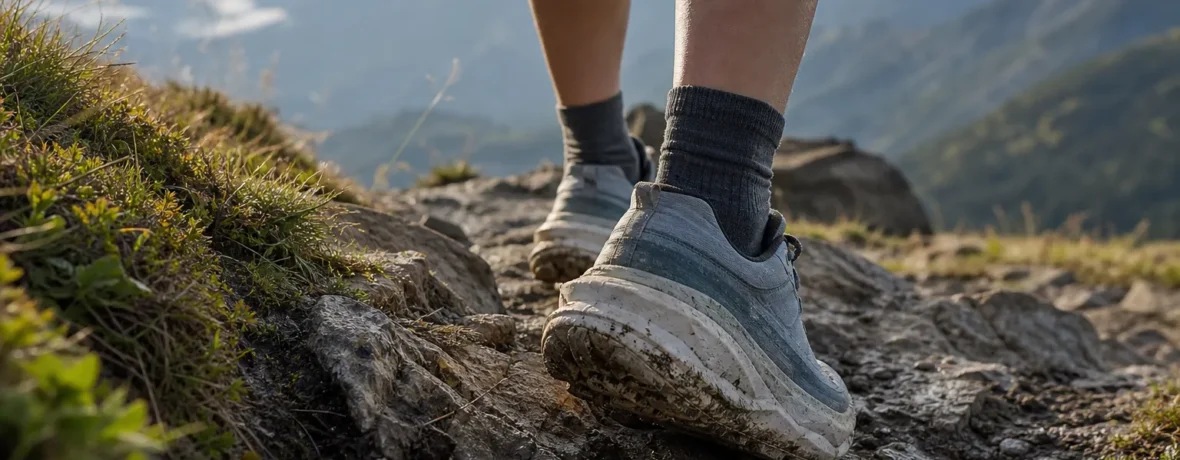
Are Hokas good for hiking? Yes, for day hikes, groomed trails, and moderate backpacking when the fit locks your heel and the outsole matches the terrain. They are less ideal for off-camber rock, heavy loads over 30 lb [13.6 kg], and hikers who need a stiff, low, precise platform.
Are Hokas good for hiking on rocky trails?
Yes, but only if you like a cushioned ride more than a ground-hugging one.
Hokas built for hiking feel different from old-school leather boots. The midsole is thicker, the heel-to-toe transition rolls forward, and the landing feels soft under tired feet. That is the draw. On hardpack, gravel, dry forest tread, desert paths, and long downhill exits, that plush foam can make a hike feel kinder on your feet.
The tradeoff is trail feel. A taller stack puts more material between your foot and the ground, so you do not sense small rocks and angled roots as clearly. Some hikers love that protection. Others feel disconnected, especially on narrow sidehill tread where every step tilts toward the downhill edge.
Think of Hokas as comfort-first trail footwear. They work best when the route is mostly walking, not scrambling. If your hike includes miles of talus, slick slabs, ladder-like roots, or Class 3 moves, a stiffer shoe with a lower platform may feel more confident.
Which Hoka hiking shoes are actually made for trails?
The best models are the dedicated HOKA hikers, not the road-running shoes with trail dust on them.
HOKA makes true hiking models and trail-running models. That matters. A road shoe like the Bondi may feel amazing in town, but it is not built with the same upper protection, lugs, or wet-trail traction you want on dirt. The main HOKA hiking shoes to compare are the Anacapa and Kaha lines, plus trail runners like the Speedgoat if you want a lighter, faster feel.
| Model type | Best use | Main tradeoff | What to check |
|---|---|---|---|
| Anacapa 2 Low GTX | Day hikes, wet grass, maintained trails, travel | Less ankle coverage than a mid boot | Heel hold and forefoot width |
| Anacapa 2 Mid GTX | Muddy trails, shoulder-season hikes, light backpacking | Warmer and slower drying than non-waterproof shoes | Collar comfort around ankle bones |
| Kaha 3 GTX | Longer hikes, rougher tread, hikers wanting more structure | More shoe underfoot than some hikers want | Sidehill stability and lace tension |
| Speedgoat or Challenger trail runners | Fast day hikes, dry trails, lighter packs | Less upper protection and support | Toe bumper, outsole bite, and fit under load |
For concrete construction details, start with HOKA’s Anacapa 2 Low GTX product information and HOKA’s Kaha 3 GTX product information. Those pages show the features that separate the hiking line from casual sneakers: waterproof builds, toe caps, cushioned midsoles, and Vibram rubber on key models.
Is Hoka cushioning good or bad for hiking?
It is good for fatigue and impact, but not perfect for balance.
HOKA’s identity is cushioning. That soft, thick midsole can help on long descents, packed-out dirt, and rocky trail where repeated foot strikes start to wear you down. If your feet usually feel bruised after 8 miles [12.9 km], Hokas make sense to try.
Cushioning helps most when the trail is repetitive. Think rolling singletrack, crushed gravel, dry woodland paths, and long approaches. The foam dulls impact and the rocker shape encourages a smooth forward roll. You can walk without feeling every pea-sized stone.
But cushioning is not the same as support. A very soft platform can feel wobbly if your foot slides inside the shoe, if the midsole compresses unevenly on angled ground, or if the shoe is too narrow and your toes cannot spread. The taller the shoe feels underfoot, the more important fit becomes.
Here is the simple read: cushioning is a comfort feature. Stability is a control feature. You want both, but if the trail is steep, loose, and off-camber, control wins.
Are Hokas stable enough for hiking with a backpack?
Yes for lighter packs, maybe for medium loads, and not always for heavy backpacking.
A cushioned HOKA can feel secure with a day pack, especially on maintained tread. Add a heavier pack and the equation changes. More weight pushes your foot deeper into the foam and increases side-to-side force on descents, switchbacks, and rocky steps.
For many hikers, the comfort range is day hiking and light overnight gear. Once your pack climbs past 30 lb [13.6 kg], test carefully before committing to a long route. A stiffer boot may spread load better, reduce foot fatigue in technical terrain, and give you more edging power on uneven rock.
Look for these stability clues during a try-on:
- Your heel stays planted when walking uphill.
- Your toes do not slam the front on a downhill ramp.
- Your foot does not spill over the midsole edge when you lean side to side.
- The shoe bends at the ball of your foot, not through the arch.
- The laces hold tension without crushing the top of your foot.
If the shoe feels floaty in the store, it will not become more precise on a rocky trail. Trust that signal.
Do Hokas have enough traction for wet rocks and mud?
Some do, especially models with Vibram Megagrip, but lug shape still matters.
Outsole rubber is where many HOKA hikers get serious. Vibram says Vibram Megagrip is made for grip on wet and dry terrain. That is a useful feature on slick roots, rain-darkened rock, and packed dirt where cheap rubber can feel sketchy.
Rubber is only half the traction story. Lug depth and pattern matter too. Wider-spaced lugs shed mud better. Shorter, broader lugs can feel smoother on rock. Aggressive lugs bite into soft dirt but may feel clunky on pavement approaches.
For wet, rocky trails, favor a hiking-specific HOKA with a protective upper and proven rubber. For deep mud, snow, or loose scree, do not expect a cushioned day hiker to act like a mountaineering boot. You may need deeper lugs, a stiffer sole, or traction devices when conditions turn icy.
Are waterproof Hokas worth it for hiking?
They are worth it for wet grass, shallow puddles, and cold rain, but not for every hike.
Many HOKA hiking models use waterproof membranes. GORE-TEX describes GORE-TEX Invisible Fit as a waterproof technology bonded into athletic footwear to preserve a sneaker-like feel. On trail, that means you can get a lighter, softer shoe without giving up basic water protection.
Waterproof Hokas shine in shoulder season. They keep dew from soaking your socks during the first mile. They help in cold rain. They make sense for muddy trailheads, shallow puddles, and damp campsites.
They are less fun in hot weather. Waterproof shoes trap more heat than mesh shoes. If water pours over the collar during a stream crossing, it can stay inside longer. In desert heat or summer humidity, a breathable non-waterproof trail shoe may be the better call.
Use this quick rule: choose waterproof for cold and damp; choose breathable for hot and dry.
How should Hokas fit for hiking?
They should feel secure in the heel, roomy in the toes, and boringly comfortable from the first walk.
Do not buy Hokas for hiking the same way you buy casual sneakers. Trail walking adds swelling, descents, socks, dust, and pack weight. Fit them like gear.
- Try them late in the day. Feet swell after standing and walking, which better matches trail conditions.
- Wear your hiking socks. Thick socks can change volume enough to create pressure on the toes or top of the foot.
- Check toe clearance. Leave roughly 0.5 in [1.3 cm] in front of your longest toe while standing.
- Test a downhill angle. Your toes should not hit the front when your heel is locked back.
- Walk side to side. If your foot rolls over the midsole edge, try a wider size or a different model.
- Use the top eyelets. A heel-lock lacing pattern can tighten the rearfoot without crushing the forefoot.
- Bring your insoles if you use them. Aftermarket insoles change volume and heel height.
HOKA fit varies by model. Some hikers find the midfoot snug. Others need wide sizes. If you are between sizes, compare both with the exact socks you hike in.
Who should buy Hokas for hiking?
Buy them if comfort, cushioning, and a smooth stride matter more than boot-like stiffness.
Hokas make the most sense for these hikers:
- Day hikers who spend 5 to 15 miles [8 to 24.1 km] on maintained trails.
- Hikers with sore feet after hardpack descents.
- Travelers who want one shoe for town walks and trail time.
- Backpackers carrying lighter kits on established routes.
- Fast hikers who want more protection than a minimal trail runner.
- Anyone who dislikes the break-in period of stiff leather boots.
The best part of Hokas is immediate comfort. The worst part is that immediate comfort can hide poor control. Walk stairs, ramps, gravel, and uneven ground before trusting them on a big hike.
Who should skip Hokas for hiking?
Skip them if you need maximum precision, stiffness, or ankle protection.
Hokas are not the automatic answer for every hiker. Choose something else if your trips often include:
- Heavy backpacking loads over 30 lb [13.6 kg].
- Off-trail travel through talus, scree, or blowdowns.
- Steep sidehills where edging matters.
- Snow travel that needs crampon-compatible boots.
- Very narrow feet that slide inside high-volume shoes.
- Very wide forefeet if the available wide size still pinches.
- Routes where ankle impact protection matters more than cushioning.
Also skip the softest-feeling pair if you pronate hard inside the shoe or feel your ankle tipping outward. A cushy shoe that feels unstable is not a bargain. It is a liability.
How do you choose between cushioning and stability?
Match the shoe to the roughest part of the hike, not the easiest mile.
Here is the clean decision process:
- Name the terrain. Smooth dirt, rocky singletrack, wet roots, desert slickrock, mud, or talus all ask for different footwear.
- Name your load. A 10 lb [4.5 kg] day pack is a different job than a 35 lb [15.9 kg] backpack.
- Decide how much trail feel you want. More cushion means less ground feedback.
- Check the outsole. For wet rock and mixed trail, quality rubber matters.
- Test sidehill control. Stand on an angled surface and see if your foot drifts.
- Walk downhill. Toe bang is a dealbreaker.
- Keep the receipt until they pass a real shakedown. Wear them indoors first, then on a short local trail.
If you are stuck between two pairs, choose the one that feels more stable after 20 minutes of walking, not the one that feels softer in the first 20 seconds.
When to see a doctor
See a clinician promptly if pain, swelling, numbness, or injury signs go beyond normal trail soreness.
Shoes can affect comfort, but they do not diagnose foot problems. Do not use Hokas, insoles, or lacing tricks to push through sharp pain. Mayo Clinic’s guidance on foot and ankle pain lists red flags such as inability to put weight on the foot, severe swelling, signs of infection, numbness or tingling, and pain after a traumatic injury.
If a new shoe causes burning, tingling, black toenails, or pain that changes your gait, stop using it until you figure out the cause. A different size may fix a fit issue. Persistent pain needs medical advice.
Verdict: Are Hokas a smart hiking buy?
Yes, if your hikes reward cushioning more than stiffness.
Hokas are good hiking shoes for a huge slice of real-world trail use: day hikes, travel hikes, wet forest paths, gravel routes, rolling singletrack, and light backpacking. They are comfortable fast, easy to walk in, and available in models with legitimate trail features like waterproof membranes, toe protection, and Vibram rubber.
They are not magic. The same thick cushion that saves your feet on a long descent can feel less precise on angled rock. The same waterproof liner that keeps out morning dew can feel hot in July. The same rocker that rolls beautifully on smooth tread can feel vague when you need to edge.
Buy Hokas if they fit securely, match your terrain, and pass a short shakedown hike. Skip them if your routes demand stiff support, low-profile precision, or heavy-load stability. Cushioning is great. Control keeps you upright.
Related reading
- Is Merino Wool Good for Summer Hiking?
- Are Timberlands Good for Hiking? An Honest Trail Test
- Are Trail Running Shoes Good for Hiking? Pros, Cons and When to Switch
- Can You Hike in Running Shoes? What Actually Changes on the Trail
FAQ
Fast answers for common HOKA hiking questions.
Are Hokas better than hiking boots?
No, not across the board. Hokas are usually softer and easier to walk in, while traditional hiking boots usually offer more stiffness, edging power, and protection under heavier loads.
Can you backpack in Hokas?
Yes, if your pack is light and the trail is maintained. For heavy backpacking, rough off-trail travel, or long rocky routes, test stability carefully before choosing Hokas over firmer boots.
Are HOKA trail runners good for hiking?
Yes, for fast day hikes and dry trails. Trail runners save weight and feel nimble, but they usually give up upper protection, long-term durability, and support compared with dedicated hiking models.
Do Hokas need a break-in period?
Usually not much. Still, wear them on short walks and one short hike before a big trip, because fit problems often show up on descents after your feet swell.
Are waterproof Hokas good for summer hiking?
Sometimes, but breathable non-waterproof shoes are often cooler. Choose waterproof Hokas for cold rain, mud, and wet grass; choose mesh models when heat and fast drying matter more.
Why do Hokas feel unstable on trails?
The thick cushioning and higher platform can feel tippy if the fit is loose or the trail is off-camber. Try a wider or narrower size, tighten the heel with different lacing, or choose a lower, firmer hiking shoe.