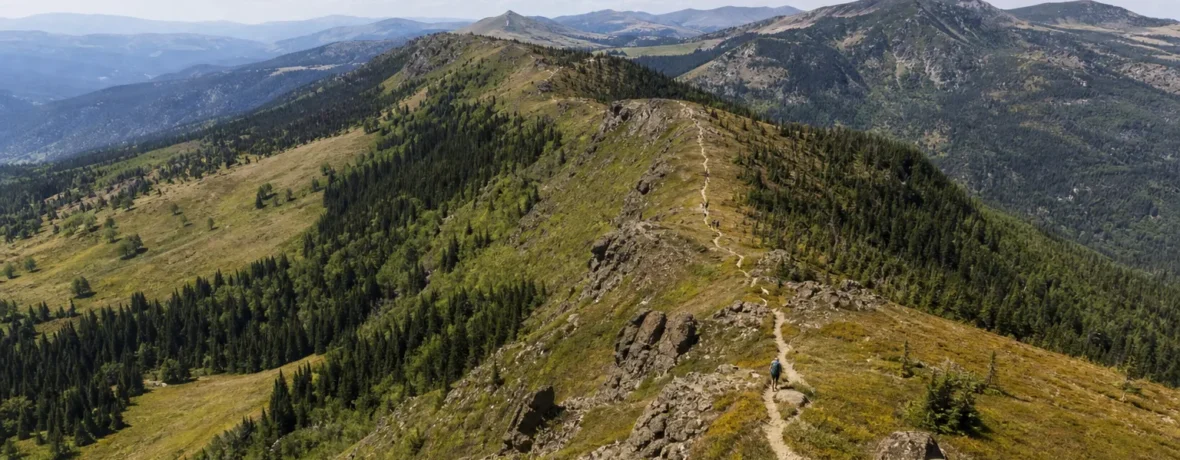
What is a long trail? In the U.S., it usually means a named route designed for multi-day travel, often 100 miles [161 km] or more. A national scenic trail is a stricter legal label: a continuous, primarily non-motorized, 100-plus-mile route created by Congress for standout scenery, culture, and recreation.
Here’s the opinionated version: not every pretty path deserves the “long trail” label. A long trail should ask something of you. Time. Planning. Weather sense. Feet that can handle repeat days. The best ones pull you through a region instead of dropping you into a single viewpoint and sending you home.
That does not mean you have to quit your job and thru-hike for five months. You can hike a long trail in sections, weekends, or one hard-earned vacation at a time. But the trail itself should have continuity. It should feel like a line across the map, not a collection of unrelated strolls stitched together by marketing copy.
What is a long trail?
A long trail is a named route long enough to require sustained travel, real logistics, and repeated days on foot.
There is no single universal U.S. legal definition for every trail using the word “long.” The cleanest practical line is this: if the route changes how you pack, resupply, sleep, and think, it is acting like a long trail. A 12-mile [19 km] loop may be hard. A 50-mile [80 km] route can be a serious weekend. But a true long trail usually lives in the 100-mile [161 km] range or beyond, because that distance forces a different relationship with terrain.
The federal government uses that 100-mile benchmark for “extended trails” in the National Trails System Act, with exceptions for some historic routes. The law says extended trails are trails or trail segments totaling at least 100 miles [161 km], and it describes scenic routes as serving recreation while protecting nationally significant scenic, historic, natural, or cultural qualities. Read the legal language in 16 U.S.C. § 1242.
So, for hikers, the answer is blunt: a long trail is not just long in mileage. It is long in commitment.
What are national scenic trails?
They are federally designated long-distance routes created by Congress for outstanding recreation and nationally significant landscapes.
As of November 2026, the National Park Service lists 11 NSTs in the United States, including the Appalachian, Pacific Crest, Continental Divide, North Country, Florida, Ice Age, Arizona, New England, Natchez Trace, Pacific Northwest, and Potomac Heritage routes. The NPS overview of these routes describes them as primarily non-motorized continuous trails that extend 100 miles [161 km] or more.
This is where language matters. A long trail can be local, state-run, nonprofit-built, unofficial, or community-maintained. A federally designated route sits in a different bucket. Congress established it, a federal agency administers it, and land managers along the way handle on-the-ground segments.
That split explains why one trail can feel simple on the map and complicated under your boots. You may cross national parks, national forests, state parks, private easements, road walks, towns, ranchland, and tribal lands. The line has one name, but the rules can change many times.
How is a long trail different from a thru-hike?
A long trail is the route; a thru-hike is one way of hiking it.
People mix these up constantly. The Appalachian Trail is a long trail. Hiking the Appalachian Trail from Georgia to Maine in one continuous trip is a thru-hike. Section-hiking the same route over 15 years still means you are hiking a long trail.
That distinction is healthy. Thru-hiking gets the books, films, and finish-line photos. Fine. But section hikers, day hikers, maintainers, weekend backpackers, and local trail crews are the reason these routes survive outside the spotlight.
| Term | What it means | Best example |
|---|---|---|
| Long trail | A named route built for sustained travel across a region | Pacific Crest Trail |
| Thru-hike | One continuous end-to-end hike of a route | Mexico to Canada on the PCT |
| Section hike | Completing pieces over separate trips | Two weeks each year on the AT |
| Backpacking trip | Any overnight foot trip, long trail or not | A 3-night wilderness loop |
Which American long-distance trails should you know first?
Start with the big names, then look beyond them.
The American imagination tends to crown the “Triple Crown”: Appalachian Trail, Pacific Crest Trail, and Continental Divide Trail. They deserve the attention. They are enormous, varied, and culturally important. But they are not the whole story, and treating them as the only serious routes flattens the country.
The North Country Trail stretches across the northern tier. The Florida Trail runs through swamps, pine flatwoods, beaches, and road-connected gaps. The Arizona Trail crosses deserts, sky islands, forests, and the Grand Canyon corridor. The Ice Age Trail follows glacial landscapes in Wisconsin. These trails prove a point hikers should repeat more often: difficulty is not only elevation gain.
Heat is difficulty. Water carries are difficulty. Mosquitoes are difficulty. Navigation is difficulty. Mud is difficulty. Road walking can grind you down faster than a clean mountain pass.
America’s long trails are not ranked by beauty in any honest way. They are different tools for seeing different versions of the country.
How do you choose your first long trail?
Pick the trail that matches your time, season, budget, and tolerance for discomfort.
The wrong first long trail is usually chosen by ego. The right one is chosen by calendar and conditions. A famous route is not automatically the right route for you this year.
- Choose your season first. Snowpack, heat, bugs, fire risk, and daylight decide more than motivation does.
- Set a real time window. Be honest with your available days, travel time, and recovery time after the trip.
- Study water and resupply. A trail with frequent towns feels very different from one with long dry stretches.
- Check permits and land rules. Use official agency pages, park pages, forest pages, and Recreation.gov when a permit system applies.
- Match the surface to your body. Rocky tread, sand, snow, bog bridges, pavement, and steep grades all load your joints differently.
- Plan an exit strategy. Know where you can leave the route if weather, injury, or family life calls you home.
That last step is not pessimism. It is respect. A long trail rewards flexible hikers and punishes romantic ones.
What should you check before hiking a long trail?
Check current conditions before you trust any guidebook, app, or old trip report.
Long trails are living systems. Fires burn bridges. Storms drop trees. Floods erase tread. Landowners change access. Agencies reroute miles. A printed map can be beautiful and still be out of date.
- Official trail association alerts
- National park and national forest notices
- Current permit pages, if your route crosses permitted areas
- Water reports and seasonal source reliability
- Road closures at trailheads and resupply towns
- Fire restrictions and active incident maps
- Shuttle availability, transit schedules, and parking rules
- Bear canister, food storage, and camping requirements for each land unit
The NPS National Trails System FAQ gives a useful explanation of how federal trail administration differs from local management. That difference matters on the ground: one agency may coordinate the overall route while another land manager controls camping, dogs, bikes, group size, or closures on a specific segment.
Why long trails still matter
They protect the idea that ordinary people should be able to move through big landscapes on foot.
That sounds simple. It is not. A long trail is a political achievement, a volunteer project, a conservation corridor, a tourism engine, and a personal challenge hiding under one line on a map. The path only exists because people fought for access, built tread, negotiated easements, cut blowdowns, painted blazes, wrote management plans, and came back after storms wrecked the work.
My position is this: we should stop treating long trails as just endurance trophies. The finish photo is the least interesting part. The real value is continuity. A long trail lets you watch a region change by walking through it: ridge to valley, desert to forest, town to empty country, spring to summer, comfort to competence.
You do not need to hike 2,000 miles [3,219 km] to understand that. You can learn it in 120 miles [193 km] if the route has a spine and you give it your attention.
Related reading
- Why Is It Called Trail Mix?
- Is the Inca Trail Worth It?
- A Short History of the Appalachian Trail
- Trail Erosion: Why Shortcuts Matter
FAQ
Quick answers for the questions hikers ask before they start planning.
How many miles is considered a long trail?
A practical cutoff is 100 miles [161 km]. Shorter routes can be tough, but 100 miles is the point where food, sleep, weather, and resupply usually become central planning problems.
Do you have to thru-hike a long trail?
No. A thru-hike is only one style. Section hiking, weekend backpacking, and day hiking are all valid ways to experience a long trail.
Are long trails only for expert hikers?
No, but they punish careless planning. Beginners should choose shorter sections, favorable seasons, reliable water, clear bailouts, and terrain that matches their current fitness.
Who maintains America’s long trails?
Many groups share the work. Federal and state agencies, nonprofit trail organizations, local clubs, private landowners, and volunteers all keep pieces of these routes open and usable.
What is the best first long trail?
The best first long trail is the one you can prepare for well. Choose a route with manageable weather, frequent resupply, clear information, and a distance that leaves room for mistakes.