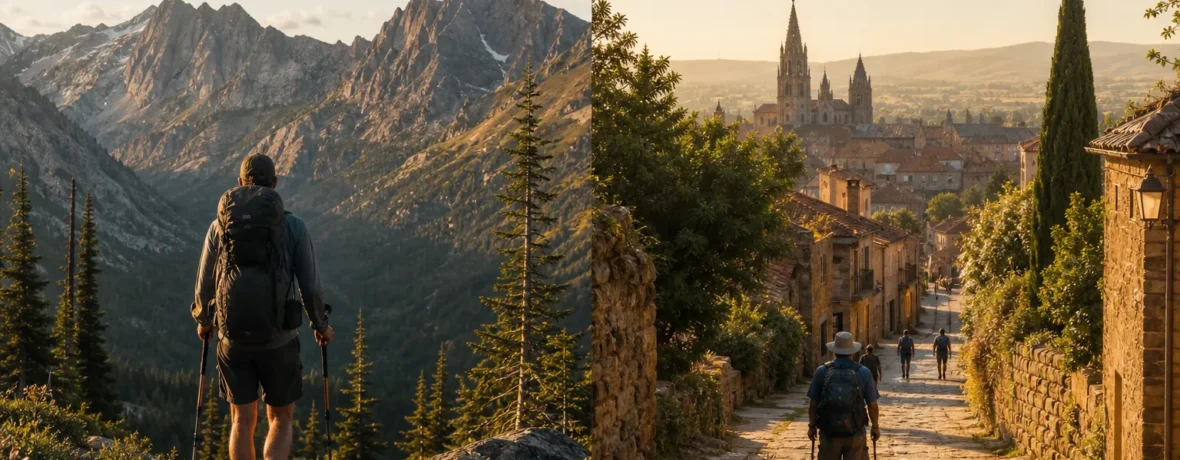
Triple crown vs camino: they are not rival versions of the same trip. The U.S. Triple Crown means hiking the AT, PCT, and CDT: roughly 7,948 miles [12,791 km]. The Camino can qualify for its Compostela after 62 miles [100 km] on foot. Choose the Triple Crown for wilderness mastery; choose the Camino for pilgrimage.
What is the real difference in triple crown vs camino?
The real difference is purpose: the Triple Crown is a long wilderness project, while the Camino is a cultural and spiritual walking route.
That sounds blunt because it needs to be. Too many hikers treat the Camino as “Europe’s thru-hike” and too many pilgrims treat American long trails as a hardship contest. Both views miss the point.
The Triple Crown asks you to build a life around trails. You string together the Appalachian Trail, the Pacific Crest Trail, and the Continental Divide Trail. You sleep outside for months. You carry your kitchen, shelter, insulation, water treatment, repair kit, and bad decisions on your back. You deal with weather, reroutes, missing signs, long resupplies, and your own brain after day 97.
The Camino asks something different. You walk toward Santiago de Compostela through towns, farms, churches, cafés, hostels, stone lanes, and shared ritual. The official Compostela requirement, as of November 2026, is at least 62 miles [100 km] on foot or horseback, or 124 miles [200 km] by bicycle, with a stamped credential, according to the official Camino de Santiago in Galicia site.
One is not “better.” But they are not equal categories. My position: comparing them as athletic achievements is the wrong frame. The Triple Crown is harder by distance, exposure, logistics, and time. The Camino is often richer for people who want a human journey rather than a remote one.
Is the Camino a thru-hike?
No, not in the American long-trail sense.
You can thru-walk a Camino route from one defined start to Santiago. You can walk every step. You can carry your gear. You can get blisters that bark at you for days. Still, the Camino is not the same animal as a U.S. thru-hike.
A thru-hike usually means walking a complete long-distance trail in one continuous trip or season. In the United States, that idea grew around trails like the AT, PCT, and CDT, where the route itself is the central test. The trail is the arena.
On the Camino, the destination carries more weight. Santiago matters. The credential matters. The daily stamps matter. The people you meet over dinner matter. You may walk a full Camino Francés from Saint-Jean-Pied-de-Port, or you may start in Sarria and still complete the official minimum on foot. Both can be legitimate pilgrimages.
That flexibility is exactly why some thru-hikers misunderstand it. They look for purity rules: continuous footsteps, no skipped miles, no baggage service, no beds. The Camino does not run on that code. It runs on continuity, hospitality, tradition, and movement toward Santiago.
How many miles are the Triple Crown trails compared with the Camino?
The Triple Crown is thousands of miles longer than the minimum Camino requirement.
As of November 2026, the Appalachian Trail Conservancy lists the AT at 2,197.9 miles [3,537.2 km]. The Pacific Crest Trail Association commonly uses 2,650 miles [4,265 km] for the PCT, while acknowledging that the precise trail length shifts with reroutes and mapping. The Continental Divide Trail is commonly described as 3,100 miles [4,989 km]. Add those together and you get roughly 7,948 miles [12,791 km] of walking before side trails, town walks, wrong turns, water carries, and detours.
| Journey | Core distance | What the number means |
|---|---|---|
| Appalachian Trail | 2,197.9 mi [3,537.2 km] | Full trail from Georgia to Maine |
| Pacific Crest Trail | 2,650 mi [4,265 km] | Rounded full-route figure from Mexico to Canada |
| Continental Divide Trail | 3,100 mi [4,989 km] | Full route through five western states |
| Camino Compostela minimum | 62 mi [100 km] on foot | Minimum walking distance for the Compostela, with credential stamps |
Numbers matter here because they reveal the shape of the commitment. A Camino can fit into a two-week vacation. A full Triple Crown usually takes multiple seasons, often multiple years, and a total life rearrangement.
That does not make the Camino small. It makes it accessible. Accessibility is not a flaw. In fact, that may be the Camino’s strongest feature. It lets people walk into a meaningful journey without first becoming backcountry specialists.
Which is harder: the Triple Crown or the Camino de Santiago?
The Triple Crown is harder in the physical, logistical, and wilderness-risk sense.
There is no honest mileage-based argument the other way. Triple Crown trails ask for heavier loads, longer food carries, bigger weather swings, more navigation, more remote camping, and more tolerance for uncertainty. You may need to manage snow travel on the PCT, high-elevation storms on the CDT, and steep, wet, repetitive climbing on the AT. You may be alone for long stretches. You may have to make judgment calls that carry real consequences.
The Camino is usually harder in a different register. It exposes impatience. It puts you around strangers. It removes the heroic privacy that wilderness gives you. You may be sleeping near snorers, sharing bathrooms, walking through towns when your feet hurt, and confronting the fact that a meaningful journey does not need to look extreme.
That last part stings some hikers.
A Triple Crown hiker may look at Camino lodging and say, “That is not hard.” Fine. It is not hard in the same way. But hardship is not the only measure of value. The Camino can be emotionally direct. It can be communal. It can be humbling because nobody cares how ultralight your quilt is when everyone is limping toward the same plaza.
Still, if the question is “Which demands more backcountry competence?” the answer is clean: the Triple Crown.
What kind of logistics should you expect on each journey?
Expect the Triple Crown to be supply-chain management and the Camino to be daily rhythm management.
On Triple Crown trails, logistics start before your first step. You need maps, permits where required, seasonal timing, gear systems, resupply boxes or town plans, transportation to remote trailheads, snow and fire information, and bailout options. You also need money to keep your off-trail life from collapsing while you are gone.
On the Camino, logistics are more immediate. Where will you sleep tonight? Do you need a bed reservation? Where do you get a stamp? Are your feet holding up on stone, pavement, and dirt? Can you keep your pack light enough to enjoy the day instead of surviving it?
The Triple Crown rewards planners who can adapt. The Camino rewards walkers who can relax without becoming careless.
Planning steps for choosing your route
- Name your real goal. If you want wilderness competence, choose a long trail. If you want reflection, culture, and a shared human corridor, choose the Camino.
- Count your available time. A Triple Crown trail takes months. A Camino section can work with a standard vacation window.
- Be honest about risk tolerance. Remote storms, water gaps, snow, fire closures, and solo camping are part of U.S. long-trail life.
- Choose your social setting. The Camino gives you towns and fellow pilgrims daily. The CDT may give you your own thoughts for a very long afternoon.
- Match your gear to the route. Do not carry a thru-hiker’s full wilderness kit on a Camino unless your route and style truly require it.
- Leave room for meaning. If you turn either journey into a spreadsheet only, you will miss the best part.
How do permits and credentials compare?
Triple Crown trails use land-management permits; the Camino uses a pilgrim credential.
That difference says a lot. A U.S. long trail passes through national parks, national forests, wilderness areas, state lands, tribal lands, and local jurisdictions. Rules can change by mile. As of November 2026, the PCT Long-distance Permit applies only to trips of 500 or more continuous miles [805 km] and is free through the PCTA. The AT does not have one single end-to-end permit, but the Appalachian Trail Conservancy states that permits are required in specific places such as Great Smoky Mountains National Park, Shenandoah National Park, and Baxter State Park. The CDT also requires planning for permits in places including Yellowstone and Glacier National Parks, along with other jurisdiction-specific requirements.
The Camino credential is not a wilderness permit. It is your pilgrim passport. You collect stamps along the way to document your passage. If you want the Compostela in Santiago, you need to meet the official distance and stamping requirements. The system is simple, but it is not meaningless. It ties your walk to a living tradition rather than a recreation bureaucracy.
So yes, paperwork exists on both sides. But it carries different energy. On the Triple Crown, permits protect crowded and fragile public lands. On the Camino, stamps mark participation in a pilgrimage.
What gear do you need for a thru-hike versus the Camino?
You need a full backcountry kit for most Triple Crown hiking and a lean walking kit for most Camino routes.
This is where hikers get into trouble. They bring the identity of one journey into the other. A Triple Crown pack is designed for nights outside, weather exposure, food carries, and self-reliance. A Camino pack is designed for daily walking between services.
For a Triple Crown trail, your core kit usually includes:
- Shelter suitable for wind, rain, and site variability
- Sleep system matched to expected temperatures
- Backpack with enough volume for food and water carries
- Stove or no-cook food system
- Water treatment
- Navigation tools, battery plan, and backup awareness
- Rain gear and insulation layers
- First-aid and repair basics
- Food storage method required by local regulations
For the Camino, your kit can be much simpler:
- Comfortable walking shoes or trail runners
- Light pack
- Sleep liner for hostels
- Rain shell or poncho
- One warm layer
- Two walking outfits
- Blister-care supplies
- Credential, passport, payment cards, and backup cash
- Earplugs for shared rooms
The best Camino pack is boring. That is a compliment. You want less weight, fewer dangling gadgets, and more energy for the walk. A heavy pack does not make the Camino more authentic. It just makes your knees mad.
How should you choose between the Triple Crown and the Camino?
Choose the journey that matches the question you are asking with your life right now.
If your question is, “Can I live outside for months and move through mountains under my own power?” pick a thru-hike. If your question is, “What happens when I slow down and walk with people toward a place layered with history?” pick the Camino.
Here is the sharper take: do not use the Camino as a consolation prize because you cannot take six months for the PCT. That attitude poisons the trip before you start. The Camino is not a lesser thru-hike. It is a different tradition with different rules, different gifts, and a different kind of challenge.
Likewise, do not chase the Triple Crown because you want a bigger badge. Badges are thin fuel. They burn fast. You need deeper reasons when the weather turns, your shoes rot, the climb keeps climbing, and town is still two days away.
Pick the Triple Crown if you want:
- Long-term wilderness immersion
- High-mileage endurance over multiple seasons
- Advanced gear and resupply problem-solving
- Solitude mixed with trail-community bursts
- A physical project that may reshape your calendar for years
Pick the Camino if you want:
- A walking journey with towns, history, and hospitality
- A route that can fit into weeks instead of months
- Less backcountry risk
- Daily contact with other walkers
- A pilgrimage structure without needing to be an expert backpacker
The cleanest answer is this: if you are measuring miles, the Triple Crown wins. If you are measuring access, tradition, and shared humanity, the Camino has its own power. Do not flatten either one.
When to see a doctor before either journey
See a doctor before you go if you have a known medical condition, chest pain, fainting, severe shortness of breath, uncontrolled asthma, diabetes concerns, major joint pain, or a recent injury.
Long walking exposes weak links. That does not mean you need medical clearance for every weekend stroll. But a multiweek Camino or a months-long thru-hike is a bigger load: repetitive impact, heat, cold, altitude, dehydration risk, sleep disruption, and stress. If you are returning from injury or managing a chronic condition, get personal guidance before your start date. General online advice cannot screen your knees, heart, lungs, medications, or history.
For warning signs during training or on route, the Mayo Clinic advises paying attention to symptoms such as chest pain, dizziness, or unusual shortness of breath during exercise. Do not tough-guy your way through red flags. Trails reward stubbornness until they don’t.
Related reading
- The Triple Crown of Hiking and Those Who Finished It
- What Is the Camino de Santiago?
- Hiking vs Walking: Where One Ends and the Other Begins
- Mountaineering vs Hiking: Where the Line Is
FAQ
Is the Camino easier than the Triple Crown?
Yes, by distance, wilderness exposure, and logistics, the Camino is easier than the Triple Crown. That does not mean it is effortless; pavement, heat, shared lodging, blisters, and emotional fatigue can still wear you down.
Can a thru-hiker enjoy the Camino?
Yes, if you stop trying to turn it into the PCT with churches. Pack lighter, accept the social rhythm, collect your stamps, and let the towns be part of the walk instead of interruptions.
Does walking the Camino count as backpacking?
Usually no, not if you sleep indoors and eat in towns. It is better described as long-distance walking or pilgrimage, though some Camino variants and personal styles can include more self-supported elements.
Which should I do first: a thru-hike or the Camino?
Do the Camino first if you are new to long walking, short on time, or unsure how your body handles repeated high-mileage days. Start with a thru-hike if you already backpack, can manage outdoor risk, and want a wilderness-centered challenge.
Is the Triple Crown worth it if I have already walked the Camino?
Yes, if you want a much bigger backcountry commitment. Your Camino experience may help with daily discipline, but you will still need to learn wilderness gear, permits, navigation, resupply, and weather judgment.
Is the Camino worth it if I have already hiked Triple Crown trails?
Yes, if you can leave the comparison game behind. The Camino offers culture, ritual, architecture, shared meals, and a walking tradition that does not need to prove itself against American mileage.