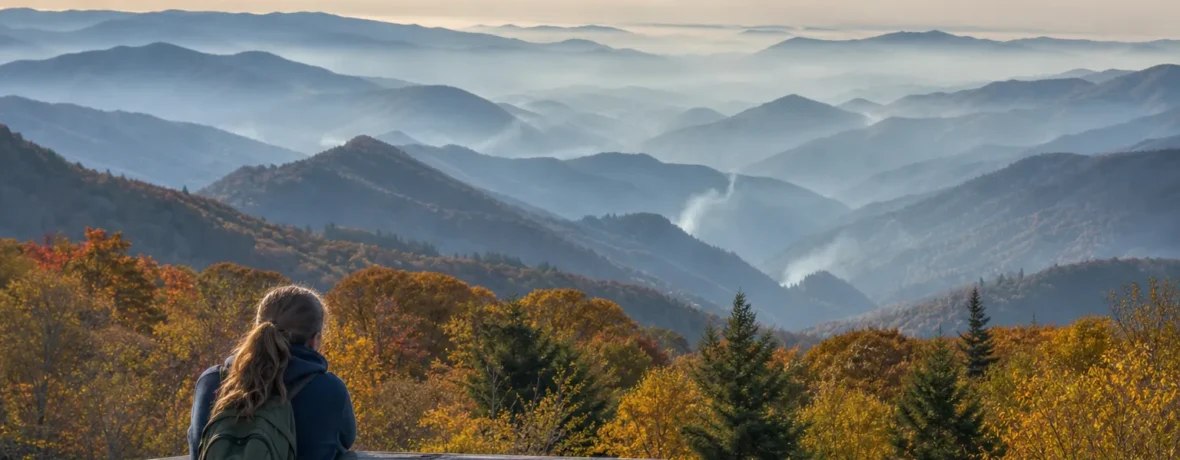
Why is it called the Smoky Mountains? Because a blue-gray haze often hangs over the ridges, making them look smoky from a distance. The Cherokee name Shaconage means “place of blue smoke,” and the haze comes mainly from trees releasing natural compounds into humid mountain air.
Why is it called the Smoky Mountains?
The short answer: the mountains look smoky because the forest breathes.
That sounds poetic, but it is also the plain truth. The Great Smoky Mountains sit in one of the lushest, wettest, most densely forested corners of the southern Appalachians. Trees, shrubs, leaf litter, soil, creeks, clouds, and heat all work together to make that famous soft haze that settles in the folds of the ridges.
The name did not start as a marketing label for cabin rentals and overlook selfies. Long before the national park existed, Cherokee people called the area Shaconage, commonly translated as “place of blue smoke.” The National Park Service describes this Cherokee name in its history of Great Smoky Mountains National Park. That matters. The best answer to the name question is not just “fog.” It is geography plus biology plus Indigenous observation.
Here is the column part, stated straight: “Smoky” is a better name than “Misty,” “Foggy,” or “Blue Ridge Junior.” Smoke is what the mountains appear to make. You stand at an overlook, look across five or six ridgelines, and the land seems to exhale. The name sticks because it is visual, old, and honest.
What makes the Smoky Mountains look smoky?
Trees make much of the haze, and humidity helps hold it in the air.
The forest releases volatile organic compounds, often shortened to VOCs. These are natural chemicals given off by plants. In warm, humid air, those compounds can form tiny particles. Sunlight scatters through them, and your eyes read the result as blue-gray haze. NASA’s Earth Observatory explains the same effect in its piece on the “Place of Blue Smoke”.
That does not mean the Smokies are literally smoking. No fire is required. You are seeing a living forest interacting with air and light. Add moisture from streams, rain, and transpiration, then stack ridge behind ridge, and the effect gets stronger.
The basic recipe looks like this:
- Dense forest releases natural gases. Trees and other plants emit VOCs, especially in warm conditions.
- Mountain humidity gives those compounds a place to linger. The Smokies are wet, green, and cloud-prone.
- Tiny particles scatter light. Shorter blue wavelengths scatter in a way that gives distant ridges their color.
- Layered terrain multiplies the effect. One ridge looks soft. Ten ridges look like smoke.
This is why the name still feels right on clear mornings, damp afternoons, and post-rain evenings. The Smokies do not need a dramatic weather event to earn their name. The effect is baked into the landscape.
Is the Smoky Mountains haze natural or pollution?
It is both, but the name comes from the natural blue haze.
That distinction matters. The old “smoke” that gave the mountains their name is natural: blue, mist-like, and tied to the forest itself. Pollution haze is different. It often looks whiter, flatter, or grayer, and it can reduce the long views hikers come for. The National Park Service separates the natural blue mist from pollution-caused haze in its air profile for Great Smoky Mountains National Park.
| Type of haze | What causes it | How it tends to look |
|---|---|---|
| Natural blue haze | Forest VOCs, humidity, sunlight, terrain | Blue-gray, layered, smoke-like |
| Clouds and fog | Moist air cooling over mountains | White, drifting, often thicker in valleys and gaps |
| Pollution haze | Airborne pollutants and fine particles | Whitish or gray, flatter, view-blocking |
So no, “smoky” should not be treated as an excuse for dirty air. The natural haze is part of the place. Pollution is not. If you hike for long views, you should care about that difference. The blue haze is character. The dirty haze is damage.
What did the Cherokee call the Smoky Mountains?
The Cherokee name is commonly given as Shaconage, meaning “place of blue smoke.”
That name is not a footnote. It is the heart of the answer. The Cherokee observed the same visual effect that later English-speaking settlers described as “smoky.” Their name carried both precision and poetry: blue smoke, not black smoke, not wildfire smoke, not chimney smoke.
You can feel the accuracy in the phrase. The haze often has a blue cast, especially when viewed across distance. It hangs low along coves, folds into drainages, and softens hard ridgelines. From a hiker’s point of view, it is one of the rare landscape names that becomes more convincing the longer you look at it.
The name also points to a deeper truth: these mountains had names, trails, stories, and meanings long before they became a national park in Tennessee and North Carolina. Any answer that skips the Cherokee name is too thin.
Why does the haze look blue instead of gray?
The haze looks blue because tiny airborne particles scatter blue light toward your eyes.
Light does strange, beautiful work in mountains. When sunlight passes through the atmosphere, short blue wavelengths scatter more readily than longer red wavelengths. That same broad principle helps explain why the sky is blue, and it helps explain why distant Appalachian ridges take on that cool blue tone.
In the Smokies, the effect gets a boost from plant-made particles and moisture. The forest is not just sitting there looking pretty. It is chemically active. Leaves are releasing compounds, water is moving through the air, and sunlight is bouncing through a stew of tiny particles.
That is why the haze changes during the day. Morning moisture can thicken it. Afternoon sun can sharpen or bleach it. After rain, clouds may lift in torn curtains from the valleys. On some days, the ridges look clean-cut. On others, they look like they were painted with watered-down ink.
When is the best time to see the smoky haze?
You have the best chance when warm, humid air, forest cover, and layered views line up.
Summer often gives the classic smoky look because heat and humidity are working hard. But spring and fall can be excellent too, especially after rain or on mornings when mist lifts out of the valleys. Winter can be clearer, which is great for distance but sometimes less “smoky” in the famous sense.
For hikers, the trick is to think like a ridge-watcher, not a postcard collector. You want elevation, layers, and side light.
- Go early for valley mist and soft light.
- Try after rain when clouds start breaking off the slopes.
- Choose an overlook with depth so several ridgelines stack in front of you.
- Look away from harsh midday glare when the haze can flatten into brightness.
- Bring patience because the best view may open for three minutes, then vanish.
This is one reason the Smokies reward repeat visits. The same overlook can feel like a different country depending on moisture, wind, temperature, and sun angle.
Are the Smoky Mountains the same as the Blue Ridge Mountains?
No, but they are closely related.
The Great Smoky Mountains are a mountain range within the southern Appalachian region, along the Tennessee-North Carolina border. They are also part of the broader Blue Ridge physiographic province. That is why the names can get tangled. “Blue Ridge” describes a larger mountain region. “Great Smoky Mountains” names a specific range, and the national park protects a major piece of it.
The similarity in names is not random. Both point to the same visual family: distant forested ridges that turn blue through haze and light. But the Smokies have their own identity. They are wetter, biologically rich, heavily forested, and culturally tied to the Cherokee name Shaconage.
So if someone says the Smokies are called that because they are part of the Blue Ridge, push back. Gently. The blue haze explains both names, but the Smokies did not borrow their meaning from a road map. They earned it ridge by ridge.
What should hikers take from the name?
The name should make you look harder.
Too many visitors treat “Smoky Mountains” as background branding. A sign. A sticker. A cabin brochure. But the name is a field lesson. It tells you what the forest is doing. It tells you how moisture moves. It tells you that people were paying close attention here long before modern recreation arrived.
When you stand on a high overlook, do not just snap the photo and leave. Watch the smoke that is not smoke. Notice how it pools in one valley but not the next. Notice how the farthest ridge fades first. Notice the color shift from green to blue to gray. That is the Smokies doing exactly what their name promises.
And yes, the name is a little mysterious. Good. Mountains should keep some mystery. But the mystery gets better when you know the mechanics behind it. Trees breathe. Air thickens. Light scatters. A Cherokee name endures. That is the real answer.
Related reading
- Why Do People Climb Mountains?
- Why Is It Called Trail Mix?
- Why Is It Colder in the Mountains?
- Great Smoky Mountains Parking Tag: Rules and Prices
FAQ
Why are they called the Great Smoky Mountains?
They are called the Great Smoky Mountains because blue-gray haze often makes the ridges look like they are covered in smoke. The name traces back to the Cherokee word Shaconage, commonly translated as “place of blue smoke.”
Is there actual smoke in the Smoky Mountains?
No, not in the naming sense. The famous smoky look is mostly natural haze from forest compounds, humidity, and scattered light, though wildfire smoke or pollution can affect views at times.
What causes the blue haze in the Smoky Mountains?
Trees release natural volatile organic compounds that interact with humid air and sunlight to create tiny particles. Those particles scatter light, giving distant ridges their blue-gray appearance.
Did the Cherokee name the Smoky Mountains?
Yes, the Cherokee name Shaconage is commonly translated as “place of blue smoke.” That name described the same haze that later shaped the English name “Smoky Mountains.”
When can you see the Smoky Mountains haze best?
Warm, humid days often show the classic haze, especially from overlooks with several ridgelines in view. Early morning and after rain can be especially good, when mist and cloud layers move through the valleys.
Is Smoky Mountains haze bad for you?
The natural blue haze is part of the forest atmosphere, not the same as pollution haze. If the air looks unusually thick, smells smoky, or local alerts warn of poor air quality, check current conditions through official sources before strenuous hiking.