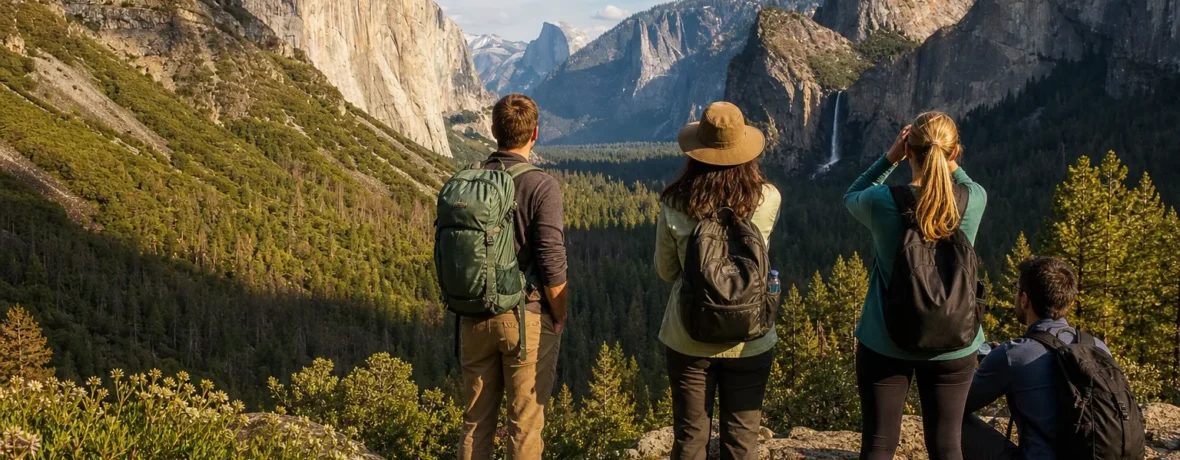
Build your trip around hikes: choose 1–2 easy Valley walks, one waterfall trail, and one viewpoint or Sequoia hike. First-timers can see major icons in one day; stronger hikers should add Nevada Fall, Four Mile Trail, Cathedral Lakes, or Half Dome with the right permit.
What are the best hikes in Yosemite for first-time visitors?
Start in Yosemite Valley, then add one quieter area if you have time. The Valley gives you Yosemite Falls, Half Dome views, El Capitan, meadows, bridges, and waterfall trails without long drives between trailheads.
For a first visit, don’t try to “do everything.” Yosemite is nearly 1,200 square miles [3,100 square km], and the park ranges from low canyon country to high Sierra terrain. Pick a zone. Hike it well. Then leave room for slow moments—the kind where you stop mid-trail because Half Dome just appeared between the pines.
Use the official Yosemite Valley day hikes page to check trail distances and elevation before you go, and check current Yosemite conditions before locking in a route.
| Hike | Best for | Distance | Difficulty |
|---|---|---|---|
| Lower Yosemite Fall Trail | Fast waterfall views | 1 mi [1.6 km] loop | Easy |
| Cook’s Meadow Loop | Classic Valley photos | 1 mi [1.6 km] loop | Easy |
| Mirror Lake | Half Dome reflections and a mellow walk | 2 mi [3.2 km] out and back to lake; 5 mi [8 km] loop | Easy to moderate |
| Mist Trail to Vernal Fall Footbridge | A taste of Yosemite’s big waterfall trails | 1.6 mi [2.5 km] round trip | Moderate |
What to do in Yosemite National Park if you only have one day?
Spend your one day in Yosemite Valley unless roads, crowds, or weather push you elsewhere. You’ll waste less time driving and see the most famous scenery on foot.
- Arrive early. Get into the Valley before midmorning, park once, and use your feet or the shuttle where available.
- Walk Lower Yosemite Fall. This 1 mi [1.6 km] loop is short, punchy, and gives you a close look at one of the park’s signature waterfalls.
- Link Cook’s Meadow and Sentinel Bridge. Keep your camera handy. This is prime Half Dome and Yosemite Falls country.
- Choose one bigger objective. Go to Mirror Lake for a calmer half-day, or hike the Mist Trail toward Vernal Fall if you want stone steps, spray, and stronger legs.
- End at Tunnel View or Glacier Point if accessible. Tunnel View is the easier add-on by car. Glacier Point is seasonal and depends on road conditions.
As of November 2026, Yosemite does not require an entrance reservation for 2026, according to the National Park Service. Standard entrance fees listed by NPS as of November 2026 include $35 for a private vehicle, $30 for a motorcycle, and $20 per person entering without a vehicle. Check the official Yosemite basic information and fees page before your trip because fee and reservation rules can change.
What are the easiest Yosemite hikes?
The easiest Yosemite hikes are short Valley and Mariposa Grove trails with low elevation gain. They still deliver huge scenery, so don’t treat them like throwaways.
Lower Yosemite Fall Trail
This is the quick win. The loop is 1 mi [1.6 km] with 50 ft [15 m] of elevation gain, and it puts you below one of the park’s most recognizable features. Spring and early summer usually bring the strongest flow; late summer can be much drier.
Cook’s Meadow Loop
This flat 1 mi [1.6 km] loop is the Yosemite Valley sampler plate. You get meadow views, cliffs, Yosemite Falls, and clean sightlines toward Half Dome. Go early or near golden hour for softer light and fewer elbows on the path.
Bridalveil Fall Trail
This short trail is 0.5 mi [0.8 km] round trip with 80 ft [24 m] of elevation gain. It’s a strong choice when your group has mixed energy levels or you need one last stop before leaving the Valley.
Big Trees Loop Trail
In Mariposa Grove, the Big Trees Loop is 0.3 mi [0.5 km] round trip on pavement, packed dirt, and boardwalk. It’s the easiest way to stand among giant sequoias without committing to a long climb.
What are the best moderate hikes in Yosemite?
The best moderate hikes give you a real trail day without requiring a pre-dawn sufferfest. Expect more elevation, more exposure, and better payoffs.
Mirror Lake Loop
Go 2 mi [3.2 km] round trip to the lake area or make it a 5 mi [8 km] loop. The elevation gain stays modest, but the scenery changes fast: forest, water, talus, and big walls pressing in from both sides.
Valley Loop Trail
The Valley Loop is 6.5 mi [10.5 km] for the half loop or 13 mi [20.9 km] for the full loop, with mostly flat walking. It’s a smart choice when high trails are icy, crowded, or too hot, and it lets you see Yosemite at human speed instead of through a windshield.
Grizzly Giant Loop Trail
This Mariposa Grove route runs 2 mi [3.2 km] round trip with 300 ft [90 m] of gain. You’ll pass the Bachelor and Three Graces, the Grizzly Giant, and the California Tunnel Tree. The trees are enormous. You will feel appropriately tiny.
Cathedral Lakes
When Tioga Road is open, Cathedral Lakes is one of the strongest high-country day hikes in the park. The route is 7.6 mi [12 km] round trip with 1,000 ft [305 m] of gain from the Tuolumne Meadows area. It climbs steadily, then pays you back with granite, clear water, and a very different mood from the Valley.
What are the hardest day hikes in Yosemite?
The hardest Yosemite day hikes combine steep gain, long mileage, exposed terrain, or permit rules. Start early, carry more water than you think, and be honest about your turnaround time.
Mist Trail to Nevada Fall
The route to Nevada Fall is 5.4 mi [8.7 km] round trip via the Mist Trail, with about 2,000 ft [610 m] of elevation gain. The shorter option to Vernal Fall Footbridge is 1.6 mi [2.5 km] round trip, while continuing to the top of Vernal Fall or Nevada Fall turns the day into a harder climb. Expect wet granite steps when the spray is heavy. Move slowly. A fall here is not a small mistake.
Yosemite Falls Trail
For a steep Valley climb, Yosemite Falls Trail brings the heat. The shorter Columbia Rock option is 2 mi [3.2 km] round trip with 1,000 ft [328 m] of gain; the full hike to the top of Yosemite Falls is 7.2 mi [11.6 km] round trip with 2,700 ft [825 m] of gain. Shade can be limited, and the descent is harder on knees than the climb feels on lungs.
Four Mile Trail
Four Mile Trail is 4.8 mi [7.7 km] one way between Yosemite Valley and Glacier Point, with 3,200 ft [975 m] of elevation change. If you hike it up and back, you’ve built yourself a serious day. If you hike one way, plan transportation before you start; don’t assume a convenient ride will appear.
Half Dome
Half Dome is a major objective, not a casual add-on. The day hike is commonly listed by NPS as 14 mi [22.5 km] round trip with about 5,000 ft [1,524 m] of elevation gain. As of November 2026, a Half Dome permit is required seven days per week when the cables are up, and NPS says the cables are normally up from just before Memorial Day to the day after the second Monday in October, depending on conditions. Read the official Half Dome permit rules before planning this hike.
Do you need permits for Yosemite hikes?
Most Yosemite day hikes do not need a hiking permit, but Half Dome and overnight wilderness trips do. That one detail can make or break your plan.
As of November 2026, NPS states that day hikes do not require wilderness permits except for Half Dome when the cables are up. Overnight backpacking, overnight climbing, and other overnight stays in the Yosemite Wilderness require a wilderness permit year-round. For wilderness trips, NPS says 60% of trailhead quota reservations become available 24 weeks in advance, with the remaining 40% released seven days in advance. Check the official Yosemite wilderness permits page before applying.
Here’s the simple version:
- Lower Yosemite Fall: no day-hiking permit.
- Mirror Lake: no day-hiking permit.
- Mist Trail to Vernal or Nevada Fall: no day-hiking permit unless continuing to Half Dome.
- Half Dome cables: permit required when cables are up.
- Backpacking: wilderness permit required year-round.
What should you pack for hiking in Yosemite?
Pack for sun, cold, water crossings, crowds, and sudden changes in weather. Yosemite can feel friendly at the trailhead and very serious two hours later.
- Trail map or downloaded offline map
- Headlamp, even for day hikes
- Water and a way to treat more
- Salty snacks and real food
- Sun hat, sunglasses, and sunscreen
- Rain shell or wind layer
- Warm layer for high country and evening descents
- First-aid kit with blister care
- Footwear with grip for granite, steps, and dusty switchbacks
- Trash bag so everything you carry in comes back out
Food storage is not optional in Yosemite. Bears, ravens, squirrels, and other animals learn fast when people get sloppy. Follow the park’s bear and food storage rules, keep food within reach while hiking or picnicking, and never leave scented items loose in your car or camp.
When is the best time to hike in Yosemite?
The best hiking season depends on the trail: spring for waterfalls, summer for high country, fall for cooler Valley miles, and winter for quiet low-elevation walks. There is no single perfect month.
Spring brings roaring waterfalls, wet trails, snow at higher elevations, and cool mornings. It’s prime time for Lower Yosemite Fall, Bridalveil Fall, and Valley loops.
Summer opens the high country when snow melts and roads allow access. Tuolumne Meadows, Cathedral Lakes, Lembert Dome, and Glen Aulin become realistic day-hike targets, but afternoon thunderstorms and intense sun deserve respect.
Fall is excellent for long Valley hikes and big climbs after the worst heat fades. Waterfalls may be lower, but the walking can be fantastic.
Winter narrows your menu. Some trails are icy, snowy, or closed, and Tioga Road and Glacier Point Road typically close seasonally. As of November 2026, NPS warns that trails not listed as closed may still be snowy and difficult to follow from roughly November through May or June. Check conditions before you drive.
How do you choose the right Yosemite hike for your group?
Choose by the least experienced hiker, not the strongest one. That keeps the day fun instead of turning it into a rescue-by-headlamp situation.
- Set a hard turnaround time. If you are not where you planned to be by that time, turn around.
- Match distance to elevation. A 5 mi [8 km] flat walk is not the same as 5 mi [8 km] with 2,000 ft [610 m] of gain.
- Check road access. Glacier Point, Tioga Road, and Mariposa Grove access can shift with snow, construction, fire, or shuttle operations.
- Plan water honestly. Yosemite granite gets hot, and many trails have limited reliable water late in the season.
- Watch the sky. If thunderheads build, leave exposed domes, ridges, and high points.
- Keep a backup hike ready. The best Yosemite plan has a Plan B that still sounds good.
When to see a doctor
Seek medical help right away for severe heat illness symptoms, chest pain, trouble breathing, confusion, fainting, a head injury, or a suspected fracture. Don’t try to “walk it off” deep into a Yosemite trail.
Heat, altitude, dehydration, smoke, and hard climbs can hit faster than expected. The CDC’s heat stress guidance lists warning signs such as confusion, loss of consciousness, and very high body temperature as medical emergencies. For milder symptoms—dizziness, nausea, unusual fatigue, pounding headache, or worsening blisters—stop, cool down, hydrate, eat, and turn around if symptoms do not improve quickly.
If you feel sick at elevation, descend rather than pushing higher. If symptoms are severe or worsen after descent, get medical care. This guide can help you plan a safer hike, but it cannot diagnose you on the trail.
Related reading
- Where to Stay in Yosemite for Hikers
- How Big Is Yosemite National Park?
- Is Yosemite a National Park?
- How to Get to Dry Tortugas National Park
FAQ
Can beginners hike in Yosemite?
Yes, beginners can hike in Yosemite if they choose short, low-gain trails. Lower Yosemite Fall, Cook’s Meadow, Bridalveil Fall, and the Big Trees Loop are strong first picks.
What is the most famous hike in Yosemite?
Half Dome is the most famous big hike in Yosemite. It requires a permit when the cables are up and is best for fit, prepared hikers who are comfortable with exposure.
Can you hike Yosemite without a reservation?
Yes, for most day hikes you can hike without a hiking permit or trail reservation. As of November 2026, Yosemite does not require an entrance reservation for 2026, but Half Dome and overnight wilderness trips have separate permit rules.
What is the best easy hike in Yosemite Valley?
Lower Yosemite Fall is the best easy hike if you want a quick payoff. Cook’s Meadow Loop is better if you want wide-open views of cliffs, falls, and Half Dome.
How many days do you need in Yosemite?
Two to three days is a sweet spot for most hikers. With one day, stay in Yosemite Valley; with three days, add Mariposa Grove, Glacier Point Road, or Tuolumne Meadows when access allows.
Is the Mist Trail hard?
Yes, the Mist Trail becomes hard if you continue beyond the footbridge to Vernal Fall or Nevada Fall. Expect steep climbing, stone steps, wet surfaces during high flow, and a slow descent.