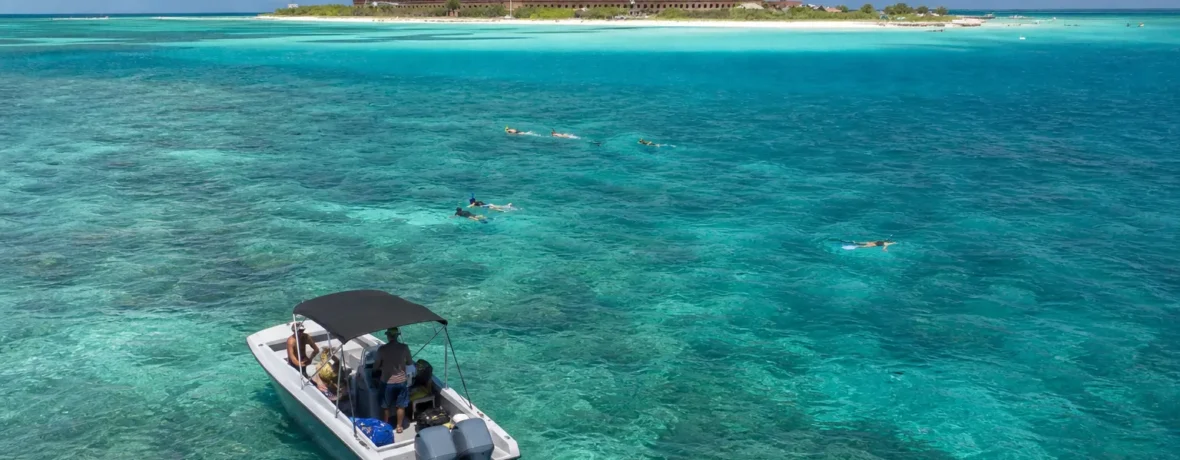
Start in Key West, then take the ferry, seaplane, permitted charter, or your own boat. There is no road, bridge, or car access. The park sits 70 miles [113 km] west of Key West, and most visitors arrive at Garden Key.
How to get to Dry Tortugas National Park from Key West?
You get there from Key West by boat or seaplane.
That’s the whole trick. Dry Tortugas National Park is not a “drive to the gate and park at the trailhead” kind of place. The National Park Service says the park is 70 miles [113 km] west of Key West and has no road access, so your trip starts with choosing your ride across open water. See the official NPS directions to Dry Tortugas National Park for the current transportation overview.
Most day visitors land on Garden Key, the island with Fort Jefferson, the visitor center, the campground, beaches, snorkel areas, and the short walking routes you’ll actually use once your feet hit sand. From there, you can walk the fort, circle the moat wall when conditions allow, swim, snorkel, birdwatch, or simply sit in the kind of blue water that makes the boat ride feel tiny.
Your main options are:
- Book the ferry from Key West. Best fit for most visitors, especially if you want a straightforward full-day trip with room for basic day gear.
- Book the seaplane from Key West. Best fit if time matters more than cost and you want the fastest crossing.
- Hire a permitted charter. Best fit for fishing, diving, snorkeling, wildlife viewing, or a custom schedule.
- Bring your own boat. Best fit for experienced boaters who can safely handle a remote 70-mile [113 km] open-water crossing.
What is the best way to get to Dry Tortugas National Park?
The ferry is the best way for most first-time visitors.
It’s the simplest plan: reserve a seat, show up in Key West, ride to Garden Key, spend your time exploring, then ride back. You don’t have to plan anchoring, fuel, navigation, or weather routing the way private boaters do. You also don’t need to pay seaplane-level prices just to reach the park.
The seaplane wins when your Key West time is tight. It cuts the travel day down and gives you the drama of landing beside a remote island fortress. For hikers and walkers, that means more energy for the fort, beaches, and snorkel stops instead of a longer sea crossing.
Private boats and permitted charters can open up more flexibility, especially beyond Garden Key. But they demand more planning. Dry Tortugas is remote, exposed, and light on services. No fuel. No restaurants. No “I forgot sunscreen” store. If you arrive by boat, you need to bring the whole day with you—and then bring everything back out.
| Option | Best for | Tradeoff |
|---|---|---|
| Ferry | First-time day visitors, campers, walkers | Fixed schedule and limited camper space |
| Seaplane | Fast trips, aerial views, tight itineraries | Higher cost and no camper transport |
| Permitted charter | Diving, fishing, snorkeling, custom plans | Availability and pricing vary by operator |
| Private boat | Skilled boaters who want flexibility | Requires serious open-water planning |
Can you drive to Dry Tortugas National Park?
No, you cannot drive to Dry Tortugas National Park.
There are no bridges, causeways, roads, or vehicle ferries linking the Florida Keys to the park. You can drive to Key West, park there, and then continue by ferry, seaplane, charter, or private boat. That’s as close as your car gets.
If you’re building a Florida Keys itinerary, treat Key West as your launch point. Stay there the night before if your transportation leaves early. Do not plan to drive down from Miami the same morning unless your schedule has a large cushion. US 1 is beautiful, but it is still a long, narrow road with traffic, drawbridges, weather, and delays.
How long is the trip to Dry Tortugas National Park?
The park is 70 miles [113 km] from Key West.
Your actual travel time depends on your transportation. The ferry takes longer but gives you a stable, easy day structure. The seaplane is the fast option. A private boat or charter can vary widely based on vessel speed, sea state, route, and weather.
Do not plan this like a normal trailhead commute. You are crossing open water to a remote island park. Wind, chop, storms, mechanical issues, and operator schedules can change the feel of the day fast. If you are prone to seasickness, prepare before boarding and choose your seat carefully.
For hikers, the key planning question is not just “how long is the ride?” It’s “how much usable island time will I have?” Once you arrive, you’ll want enough time to walk Fort Jefferson, stroll the beaches, eat, refill from what you brought, and snorkel if conditions look good.
Where do you arrive in Dry Tortugas National Park?
Most visitors arrive at Garden Key.
Garden Key is the practical heart of the park. It holds Fort Jefferson, the visitor center, the campground, docks, swimming areas, and the easiest walking. If you’re coming by ferry or seaplane, this is where your Dry Tortugas day happens.
For a hiking-minded visit, start with Fort Jefferson. The brick fort is massive, strange, photogenic, and easy to explore on foot. Then look for time along the beaches and shoreline paths. The mileage is short, but the exposure is real. Sun bounces off water, sand, and brick. Shade is limited. Bring a hat you trust.
Loggerhead Key sits farther out and is not a casual add-on for ferry or seaplane day visitors. NPS says ferry and seaplane visitors generally do not have time to visit Loggerhead Key. Private boaters and some charters have more flexibility, but access still depends on conditions, rules, and closures.
Do you need reservations, permits, or entrance fees?
Yes, you should reserve transportation, and some visitors must handle fees or camping details before arrival.
As of November 2026, the Dry Tortugas entrance fee is $15 per person and is valid for 7 consecutive days; visitors under 16 are exempt, according to the park’s NPS Dry Tortugas FAQ. Ferry tickets include the park entrance fee but not camping fees. Seaplane passengers pay or show a valid pass before departure. Private boaters and private seaplane visitors should purchase or handle entrance passes through Recreation.gov and download proof before arrival because cell service and Wi-Fi are not available in the park.
Camping is separate. As of November 2026, NPS lists Garden Key individual campsites at $15 per night per site and the group campsite at $30 per night, with the group site requiring advance reservation. Check the official NPS Dry Tortugas campground page before you commit, because payment instructions and transport limits can change.
Private boaters have more rules to track. As of November 2026, NPS says Dry Tortugas is cashless for entrance fees, entrance fees apply to individuals 16 and older, and payment must be completed within one hour of arrival. The park also lists specific rules for anchoring, docking, landing, mooring buoys, and closed areas on its NPS boating page.
Can you camp at Dry Tortugas National Park?
Yes, you can camp on Garden Key.
Camping here is primitive, exposed, and unforgettable if you plan well. There are no hotels, cabins, restaurants, grocery shelves, or gear rentals waiting for you. You bring your shelter, food, water, cooking setup allowed by your transportation provider, and the discipline to pack out every scrap of trash.
The ferry can transport campers, but space is limited. As of November 2026, NPS says the ferry is limited to 10 camping passengers per day, and campers should book months in advance during busy periods. The seaplane does not transport campers due to gear weight limits.
Bring a real tent. NPS says tents are required for camping because of wildlife. Also bring more water than you think you’ll want. For private boaters, NPS recommends 2 gallons [7.6 L] of water per person per day and at least one additional day of food and water in case weather delays your return.
What should you pack for a Dry Tortugas day trip?
Pack like you’re going somewhere with no backup.
Dry Tortugas looks dreamy, but it is still a remote marine park with hard sun, salt, wind, and limited services. Your day will be better if your bag is boringly complete.
- Government-issued ID and transportation confirmation
- Printed or downloaded park pass if you need one
- Reusable water bottles or hydration reservoir
- Lunch and snacks if your transportation does not provide meals
- Sun hoodie or long-sleeve UPF shirt
- Wide-brim hat with a secure chin strap
- Sunglasses with retention strap
- Reef-conscious sunscreen
- Swimsuit and quick-dry towel
- Water shoes or sandals with heel straps
- Light walking shoes for the fort
- Dry bag for phone, wallet, and camera
- Motion sickness supplies if you need them
- Small first-aid kit
- Trash bag, because this is a pack-it-out park
For walking, keep it simple. You do not need trekking poles or boots for Garden Key. You do need sun protection, water, and footwear that handles hot surfaces, sand, wet docks, and rough brick.
What can you do after you arrive?
You can walk Fort Jefferson, swim, snorkel, birdwatch, beachcomb, and camp if you planned ahead.
Fort Jefferson is the anchor. Walk the parade ground, climb the safe public levels, look out over the water, and slow down. This is not a summit day. It is a heat-and-light day. Pace matters.
Snorkeling is the other big draw. Conditions vary, but the clear water around Garden Key can be excellent when wind and visibility cooperate. Stay inside allowed areas, give coral and wildlife space, and keep an eye on your exit point. If the water looks rough, skip it. The fort will still be there.
As of November 2026, NPS says Garden Key is open year-round, Fort Jefferson is open from sunrise to sunset, Loggerhead Key is open to day visitors from sunrise to sunset, and East Key, Middle Key, Hospital Key, and Long Key are closed year-round for nesting wildlife. Check the official NPS operating hours and closures page before your trip.
When is the best time to go to Dry Tortugas National Park?
The best time is the day your transportation runs and the marine forecast behaves.
That sounds blunt because it is. In a remote island park, weather matters more than your color-coded itinerary. Summer can bring calmer seas, heat, humidity, and storms. Winter can bring drier air and stronger winds. Shoulder months can be excellent, but there are no guarantees.
If your dates are flexible, build a buffer day into your Key West stay. That gives you a second chance if weather cancels or delays your trip. If your dates are fixed, book early and accept that the Gulf gets a vote.
Campers should be even more conservative. A night on Garden Key is magic when you are ready for it and miserable when you packed like you were car camping in a state park with a camp store nearby.
Related reading
- How to Get to Channel Islands National Park
- How to Get to Isle Royale National Park
- How to Get to Katmai National Park
- How to Get to Big Bend National Park
FAQ
Is Dry Tortugas National Park worth it for hikers?
Yes, but think “walking adventure,” not backcountry hiking. The mileage is short, while the payoff is remote beaches, Fort Jefferson, birdlife, snorkeling, and a national park that feels far from the mainland.
What is the cheapest way to get to Dry Tortugas National Park?
For most travelers, the ferry is usually the lowest-cost public transportation option. Prices change, so check the operator before booking and compare it with seaplane and charter options for your exact date.
Can you go to Dry Tortugas without a tour?
Yes, if you arrive by private boat or permitted charter. Ferry and seaplane trips follow operator schedules, while private boaters must follow NPS entrance, anchoring, docking, and closure rules.
Can you stay overnight at Dry Tortugas National Park?
Yes, you can stay overnight by camping at Garden Key. You need to bring your own gear, pay camping fees, pack out all trash, and arrange transportation that allows campers.
Is there food or water at Dry Tortugas National Park?
No, you should bring what you need for the full day or overnight stay. Some transportation operators may provide or sell limited food and drinks to their passengers, but the park itself has no restaurant, grocery, fuel, or public water supply.
Do cell phones work at Dry Tortugas National Park?
Do not count on cell service. Download confirmations, passes, maps, and key details before leaving Key West, and print anything you cannot afford to lose.