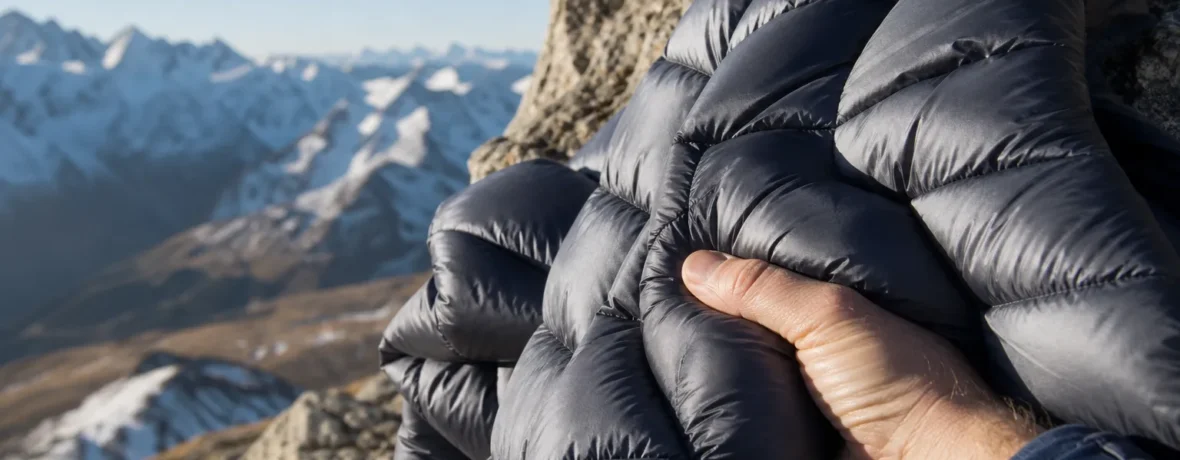
What is a down jacket? It’s an insulated jacket filled with soft goose or duck down clusters that trap warm air around your body. For hiking, a good down jacket gives high warmth for low weight, usually with 600- to 900-fill-power down, sewn into baffles that keep the insulation from shifting.
What is a down jacket made of?
A down jacket is made of a shell fabric, a lining, baffles, and down insulation. The magic is the down itself: fine, fluffy clusters from waterfowl that loft up and hold still air. Still air is what keeps you warm. Not feathers poking around like quills in a pillow.
Down clusters are different from feathers. Feathers have a central shaft. Down is softer and three-dimensional, more like a tiny dandelion puff. That shape lets it expand after being compressed, which is why a warm hiking jacket can squash into a stuff sack the size of a grapefruit.
In the U.S., advertising and labeling claims for down products must be truthful and substantiated; the Federal Trade Commission’s feather and down guidance says a product called “pure down,” “all down,” or “100% down” must actually contain only down, as of November 2026.
How does a down jacket keep you warm?
A down jacket keeps you warm by trapping air your body has already heated. The loftier the down, and the more of it inside the jacket, the more warm air the jacket can hold.
Down does not create heat. You do. That’s why a down jacket feels best when you throw it on before you’re chilled to the bone. On trail, it works especially well during breaks, cold starts, windy overlooks, camp chores, and slow miles where your sweat rate drops.
Three parts drive warmth:
- Fill power: how lofty the down is for its weight.
- Fill weight: how many ounces [grams] of down are inside the jacket.
- Construction: how well the baffles, shell, cuffs, hood, and hem hold heat in.
If two jackets both use 800-fill down but one has 2 oz [57 g] of down and the other has 5 oz [142 g], the second jacket will be much warmer. Fill power alone never tells the whole story.
What does fill power mean in a down jacket?
Fill power measures loft: how many cubic inches 1 oz [28 g] of down occupies under a standard test. An 800-fill-power down sample lofts to 800 cubic inches [13.1 L] per ounce, while 650-fill down lofts to 650 cubic inches [10.7 L].
The American Down and Feather Council’s terminology defines fill power as a measure of loft, or insulation ability, in cubic inches per ounce. Higher fill power usually means better warmth-to-weight and better packability.
Here’s the straight trail version:
| Fill power | Best use | What you get |
|---|---|---|
| 550-650 | Town, car camping, budget hiking | Durable value, more bulk for the same warmth |
| 700-750 | Day hikes, shoulder-season layers | Good warmth-to-weight without premium pricing |
| 800-850 | Backpacking, alpine starts, cold camps | High loft, low weight, strong packability |
| 900+ | Ultralight and expedition-style kits | Top-tier loft, high cost, delicate handling |
Do not buy by fill power alone. A thin 900-fill sweater can be colder than a chunky 650-fill parka because the parka may simply contain much more insulation.
What are baffles on a down jacket?
Baffles are the chambers that hold down in place. Without them, the down would slide to the hem and leave cold bare spots across your chest and shoulders.
Most hiking jackets use one of these baffle styles:
| Baffle type | How it’s built | Best for | Tradeoff |
|---|---|---|---|
| Sewn-through | Outer shell and liner stitched together | Lightweight hiking jackets | Stitch lines can leak heat |
| Box-wall | Fabric walls separate shell and liner | Very cold weather | Heavier, bulkier, pricier |
| Welded or bonded | Chambers joined without regular stitching | Wind resistance and cleaner shells | Depends heavily on brand execution |
Sewn-through baffles dominate lightweight backpacking jackets because they save weight and cost. Box-wall baffles show up in serious winter parkas because they reduce cold spots and allow more loft.
Is down warmer than synthetic insulation?
Down is usually warmer for its weight than synthetic insulation. It also packs smaller and lasts a long time when cared for well.
Synthetic insulation fights back in wet conditions. When down gets soaked, the clusters collapse, lose loft, and stop trapping air well. Synthetic fills also lose performance when soaked, but they tend to retain more structure and dry faster. That’s why wet forests, cold rain, and high-output winter hiking can make synthetic insulation the smarter call.
The REI insulated outerwear guide also points hikers toward down for high warmth-to-weight and packability, while synthetic insulation is the usual pick for damp conditions and lower cost.
Is a down jacket waterproof?
No, a down jacket is not waterproof unless it has a true waterproof shell layer, and most lightweight down jackets do not. Many have a DWR finish that sheds light snow or mist, but that is not rain armor.
Think of a down jacket as insulation, not your storm shell. If the forecast calls for steady rain, pack a waterproof rain jacket over it. If you hike in the Pacific Northwest, southern Appalachians, or any place where “mist” turns into a full soaking by lunch, this matters.
Hydrophobic down is treated to resist moisture better than untreated down. Helpful? Yes. Magic? No. If it gets saturated, you still have a problem.
How should a down jacket fit for hiking?
A down jacket should fit close enough to trap heat but roomy enough to layer over a base layer and fleece. If it crushes the down, it loses loft and warmth.
Check these fit points before you buy:
- Shoulders: you can reach forward with trekking poles without tight pulling.
- Torso: the jacket covers your waist when you lift both arms.
- Hood: it seals around your face and fits your helmet if you climb or ski.
- Cuffs: they block drafts without cutting into gloves.
- Hem: it cinches below your waist or hips to stop warm air from pumping out.
How do you choose the right down jacket?
Choose a down jacket by matching warmth, weight, weather, and fit to your actual hiking style. Don’t buy the puffiest jacket on the rack unless your trips need it.
- Pick your temperature range. For cool three-season hiking, a lightweight down sweater can work. For freezing camps, look for more fill weight, a warmer hood, and better draft sealing.
- Check fill power and fill weight together. Fill power tells quality. Fill weight tells quantity. You want both numbers when comparing technical jackets.
- Match insulation to moisture. Dry cold favors down. Wet cold may favor synthetic or a down jacket protected by a reliable shell.
- Look at baffle design. Tiny sewn-through baffles keep weight low. Larger box-wall baffles hold more loft for real winter use.
- Try your layers underneath. Bring or wear your hiking fleece when testing fit. A jacket that fits over a T-shirt may bind over trail layers.
- Inspect the details. Zipper draft flap, adjustable hood, hem cord, pocket placement, and shell fabric all matter when wind hits.
How do you care for a down jacket?
Wash a down jacket gently, dry it completely, and store it uncompressed. Dirty down loses loft, and damp stored down can clump.
Follow the garment label first. When the label allows machine washing, use a down-specific cleaner, rinse well, and dry on low heat until every clump is gone. The REI guide to washing a down jacket recommends low heat and clean tennis balls or dryer balls to help break up clumps during drying.
For storage, skip the tiny stuff sack. Hang the jacket or keep it in a loose cotton or mesh storage bag. Compression is fine for a day in your pack. Months in a tight sack is rough on loft.
What does responsible down mean?
Responsible down means the supply chain has been audited against animal-welfare and traceability standards. It does not make the jacket warmer, but it does help you buy with better sourcing information.
The Textile Exchange manages standards used in the textile supply chain, including the Responsible Down Standard. When shopping, look for clear certification language rather than vague claims like “ethical down” with no standard named.
Related reading
- How to Wash a Down Jacket in a Washing Machine
- How to Patch a Down Jacket on the Trail and at Home
- How to Wash a Rain Jacket and Keep It Waterproof
- How to Wash a Down Sleeping Bag and Restore the Loft
FAQ
Is a down jacket good for hiking?
Yes, a down jacket is excellent for hiking when conditions are cool to cold and mostly dry. It gives strong warmth for low weight, which is exactly what you want in a pack.
Can you wear a down jacket in the rain?
You can wear one in light drizzle for a short time, but you should not rely on it as rain gear. Use a waterproof shell over it during steady rain to protect the down’s loft.
Is 800-fill down warmer than 650-fill down?
Not always. 800-fill down is loftier per ounce [28 g], but a 650-fill jacket with more fill weight can be warmer than a thin 800-fill jacket.
Why do down jackets have cold spots?
Cold spots usually happen where baffles are stitched through, where down has shifted, or where the jacket is compressed by a pack strap. Shaking the jacket can redistribute loose down, but sewn-through seams will always be less insulated than the chambers beside them.
How long does a down jacket last?
A well-cared-for down jacket can last many seasons of hiking. Keep it clean, dry it fully after washing, repair shell tears quickly, and store it loose instead of compressed.