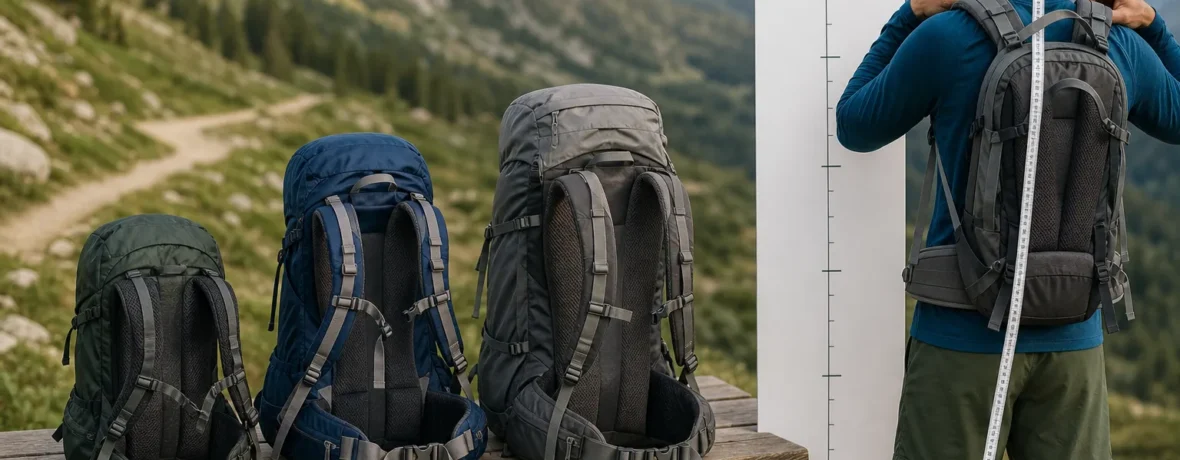
To choose a hiking backpack, match pack volume to trip length, then fit the pack to your torso length and hips—not your height. Use 15–30 liters for day hikes, 45–60 liters for most 1–3 night trips, and 60–75 liters for longer or bulkier loads.
How do you choose a hiking backpack without buying the wrong size?
Start with the gear you need to carry, then choose the smallest pack that fits it comfortably.
A backpack is not just a sack with shoulder straps. The right one carries weight on your hips, keeps dense gear close to your spine, gives you fast access to water and layers, and stays stable when the trail tilts sideways. The wrong one? It bounces, rubs, pulls your shoulders down, and makes five miles feel like fifteen.
The smartest way to shop is simple:
- Pick the trip type. Day hike, hut trip, overnight, weekend backpacking, winter hiking, or multi-day backcountry travel.
- Estimate volume in liters. Your sleeping bag, shelter, food, and insulation decide pack size faster than any chart.
- Measure torso length. Pack size comes from torso length, not your overall height. REI’s pack fitting guide shows the standard C7-to-iliac-crest measurement method.
- Check hipbelt fit. The padded belt should wrap your iliac crest and tighten with room left on both sides.
- Load it before judging it. A pack that feels fine empty can feel terrible with 25 lb [11.3 kg] inside.
- Walk, bend, climb stairs, and twist. If the pack shifts around in a store, it will shift more on rock, roots, and snow.
Buy your pack after you know your sleep system, shelter, bear canister needs, and typical food volume. That one decision prevents the classic beginner mistake: buying a giant pack, then filling every inch because the space is there.
What size hiking backpack do I need?
Most day hikers need 15–30 liters, while most overnight backpackers need 45–60 liters.
The phrase “what size hiking backpack do I need” really means two different things: volume and body fit. Volume is measured in liters. Fit is measured by torso length and hipbelt size. You need both right.
| Trip type | Best pack volume | What it usually carries |
|---|---|---|
| Short summer day hike | 10–20 L | Water, snacks, rain shell, small first-aid kit, phone, keys |
| Long day hike or shoulder-season hike | 20–30 L | Extra layers, more food, headlamp, water filter, emergency kit |
| Winter day hike | 25–40 L | Insulation, traction, gloves, hot drink, emergency shelter |
| Fast overnight with compact gear | 30–45 L | Quilt or bag, tarp or small tent, food, stove, light layers |
| Typical 1–3 night backpacking trip | 45–60 L | Tent, sleep system, stove, food, water treatment, layers |
| Longer trip or bulky gear load | 60–75 L | More food, warmer bag, bear canister, cold-weather clothing |
For day hiking, a pack under 20 liters works when the weather is stable and you are not carrying gear for kids, a dog, or a slower partner. Once you add a puffy jacket, rain pants, microspikes, a water filter, and a real lunch, 25–30 liters feels much less cramped.
The National Park Service Ten Essentials list is a good reality check. Navigation, sun protection, insulation, light, first aid, fire, repair kit, food, water, and shelter take up space. Tiny packs tempt you to leave useful things behind.
What size backpacking pack do I need for overnight trips?
For most overnight and weekend backpacking trips, choose a 45–60 liter pack.
If you are asking “what size backpacking pack do I need,” look at the bulk of your gear before the number of nights. Food volume grows each day, but your shelter, sleeping bag, pad, stove, and clothing create the base load. A one-night trip with old synthetic gear can need more space than a three-night trip with compact down gear.
Here is a practical breakdown:
- 30–40 L: Works for experienced hikers with dialed, compact gear and mild weather.
- 40–50 L: Good for a light overnight kit, hut trip, or summer weekend with small shelter and down sleep system.
- 50–60 L: The safest range for most new backpackers because it fits standard gear without forcing sloppy outside carry.
- 60–75 L: Better for cold weather, bear canisters, group gear, bulky sleeping bags, or trips longer than three nights.
- 75 L and up: Expedition territory, winter loads, packrafting gear, family gear, or professional field work.
Do not choose a 70-liter pack just because you want “room to grow.” Extra room invites extra weight. A half-empty big pack can also carry poorly if the load sags away from your back.
On the other side, going too small causes its own mess. Strapping a sleeping pad, shoes, pot, and tent pieces all over the outside makes the pack snag on brush, swing on scrambles, and soak gear in rain. External lash points are useful. They are not a fix for a pack that is 15 liters too small.
How do you measure torso length for a hiking backpack?
Measure from the C7 vertebra at the base of your neck to the line between the tops of your hip bones.
Stand upright and tilt your head forward. The bony bump that sticks out at the base of your neck is C7. Then put your hands on the top edges of your hip bones, with thumbs pointing toward your spine. The imaginary line between your thumbs is your iliac crest line. Your torso length is the distance between C7 and that line.
Use a soft tape measure and ask another person to help. Measuring yourself can work, but it is easy to bend, twist, or angle the tape and get a number that sends you into the wrong size.
Many backpack brands use overlapping torso ranges, so a 19-inch [48 cm] torso might fit two sizes in the same model. That is normal. The number gets you close; the loaded try-on makes the call.
Brands publish their own size charts, and they do not all use identical cutoffs. Check the specific chart for the pack you are considering. Osprey’s sizing guide and Gregory’s fit guide both center fit around torso length first, then fine-tune hipbelt and shoulder harness fit.
Should a hiking backpack fit your height or your torso?
A hiking backpack should fit your torso, not your height.
Two hikers can both be 5 ft 10 in [178 cm] and need different pack sizes. One may have long legs and a short torso. The other may have a long torso and shorter legs. Same height. Different pack.
This is why buying a “men’s medium” or “women’s small” based on clothing size can miss badly. Backpack sizing is its own thing. Use the brand chart, measure your torso, then put weight in the pack.
Height still matters in a smaller way. Very tall hikers may need a frame that rises high enough for effective load lifters. Shorter hikers may find some tall frames hit the back of the head when looking up. But height is secondary. Torso length leads.
How should a hiking backpack fit on your hips and shoulders?
The hipbelt should carry most of the load, while the shoulder straps stabilize the pack without crushing your shoulders.
Put 15–25 lb [6.8–11.3 kg] in a day pack or 25–35 lb [11.3–15.9 kg] in a backpacking pack before adjusting. Use soft goods, water bottles, or sandbags. Empty packs lie.
- Loosen every strap. Start fresh: hipbelt, shoulder straps, load lifters, sternum strap, and compression straps.
- Place the hipbelt. Center the padded wings over the top of your hip bones. The belt should wrap, not perch on your stomach.
- Tighten the hipbelt first. Snug it enough that the pack weight drops onto your hips.
- Pull the shoulder straps down and back. They should curve smoothly around your shoulders without big gaps.
- Set the load lifters. These small straps run from the top of the shoulder straps to the pack. Tighten until the upper pack comes slightly toward your back.
- Clip the sternum strap. Put it across the upper chest, then tighten only enough to keep shoulder straps from sliding outward.
- Walk for five minutes. Stairs are better than flat carpet. Watch for rubbing, slipping, pinching, or sway.
A good fit feels boring. That is the goal. No sharp pressure. No pack yanking you backward. No shoulder straps digging into your neck. No hipbelt sliding down every two minutes.
What are the signs that a backpack does not fit?
A pack does not fit if you cannot keep weight on your hips without pain, gaps, slipping, or shoulder pressure.
Watch for these red flags before you remove the tags:
- The hipbelt bottoms out before it is tight.
- The hipbelt padding ends too far forward or too far back on your hips.
- The shoulder straps start too low and wrap upward from behind your shoulders.
- The shoulder straps hover above your shoulders with a visible gap.
- The sternum strap sits too high on your throat or too low on your chest.
- The frame hits your head when you look uphill.
- The pack pulls away from your back even after adjusting load lifters.
- Your shoulders carry the load no matter how you adjust the hipbelt.
- The pack squeaks, barrels, or shifts side to side while walking.
One bad sign does not always mean the model is wrong. You may need to adjust the torso setting, move the sternum strap, swap hipbelt sizes, or repack the load. Three or four red flags usually mean the shape is wrong for your body.
Do you need an internal frame, external frame, or frameless pack?
Most hikers should choose an internal-frame pack unless they carry very light or very awkward loads.
Internal-frame packs dominate modern hiking for a reason. They keep the load close to your back, move well on uneven trail, and handle normal backpacking gear cleanly. External-frame packs still have a place for heavy, bulky loads on open terrain. Frameless packs work best for low base weights and skilled packing.
| Frame type | Best use | Main tradeoff |
|---|---|---|
| Internal frame | Day hiking, backpacking, rough trails, most hikers | Warmer against your back than some external-frame designs |
| External frame | Heavy loads, trail work, hunting loads, bulky gear | Awkward in brush, on scrambles, and tight terrain |
| Frameless | Ultralight kits, low pack weights, simple trails | Unforgiving if overloaded or poorly packed |
If your loaded pack often weighs more than 30 lb [13.6 kg], choose a real frame and a supportive hipbelt. If your total load stays under 20 lb [9.1 kg], frameless can make sense. In the mushy middle, try both before committing.
What features matter most in a hiking backpack?
The best features are the ones that help you carry your actual gear without fuss.
Do not get hypnotized by pockets. Start with fit, volume, and frame support. Then look at features.
- Hipbelt pockets: Great for snacks, sunscreen, lip balm, and a small camera.
- Stretch front pocket: Useful for rain gear, wet layers, water filter, or a sit pad.
- Side water bottle pockets: Check that you can reach bottles while wearing the pack.
- Hydration sleeve: Handy if you prefer a bladder, but confirm hose routing works for you.
- Top lid: Adds storage and compression, but removable lids save weight when you do not need them.
- Sleeping bag compartment: Convenient, though many hikers prefer one main cavity for simpler packing.
- Compression straps: Help stabilize partial loads and secure foam pads or tent poles.
- Rain cover or water-resistant fabric: Useful, but use a pack liner for critical dry gear.
- Bear canister fit: Essential in places that require canisters; check fit inside the pack before your trip.
A clean design often beats a busy one. Every zipper, pocket, buckle, and divider adds weight and one more thing to snag or break.
How heavy should your hiking backpack be?
Your pack should be light enough that you can walk steadily, control your footing, and finish the day without hot spots or numbness.
There is no single perfect pack weight. A strong hiker on a maintained trail can carry more than a new hiker on steep, loose terrain. Cold weather, waterless stretches, group gear, and required bear storage all change the load.
Instead of chasing a magic number, sort your weight into three buckets:
- Pack weight: The empty backpack itself.
- Base weight: Pack plus non-consumable gear such as shelter, sleep system, stove, clothing, and repair kit.
- Total pack weight: Everything, including food, water, and fuel.
New hikers often try to save weight by buying a lighter pack first. Better move: reduce the bulk and weight of what goes inside. A 2 lb [0.9 kg] frameless pack is miserable with a load it cannot support. A 4.5 lb [2 kg] framed pack can feel better if it transfers weight cleanly to your hips.
Should you buy a men’s, women’s, unisex, or plus-size hiking backpack?
Buy the pack that fits your torso, hips, shoulders, and chest best, regardless of the label.
Women’s packs often have shorter torso ranges, narrower shoulder harnesses, and hipbelts shaped for different hip angles. Men’s packs often run longer in torso and broader in shoulder fit. Unisex packs can work well if the harness shape matches your body.
Plus-size packs are not just larger versions of standard packs. The useful ones adjust hipbelt length, shoulder strap shape, pocket placement, and sternum strap range so the pack can sit where it should. If a standard hipbelt barely closes or the shoulder straps cut into your chest, try a model built with extended fit in mind instead of sizing up the whole pack.
Labels are starting points. Fit wins.
What should you bring to a backpack fitting?
Bring your real gear or a detailed gear list, then test the pack with realistic weight.
A fitting without weight is a guess. A fitting with your own gear is much closer to the truth.
- Your sleeping bag or quilt
- Your sleeping pad
- Your tent or shelter
- A bear canister if you use one
- Your typical water capacity
- Rain shell and insulation layer
- Food bag or a bulk substitute
- Stove, pot, and fuel bottle if backpacking
- The shoes or boots you hike in
If you shop online, keep the tags on and load the pack at home. Walk stairs. Step onto a curb. Lean forward like you are climbing. Twist like you are looking down a switchback. Do not judge it by standing in front of a mirror for thirty seconds.
What is the best way to pack a hiking backpack?
Put dense gear close to your spine and mid-back, soft gear low, and quick-access items where you can reach them fast.
Pack shape affects fit. Even a well-sized backpack feels wrong if the heaviest items sit far from your back or high above your shoulders.
- Bottom: Sleeping bag, sleep clothes, and other soft items you will not need until camp.
- Middle, close to spine: Food, stove, fuel, bear canister, and dense gear.
- Outer middle: Tent body, extra layers, and lighter camp items.
- Top: Rain gear, insulation, first-aid kit, water filter, toilet kit, and snacks.
- External pockets: Wet gear, map, sunscreen, headlamp, gloves, and items you use during the day.
Keep left and right weight balanced. Tighten compression straps after loading. If the pack has a top lid, do not turn it into a junk drawer full of dense stuff. Too much weight up high makes the pack sway.
How do you choose between two hiking backpacks that both fit?
Pick the pack that carries your real load better, not the one with the longest feature list.
If two packs fit well, use this checklist:
- Can it fit your bulkiest gear inside?
- Can it carry your heaviest realistic load without shoulder pain?
- Can you reach water, snacks, and layers without unpacking everything?
- Does it stay stable when you step up, turn, and lean?
- Does the back panel ventilation match your climate?
- Are the straps easy to adjust with gloves or cold hands?
- Does it work with a bear canister if your trips require one?
- Can you return or exchange it after an indoor loaded try-on?
When in doubt, choose better carry over lower weight. A slightly heavier pack with a better frame, hipbelt, and harness can feel lighter after mile six.
Related reading
- How to Choose a Sleeping Bag: Temperature Ratings, Fill and Shape
- How to Pack a Hiking Backpack: Weight Zones and a Simple Diagram
- How to Choose a Tent: Capacity, Seasons and Weight
- How to Choose Hiking Poles: Length, Locks and Materials
FAQ
Is a 40L backpack big enough for backpacking?
Yes, a 40L backpack can work for overnight backpacking if your gear is compact and the weather is mild. For most new backpackers with standard tents, sleeping bags, and layers, 45–60L is more forgiving.
Is a 30L backpack too big for a day hike?
No, 30L is not too big for a long day hike, winter hike, or hike where you carry extra layers and safety gear. For short summer hikes, 15–20L is usually cleaner and lighter.
How do I know if my backpack torso is too long?
Your backpack torso is too long if the shoulder straps do not wrap cleanly over your shoulders or the frame rises awkwardly behind your head. You may also feel the hipbelt slipping because the pack cannot settle correctly on your hips.
How tight should a hiking backpack hipbelt be?
The hipbelt should be snug enough to hold most of the pack weight on your hips without pinching or cutting off movement. If you need to crank it fully closed and the pack still slides, the hipbelt is too large.
Should I size up or down if I am between backpack sizes?
Try both sizes loaded before choosing. If the smaller size gives clean shoulder wrap and effective hipbelt placement, choose it; if the load lifters and shoulder straps feel cramped, the larger size may carry better.
What is the most common mistake when choosing a hiking backpack?
The most common mistake is buying by volume alone. A 60L pack with the wrong torso length or hipbelt shape will carry worse than a 50L pack that fits your body correctly.