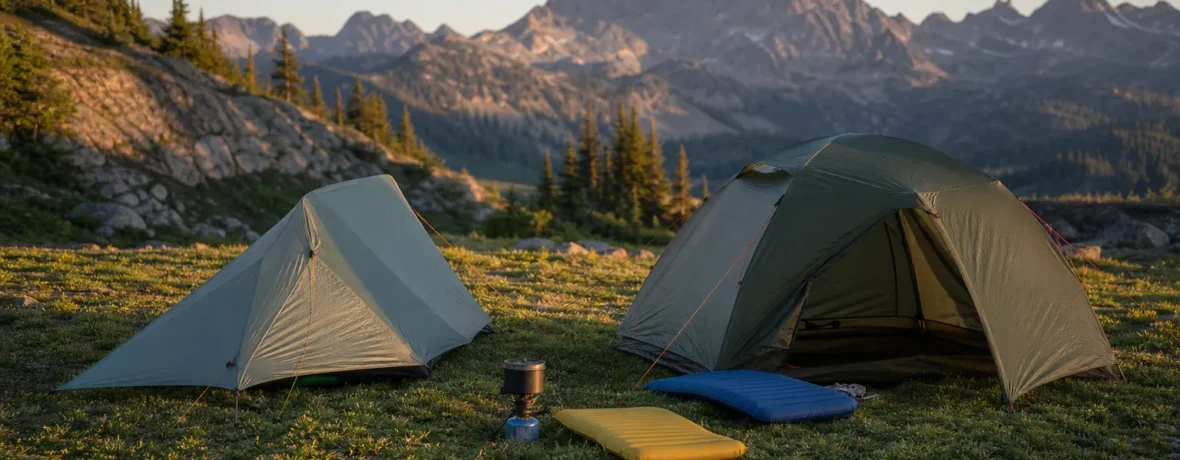
To choose a tent, match capacity to real sleeping space, pick a 3-season tent for most backpacking, choose 4-season only for snow or harsh alpine wind, and keep backpacking shelter weight near 2-3 lb [0.9-1.4 kg] per person, including poles, stakes, and stuff sacks.
How do you choose a tent for backpacking or camping?
Start with your trip style, then work through capacity, season rating, weight, space, weather protection, and setup.
A tent that feels perfect at a campground can feel like a brick after six uphill miles. A featherweight shelter that shines on dry summer trails can feel miserable when rain blows sideways for eight hours. The trick is not buying the “best” tent. The trick is buying the right tent for the trips you actually take.
Use this order when choosing:
- Pick your use case. Backpacking, car camping, bikepacking, mountaineering, hunting base camp, or family campground weekends.
- Choose capacity. Decide how many sleeping pads must fit, then add room for dogs, kids, broad shoulders, or restless sleepers.
- Choose season rating. Most hikers need a 3-season tent. Snow campers and exposed alpine travelers may need a 4-season shelter.
- Set a weight target. For backpacking, think in pounds per person, not just total tent weight.
- Check floor dimensions. Compare stated capacity against your pad width and body height.
- Look at doors and vestibules. Two doors matter more than many shoppers think.
- Match setup style to terrain. Freestanding tents are easy on rock, platforms, and tight sites; trekking-pole shelters save weight but need good staking.
- Inspect weather details. Full-coverage fly, venting, pole structure, bathtub floor, and guyout points all matter in rough weather.
What tent capacity do you really need?
Buy the smallest tent you can sleep in comfortably, but size up when comfort, pets, winter gear, or long storms matter.
Tent capacity is not a hotel-room rating. A 2-person backpacking tent usually means two standard sleeping pads placed close together, with little extra floor space. If both sleepers use 25 in [64 cm] wide pads, many 2-person tents become tight fast. If one person is tall, check floor length and wall angle, not just the number printed on the hangtag.
Here is the straight read:
| Tent size | Best for | Watch out for |
|---|---|---|
| 1-person | Solo backpackers who want low weight and a small footprint | Limited room for gear, changing clothes, or waiting out storms |
| 2-person | Two close sleepers, one roomy solo shelter, or a hiker plus dog | Can feel cramped with wide pads or large winter sleeping bags |
| 3-person | Two hikers who want comfort, two adults plus a child, or gear-heavy trips | Heavier, larger packed size, and bigger campsite footprint |
| 4-person+ | Car camping, families, base camps, and short walk-in sites | Too bulky for most backpacking unless split among a group |
For backpacking couples, a 2-person tent is efficient. A 3-person tent is more livable. That extra floor width helps when rain pins you down, when sleeping pads slide around, or when both people want to sit up without elbowing each other in the ribs.
For solo hikers, a 1-person tent saves weight and packs small. Still, a 2-person tent can be the smarter call if you bring a large dog, use a wide pad, hike in wet climates, or hate feeling boxed in.
What is the best season rating for a tent?
A 3-season tent is the right choice for most hikers in spring, summer, and fall.
Season ratings describe intended weather, not the number of calendar seasons you are “allowed” to use the tent. A 3-season tent is built for rain, bugs, moderate wind, and warm-to-cool temperatures. It usually has mesh panels for airflow, a rainfly for storms, and a lighter pole structure than a winter tent.
A 4-season tent is not simply a warmer tent. It is built for snow loading, stronger wind, and colder exposed camps. That usually means more fabric, stronger poles, less mesh, more guyout points, and more weight. Cascade Designs, the company behind MSR tents, describes 4-season shelters as being made for high winds and snowy environments in its 4-season and mountaineering tent guidance.
Pick by conditions:
- 2-season: Mild summer trips, fair-weather camping, warm nights, low wind.
- 3-season: The standard backpacking choice for rain, insects, shoulder-season chill, and normal wind.
- 3+ season: A stronger 3-season design with more fabric coverage and better wind handling.
- 4-season: Snow, alpine wind, winter backcountry travel, and exposed camps above treeline.
Do not buy a 4-season tent for ordinary summer backpacking unless you have a clear reason. The reduced mesh can make it stuffy. The stronger build adds weight. In humid weather, poor airflow can lead to heavy condensation.
What is a good weight for backpacking tent use?
A good weight for backpacking tent use is usually 2-3 lb [0.9-1.4 kg] per person, with ultralight shelters below that and budget tents often above it.
Look at packed weight, not only “minimum trail weight.” Minimum trail weight often counts the tent body, fly, and poles, but may leave out stakes, guylines, repair sleeves, footprint, and stuff sacks. Packed weight is closer to what rides in your pack.
Use these practical targets:
- Solo backpacking: 1.5-3 lb [0.7-1.4 kg] is a strong range for most hikers.
- Two-person backpacking: 3-5 lb [1.4-2.3 kg] total works well when split between two packs.
- Ultralight shelters: Under 2 lb [0.9 kg] total is possible, often with tradeoffs in cost, durability, space, or setup ease.
- Car camping tents: Weight matters far less; standing height, doors, and weather protection matter more.
Weight is not everything. A tent that saves 12 oz [340 g] but forces you to crawl through a tiny front door every night may not feel like a win. A slightly heavier tent with two side doors, better ventilation, and a tougher floor can be the better tool for a wet week in the mountains.
If you are comparing two tents, calculate weight per sleeper. A 4 lb [1.8 kg] 2-person tent equals 2 lb [0.9 kg] per person. A 3 lb [1.4 kg] solo tent is heavier per person even though the total weight is lower.
Is a 1-person or 2-person tent better for solo hiking?
A 1-person tent is better for low weight, while a 2-person tent is better for comfort.
Solo hikers face a classic trade. A 1-person tent gives you a smaller footprint, lower packed weight, and easier site selection on narrow backcountry benches. It also helps if you move camp daily and care about every ounce.
A 2-person tent gives you room to bring your pack inside, spread out damp layers, keep a dog sheltered, or sit through bad weather without feeling like you are living in a nylon coffin. For long trails, wet regions, and larger hikers, that space can be worth the weight.
Choose a 1-person tent if:
- You count ounces closely.
- You usually camp in mild weather.
- You sleep still and use a regular-width pad.
- You want a smaller campsite footprint.
Choose a 2-person tent for solo trips if:
- You use a wide sleeping pad.
- You bring a dog.
- You hike in rainy climates.
- You want room to organize gear inside.
- You get claustrophobic in narrow shelters.
How much floor space and headroom should a tent have?
Your tent should fit your sleeping pad, your height, and your sitting posture without pressing your bag into wet walls.
Start with pad width. Regular backpacking pads are often 20 in [51 cm] wide. Wide pads are often 25 in [64 cm]. Two wide pads need at least 50 in [127 cm] of usable floor width, and “usable” is the key word. Sloping walls can steal shoulder room even when the floor dimensions look fine.
Then check length. Tall hikers should be careful with tapered foot ends and steeply sloped walls. If your sleeping bag touches the tent wall all night, moisture can transfer to the insulation. Down bags suffer most because wet down loses loft.
Peak height matters too, but peak height alone can fool you. A tent with one tall point and steep walls may feel smaller than a tent with a slightly lower peak and a ridge pole that spreads headroom across the ceiling. If two people will sit up at once, look for near-vertical sidewalls or a brow pole.
For comfort, check these dimensions before buying:
- Floor width: Enough for your exact sleeping pad setup.
- Floor length: Enough for your height plus sleeping bag loft at both ends.
- Peak height: Enough to sit up without brushing the ceiling.
- Shoulder room: Enough for two sleepers to lie naturally.
- Vestibule area: Enough for shoes, pack, stove storage, or wet layers.
Should you get a freestanding, semi-freestanding, or trekking-pole tent?
Freestanding tents are easiest, trekking-pole tents are lightest, and semi-freestanding tents sit in the middle.
A freestanding tent uses poles to hold its main structure. You should still stake it down, but it can stand before every corner is tensioned. That helps on wooden platforms, rock slabs, sandy ground, and compacted tent pads.
A semi-freestanding tent uses a pole structure plus stakes to pull out the footbox or corners. These tents often save weight while keeping setup fairly simple.
A trekking-pole tent uses your hiking poles instead of dedicated tent poles. This can cut packed weight, but the tent depends on solid staking and good tension. Rocky ground, loose sand, frozen soil, and cramped campsites can make setup fussier.
| Setup type | Best advantage | Main tradeoff |
|---|---|---|
| Freestanding | Fast setup and flexible campsite choice | Usually heavier because of full pole structure |
| Semi-freestanding | Good balance of weight and convenience | Needs solid staking for full interior space |
| Trekking-pole | Very low packed weight | More dependent on skill, stakes, and ground conditions |
What weather protection should you look for in a tent?
Look for a full rainfly, a bathtub floor, stable poles, usable vents, and enough guyout points for wind.
A good backpacking tent keeps rain out from above, splashback out from below, and condensation under control. That last part matters. Humans breathe moisture all night. Wet ground adds more. If the fly is sealed tight with no airflow, condensation builds on the inside of the fly and may drip or brush onto gear.
For wet weather, choose:
- Full-coverage rainfly: Better storm protection than tiny cap-style flies.
- Bathtub floor: Raised floor edges help block splash and shallow runoff.
- Factory-taped or sealed seams: Reduces leak points.
- Roof vents: Helps move moist air out.
- Vestibules: Keeps wet shoes and packs out of the sleeping area.
- Guyout points: Lets you stabilize the tent in wind.
Pitch location matters as much as design. The Leave No Trace guidance on durable surfaces recommends camping on durable sites such as established tent pads, rock, gravel, dry grasses, or snow when suitable. The National Park Service also teaches durable-surface camping as a core low-impact practice. Good ethics and good sleep often point to the same choice: a flat, durable, well-drained site.
Do you need one door or two doors?
Two doors are better for two people; one door is fine for many solo tents.
Door count changes daily comfort. With one front door, the inside sleeper may need to crawl over the other person for a midnight bathroom trip. With two side doors, each sleeper gets a personal exit and usually a personal vestibule. That keeps wet shoes, packs, and small items separated.
For one person, one door can work beautifully, especially if it saves weight. For two people, two doors are one of the cleanest upgrades you can buy. Less crawling. Less gear clutter. Less grumbling when rain is hammering the fly.
How durable should tent fabric be?
Choose lighter fabrics for long backpacking trips and tougher fabrics for rough camps, dogs, kids, and frequent use.
Tent fabric durability is often described by denier, shown as 10D, 15D, 20D, 30D, 40D, and so on. Lower denier fabrics are usually lighter and more delicate. Higher denier fabrics are usually tougher and heavier. Fabric type, coating, weave, and construction also matter, so denier is not the whole story, but it is a useful clue.
Ultralight tents often use thinner floors. That saves weight, but you need better site selection. Clear sharp sticks, pinecones, and stones by hand. Do not dig trenches or remodel a campsite. If the floor fabric is thin, consider a footprint or a sheet of polycryo when camping on abrasive ground.
For car camping, err toward durability. The weight penalty barely matters when the tent rides in a trunk. For backpacking, split the difference: light enough to carry, strong enough to survive the places you camp.
What tent features are actually worth paying for?
Pay for weather protection, livable space, low weight, and reliable poles before chasing small extras.
Some features improve every night outside. Others look great in product photos and barely matter on trail. Focus on the pieces that affect sleep, storm performance, and setup.
Worth prioritizing:
- Two doors for two sleepers: Big comfort gain.
- Two vestibules: Better gear storage and cleaner exits.
- Good vents: Less condensation.
- Color-coded poles and clips: Faster setup in rain or fading light.
- Multiple guyout points: Better wind handling.
- Interior pockets: Keeps headlamps, glasses, and phones off the floor.
- Fast-pitch option: Useful when the fly and footprint can pitch without the inner tent.
Lower priority:
- Oversized gear lofts that add clutter.
- Huge stuff sacks that pack poorly.
- Tiny windows that add weight without much function.
- Unusual pole shapes that are hard to replace.
How do you choose a tent for different trips?
Match the tent to the hardest conditions you realistically expect, not the scariest conditions you can imagine.
For summer backpacking on maintained trails, choose a light 3-season tent with good mesh, a full fly, and enough vestibule space for wet gear. For shoulder-season mountain trips, look for a stronger pole structure, more fabric coverage, and extra guyout points. For snow camping, choose a true 4-season tent or a winter-ready shelter built for snow loading and wind.
For car camping, stop obsessing over ounces. Get standing or near-standing height if you value comfort. Pick big doors, tough fabric, and a rainfly that gives real coverage. A large vestibule or awning can make rainy campground mornings much easier.
For desert trips, ventilation and staking matter. Sand can make standard stakes weak, and wind can shove grit into every zipper. For humid forests, prioritize airflow, vestibules, and a fly that can handle all-night rain. For alpine terrain, wind stability and a small footprint beat palace-like floor space.
What is the final tent buying checklist?
The right tent should pass every item that matches your trips.
- The capacity fits your actual sleeping pads.
- The floor length works with your height and sleeping bag loft.
- The season rating matches your coldest and stormiest expected trips.
- The packed weight fits your hiking style.
- The packed size fits inside or outside your pack cleanly.
- The doors and vestibules match the number of sleepers.
- The setup style works on your usual terrain.
- The fly gives full storm coverage.
- The tent has enough ventilation for humid nights.
- The floor fabric is tough enough for your campsites.
- You can pitch it fast before taking it into the backcountry.
- You know how to stake and guy it out before wind arrives.
One last move: set the tent up at home before the first trip. Check the stakes, guylines, pole sections, fly orientation, zipper movement, and seam condition. A backyard pitch catches small problems while the house is still ten steps away.
Related reading
- How to Waterproof a Tent: Seams, Rainfly and Floor
- How to Choose a Sleeping Bag: Temperature Ratings, Fill and Shape
- How to Set Up a Tent Step by Step (Even Alone)
- How to Clean a Tent (Including Mold and Mildew)
FAQ
What size tent should I buy for two people?
Buy a 2-person tent if you want low weight, or a 3-person tent if you want comfort. Two wide sleeping pads, large sleeping bags, or a dog can make many 2-person tents feel cramped.
Is a 4-season tent too hot for summer?
Yes, it can be too hot and stuffy for summer backpacking. Many 4-season tents use less mesh and heavier fabric, which helps in snow and wind but reduces airflow in warm, humid weather.
How heavy is too heavy for a backpacking tent?
For most backpackers, more than 3 lb [1.4 kg] per person starts to feel heavy. That can still be acceptable for winter trips, budget setups, short mileage, or harsh weather where strength matters more than low weight.
Do I need a footprint under my tent?
You do not always need one, but a footprint helps protect thin tent floors on rough or abrasive ground. It should be slightly smaller than the tent floor so it does not catch rainwater and funnel it underneath you.
Are trekking-pole tents hard to set up?
They are not hard once practiced, but they are less forgiving than freestanding tents. You need solid stake placement, correct pole height, and even tension to get full interior space and good storm performance.
What is the best tent for most hikers?
The best tent for most hikers is a 3-season, double-wall, 2-person tent that weighs 3-5 lb [1.4-2.3 kg] total. It gives a strong mix of weather protection, ventilation, livable space, and manageable trail weight.