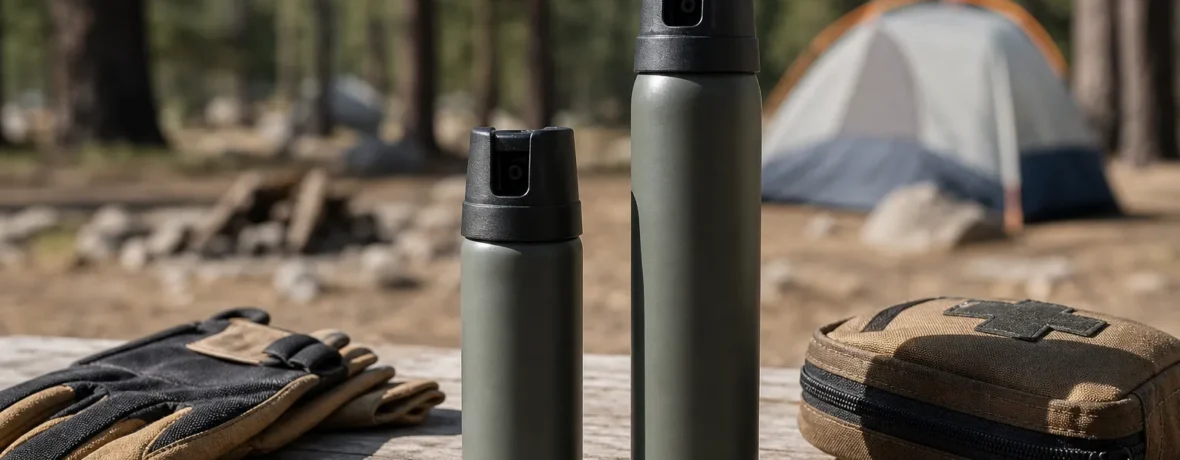
No. Not in trail use, labeling, range, or spray pattern. Bear spray is EPA-registered for aggressive bears, usually 7.9 oz [225 g] or larger, with 1% to 2% capsaicin-related active ingredients. Personal pepper spray is made for humans at close range.
They come from the same spicy family. Both use oleoresin capsicum, the hot-pepper extract that lights up eyes, nose, throat, and lungs. That shared ingredient is where the similarity ends. On a hike, those differences matter.
A pocket pepper spray clipped to your keychain is not a bear-country tool. A bear spray canister buried in your backpack is not much help either. The right choice depends on what you are trying to stop, how far away it is, and what the label says the product is made to do.
Is bear spray the same as pepper spray?
No. Bear spray is a bear deterrent; pepper spray is usually a personal-defense spray for humans.
Bear spray is built to put a large, expanding cloud between you and a charging bear. It is not meant to be sprayed on your tent, pack, boots, dog, clothes, or campsite. The National Park Service calls bear spray a deterrent, not a repellent, and says to buy an EPA-approved product specifically designed for bears in its bear spray safety guidance.
Personal pepper spray is built for a different problem: a close human threat. Many small units use a narrow stream, gel, cone, or foam. That can make sense in town, but it is the wrong design for a fast animal with a long nose, low head position, and a charge that can close distance in seconds.
Bear spray also has a different regulatory setup. In Yellowstone’s regulations, bear spray is defined as a chemical formula designed specifically to deter aggressive or attacking bears, registered with the EPA and individual states, commercially manufactured, labeled as “bear spray,” and containing 1% to 2% capsaicin and related capsaicinoids under Yellowstone National Park’s laws and policies.
| Feature | Bear spray | Personal pepper spray |
|---|---|---|
| Main job | Deter an aggressive or charging bear | Stop or slow a close human attacker |
| Spray pattern | Wide fog or cloud | Often stream, gel, foam, or small cone |
| Typical carry size | Large canister; bear products are commonly 7.9 oz [225 g] or more | Small pocket, purse, belt, or keychain size |
| Best trail use | Bear country | Human self-defense where legal |
Is bear spray stronger than pepper spray?
Usually by active capsaicinoid percentage, yes, but “stronger” is the wrong way to shop.
The better question is: will it reach the threat and create the right barrier? Bear spray is designed around distance, volume, cloud size, and a formula approved for deterring bears. Personal pepper spray can feel brutally hot, and some labels shout big numbers, but those numbers are often not directly comparable.
Look for “capsaicin and related capsaicinoids,” not just “oleoresin capsicum” or “OC.” OC percentage can describe the pepper extract in the can, not the active heat that matters most. That is how tiny sprays can advertise dramatic-looking figures while still being the wrong tool for bears.
For bear country, the label should clearly say bear spray or bear deterrent, show an EPA registration number, and list capsaicin and related capsaicinoids in the bear-spray range. If it says “pepper spray” and fits in a jeans coin pocket, leave it out of your bear plan.
Can you use pepper spray on a bear?
You should not rely on personal pepper spray for a bear.
The National Park Service says personal protection or law enforcement sprays are not strong enough to affect a bear’s senses the way bear spray is meant to in its bear spray and firearms guidance. That does not mean a small pepper spray can has zero irritant effect. It means you do not want to gamble your face, hands, and throat on a close-range human-defense product when a bear is coming in fast.
Here is the trail reality: bears do not square up like a training dummy. They move low and quick. Wind shifts. Your heart rate spikes. Brush blocks your view. A narrow stream is much harder to place on target than a fog cloud when the target is a moving animal with momentum.
Bear spray gives you a larger margin. That margin is the point.
Can you use bear spray on a person?
Do not carry bear spray as your human self-defense plan.
Bear spray labels are written for use against bears, not people. Some EPA-registered bear spray labels plainly state “not for use on humans.” That matters legally and practically. A large fogger can contaminate you, your hiking partner, your dog, your car, or everyone standing downwind.
If your concern is human self-defense, check your state and local laws and choose a product labeled for that purpose. Bear spray belongs in bear country because of bears. Not because it looks like a giant version of pocket spray.
What should you look for when buying bear spray?
Buy EPA-registered bear spray with a current expiration date.
Do not overthink the brand first. Read the label first. A good bear spray canister should be easy to identify without decoding marketing copy.
- EPA registration: The can should show an EPA registration number.
- Bear-specific wording: Look for “bear spray,” “bear deterrent,” or language about deterring attacks by bears.
- Active ingredient: Look for capsaicin and related capsaicinoids in the proper bear-spray range.
- Canister size: Choose a full-size trail can, not a pocket personal-defense unit.
- Spray pattern: Pick a fog or cloud pattern made for bears.
- Range and duration: Compare labels, but do not buy a can you cannot draw quickly.
- Expiration date: Replace expired cans before a trip.
- Holster: Carry it where your hand can reach it instantly.
Yellowstone National Park advises visitors to select an EPA-approved product made specifically to stop bears and to check the expiration date before buying in its current bear safety guidance. That is simple advice. Follow it.
How do you carry bear spray while hiking?
Carry it on your body, not inside your pack.
A canister in the brain of your backpack is a comfort object. It is not a ready tool. Same for a side pocket under compression straps. If you cannot draw it while stepping backward, talking loudly, and keeping your eyes on a bear, it is in the wrong place.
Good carry spots include:
- A chest harness pocket
- A hip-belt holster
- A belt holster on your dominant-hand side
- A shoulder-strap holster that does not interfere with your sternum strap
Bad carry spots include:
- Inside the main compartment of your backpack
- Buried under a rain jacket
- In a loose side pocket
- In your hiking partner’s pack if you are often separated
- In the car at the trailhead
Practice the draw with the safety on. Better yet, buy an inert training can if you can. You want the motion to feel boring before you ever need it.
How do you use bear spray?
Use bear spray to create a cloud between you and the bear.
Yellowstone tells visitors that if a bear charges, remove the safety clip, point the nozzle slightly down, adjust for crosswind, and spray when the bear is 30 to 60 ft [9 to 18 m] away to create a wall between you and the bear in its park safety instructions.
- Get it in hand. Do not wait until the bear is almost on you.
- Pull the safety. Keep your finger off the trigger until you are ready.
- Aim slightly downward. A charging bear’s head is low.
- Account for wind. Shift your angle if a crosswind is pushing the cloud.
- Spray a barrier. Put the fog between you and the bear, not high over its back.
- Keep spraying if needed. Be ready for a second burst or a continued charge.
- Leave without running. Back away when the bear breaks off or changes direction.
Do not test-fire your real can for fun before a trip. You may reduce the pressure or empty enough contents to hurt performance later. Use an inert trainer for practice.
What happens if bear spray or pepper spray gets on you?
Expect burning eyes, coughing, skin pain, tearing, and temporary trouble seeing.
That sounds mild on paper. It does not feel mild when it hits you. The goal is to get away from the contaminated air, avoid spreading the oil, and flush exposed areas.
The CDC says riot control agents, including oleoresin capsicum pepper spray, irritate exposed areas such as the eyes, skin, nose, and respiratory tract within seconds in its chemical emergency fact sheet. NIH’s medical reference on tear gas and pepper spray toxicity also describes eye, skin, and breathing irritation and the need for decontamination in StatPearls via the NIH Bookshelf.
If you get sprayed:
- Move to fresh air as soon as you can.
- Do not rub your eyes.
- Remove contaminated clothing if you can do that without dragging it over your face.
- Flush eyes with clean water.
- Wash exposed skin with soap and water.
- Keep contaminated gear away from children, pets, and sleeping areas.
Skip folk remedies on the trail. You need clean water, air, time, and medical help when symptoms are severe or do not improve.
When to see a doctor
Get medical help right away for breathing trouble, chest pain, severe eye pain, or symptoms that do not improve.
Do not try to diagnose yourself on the trail. Pepper spray and bear spray exposures are usually temporary, but they can be more serious for people with asthma, COPD, heart or lung conditions, eye disease, children, older adults, and anyone hit in an enclosed space.
Seek urgent care if you have wheezing, shortness of breath, persistent coughing, chest tightness, vision changes, eye pain that continues after flushing, chemical exposure under contact lenses, burns, faintness, or repeated vomiting. If the exposure happened during a bear encounter, also deal with any fall, bite, claw wound, head strike, or shock from the incident.
Bear spray vs pepper spray: which one should hikers carry?
Carry bear spray in bear country and personal pepper spray only where it is legal and appropriate for human self-defense.
If you are hiking in grizzly country, the answer is easy: carry bear spray, know how to use it, and keep it reachable. That includes places like parts of Montana, Wyoming, Idaho, Alaska, and other bear habitats where agencies recommend bear-specific deterrent spray.
If you are hiking where black bears live but grizzlies do not, the choice is more local. Bear spray can still be a reasonable tool where legal, especially in remote country with dense brush or limited visibility. But spray is not a substitute for clean camp habits, smart food storage, noise in thick cover, and giving wildlife space.
If your concern is dogs or people near an urban trail, a personal-defense spray may be the product made for that problem. Check local rules before carrying it. Laws change, labels differ, and some parks restrict certain weapons or defensive sprays.
What mistakes do hikers make with bear spray?
The biggest mistake is owning bear spray without being ready to use it.
A canister on your shelf does nothing. A canister in your pack does almost nothing. A canister with an expired date, cracked safety clip, missing holster, or unknown trigger feel gives you false confidence.
- Buying pepper spray instead of bear spray: The label must say it is for bears.
- Carrying it buried: If you need to take off your pack to reach it, it is too slow.
- Spraying gear as “repellent”: Bear spray is not campsite perfume. Do not apply it to equipment.
- Ignoring wind: Wind can push the cloud back at you or away from the bear.
- Letting it bake in a car: Yellowstone warns that bear spray can explode if it reaches 120°F [49°C].
- Trying to fly with it: Yellowstone also states that bear spray cannot be taken on airplanes.
- Never practicing: Practice drawing with the safety on, or use an inert can.
The clean setup is boring: one current can, one solid holster, one practiced draw, one shared plan if you hike with a group.
Quick buying checklist
Use the label, not the front-of-package hype.
- Does it say “bear spray” or “bear deterrent”?
- Does it show an EPA registration number?
- Does it list capsaicin and related capsaicinoids?
- Is the canister full-size for bear defense?
- Does it spray a fog or cloud?
- Is the expiration date still good for your trip?
- Does it come with a holster you will actually wear?
- Can you draw it with either hand while wearing your pack?
Related reading
- What Is Bear Spray and How Effective Is It?
- Where to Buy Bear Spray and How Much It Costs
- How to Use Bear Spray Correctly
- Does Bear Spray Work on Mountain Lions and Other Animals?
FAQ
Is bear spray just a bigger can of pepper spray?
No. Bear spray is bigger, but it is also labeled, regulated, and designed for bears. The fog pattern, range, volume, and EPA bear-deterrent labeling are the key differences.
Will bear spray stop a grizzly?
Bear spray is made to deter an aggressive or charging bear, including grizzlies. It is not magic, so you still need distance, correct carry, fast deployment, and smart bear-country behavior.
Can I spray bear spray around my tent?
No. Do not use bear spray as a repellent on tents, packs, clothes, or food-storage areas. The National Park Service says bear spray is a deterrent for aggressive encounters, not something to apply to gear.
Is pepper spray better than bear spray for mountain lions or dogs?
Not always. For human self-defense, carry a legal product labeled for that purpose; for wildlife, follow local agency guidance and the product label. Bear spray may deter other animals, but its primary job is bear defense.
Can I bring bear spray on a plane?
No for normal air travel. Yellowstone National Park states that bear spray cannot be taken on airplanes, so plan to buy, rent, donate, or recycle it at your destination instead of packing it for a flight.
How close should a bear be before I spray?
Follow the can label and local agency guidance. Yellowstone tells visitors to spray when a charging bear is 30 to 60 ft [9 to 18 m] away, creating a wall of spray between you and the bear.