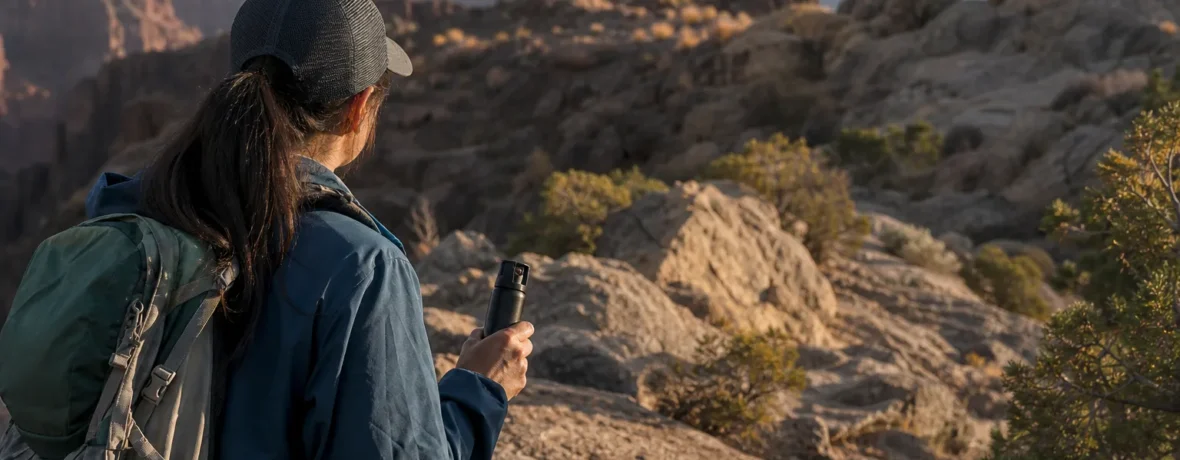
Yes. Bear spray can deter a charging or attacking mountain lion when sprayed into its face at close range, usually inside 25-35 feet [7.6-10.7 m]. It is not a force field. You still need distance, noise, eye contact, and a clean escape route.
Does bear spray work on mountain lions?
Yes, bear spray can work on mountain lions if the lion is close and acting aggressively.
Mountain lions breathe, blink, and smell like other mammals, so capsaicin spray can hit the eyes, nose, mouth, and lungs hard enough to break an attack. The National Park Service tells visitors in mountain lion country to stand their ground, appear large, back away slowly, and use bear spray if the lion attacks.
Timing matters. Spray too early and the cloud may drift away before the lion reaches it. Spray too late and you may not get a full burst between you and the animal. Think of bear spray as a last-ditch defensive tool, not your first move.
Does bear spray work on cougars?
Yes, and this is the same animal under a different common name.
Cougar, mountain lion, puma, and panther can all refer to Puma concolor. The response stays the same: do not run, do not crouch, do not turn your back, and do not act like prey. Make yourself look bigger. Pick up small children without bending low. Speak firmly. Back away.
If the cougar closes distance, reaches striking range, or attacks, bear spray gives you a non-lethal tool with more reach and volume than pocket pepper spray. If contact happens, fight back hard with rocks, sticks, trekking poles, your pack, and anything else you can drive toward the animal’s face.
Will bear spray stop a bear better than a mountain lion?
Bear spray is designed, labeled, and sold for bears first.
That does not mean it only affects bears. It means the canister size, spray pattern, concentration, distance, and label directions are built around stopping a large, fast animal at close range. Grand Teton National Park advises aiming slightly downward toward a charging bear’s front legs at 15-30 feet [4.6-9.1 m] and firing a 1-2 second burst to create a cloud the bear runs through; if the charge continues, spray again. Read the park’s bear spray instructions before you carry it.
Bear spray is not magic. Wind can shove it sideways or back into your face. Rain can knock the cloud down. Dense brush can block your view until the animal is already too close. A half-buried can in the bottom of your pack is dead weight.
| Animal | Can bear spray help? | Best use | Big caution |
|---|---|---|---|
| Mountain lion / cougar | Yes, at close range | Spray if it attacks or keeps closing | Do not run; fight back if contact happens |
| Black bear / grizzly | Yes, for charges and attacks | Cloud between you and the bear | Do not spray tents, packs, or yourself |
| Aggressive dog | It may, but it is not ideal | Only as an emergency barrier | Dog-specific spray is usually easier to aim |
| Coyote or fox | Likely, if very close | Last resort if hazing fails | Keep distance; never feed wildlife |
Does bear spray work on dogs?
Yes, it can affect dogs, but bear spray is usually the wrong tool for everyday dog problems.
A full-size bear canister throws a wide, fogging cloud. That is useful when a bear or lion is closing fast. On a trail with hikers, kids, horses, or your own dog nearby, that same cloud can hit everyone downwind. Dog deterrent sprays are smaller and more targeted, and some are made for cyclists, runners, mail carriers, and hikers dealing with charging domestic dogs.
There is also a label issue. In the United States, bear spray products are pesticides, and EPA-registered products must be used according to their labels. As of November 2026, the EPA’s public label for one common bear deterrent says it may be used only to deter bears that are attacking or appear likely to attack humans, lists a range up to 32 feet [9.8 m], and says the can empties in roughly 7 seconds; read the EPA product label before you rely on any can.
How should you use bear spray if an animal charges?
Use bear spray fast, low, and in short bursts.
- Carry it where your hand can reach it. Belt holster, chest strap, or shoulder strap. Not inside your pack.
- Pop the safety clip only when you may need to fire. Practice the motion with an inert training can if you can.
- Stand your ground for a charge. Backpedaling on rocks and roots is how ankles get wrecked.
- Aim slightly down. You want the cloud in the animal’s path and rising into its face.
- Fire a 1-2 second burst. Save spray for a second burst if the animal keeps coming.
- Move away when it breaks off. Do not chase it. Do not stop to film it. Leave the area.
What should you look for in a bear spray canister?
Buy a real EPA-registered bear deterrent, not tiny keychain pepper spray.
- EPA registration number: It should be printed on the label.
- Full-size can: Choose a can meant for backcountry bear defense, not urban self-defense.
- Reach: Look for a label range in the 25-35 foot [7.6-10.7 m] class.
- Holster: If it does not ride on your body, you will not draw it in time.
- Expiration date: Propellant pressure drops over time. Replace expired cans.
- Practice option: Inert training cans teach your thumb, wrist, and brain what to do.
Can you spray bear spray on your tent, boots, or backpack?
No, do not use bear spray like bug spray.
Bear spray is for an aggressive or attacking animal, not for coating gear. Spraying it on tents, packs, boots, trash bags, or picnic tables can contaminate your camp and may create a nasty surprise for you later. It also wastes the one tool you may need when seconds count.
For prevention, use food storage, distance, clean cooking habits, leash control, and noise. Bear spray is the emergency brake.
What else should you do during a mountain lion encounter?
Act big, stay upright, and make the lion rethink the whole deal.
- Face the animal and maintain eye contact.
- Do not run. Running can trigger a chase.
- Raise trekking poles, a jacket, or your pack to look larger.
- Pick up children without crouching or turning away.
- Speak in a loud, firm voice.
- Back away slowly and leave the animal an escape route.
- If attacked, fight back and target the face and eyes.
When to see a doctor
See a doctor promptly after any bite, claw wound, deep puncture, severe bleeding, or possible rabies exposure.
Wash bites and scratches with soap and running water as soon as you can. Mayo Clinic says to seek prompt medical care for deep punctures, badly torn or crushed skin, severe bleeding, signs of infection, or bites from animals with unknown rabies vaccination status; review its animal bite first aid guidance. The CDC also says rabies needs urgent medical attention after contact with wildlife or unfamiliar animals, especially bites and scratches; see the CDC’s rabies care guidance.
If bear spray blows back into your eyes or lungs, get to fresh air, follow the can’s first-aid label, and get medical help if you have trouble breathing, chest pain, vision problems, or pain that does not ease.
Related reading
- What Is Bear Spray and How Effective Is It?
- Where to Buy Bear Spray and How Much It Costs
- How to Use Bear Spray Correctly
- Bear Spray vs Pepper Spray: What's the Difference?
FAQ
Is bear spray better than pepper spray for mountain lions?
Yes, for trail defense it usually is. Bear spray has a larger canister, longer reach, and wider cloud than pocket pepper spray, which gives you a better chance of putting irritant between you and a charging animal.
How close should a mountain lion be before you spray?
Close enough that the cloud can reach its face. For most bear sprays, that means inside the labeled range, often 25-35 feet [7.6-10.7 m], with wind and terrain affecting the real distance.
Will bear spray make a mountain lion angrier?
It is meant to stop or interrupt an attack, not punish the animal. If it works, your job is to leave immediately and report the encounter to local land managers if needed.
Can you carry bear spray in national parks?
Sometimes, but rules vary by park and location. Check the official park website before your trip, because some places restrict possession or use of bear spray.
Should you carry bear spray where there are no bears?
Maybe, if the area has mountain lions, aggressive dogs, or other large mammals and local rules allow it. Still, your best defenses are awareness, distance, traveling with control over kids and pets, and knowing what to do before the animal appears.