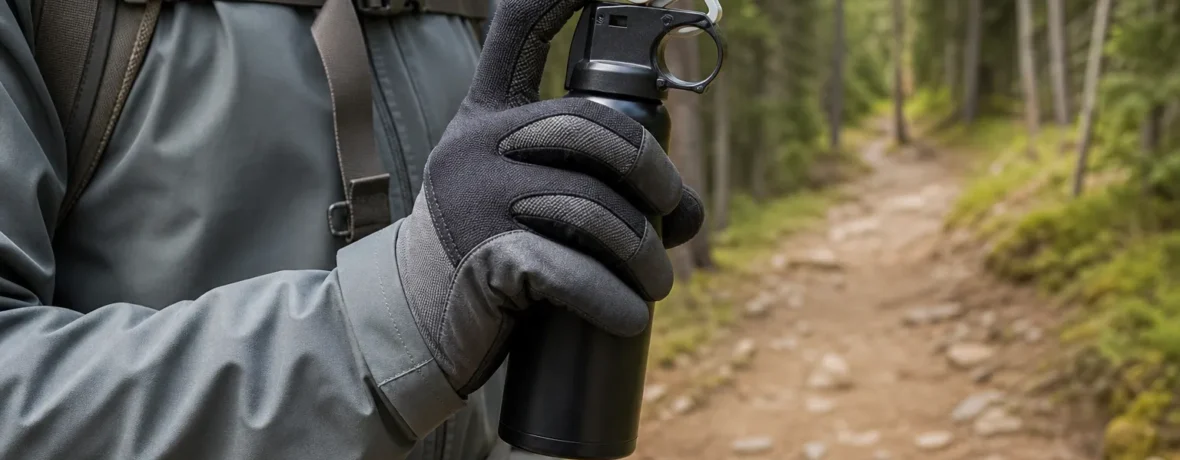
To use bear spray, carry it where your hand can reach it fast, pull the safety only during a serious encounter, aim slightly downward, and spray a cloud when a charging bear is 30-60 feet [9-18 m] away. Keep spraying until the bear veers off, then leave without running.
What is bear spray, and how is it different from pepper spray?
Bear spray is a wide-cloud bear deterrent, not pocket pepper spray.
Good bear spray is built to throw a large orange cloud between you and an aggressive bear. That cloud matters. You are not trying to hit a moving nose like a bullseye. You are trying to put a wall of irritant in the bear’s path so it runs into it.
The Interagency Grizzly Bear Committee says to buy spray labeled for deterring bear attacks, choose an EPA-registered product, and use it only as an airborne deterrent during an aggressive or attacking bear encounter. Do not spray it on your tent, pack, boots, food bag, dog, or jacket. That is not protection. That is contamination.
| Gear | Best use | Trail problem |
|---|---|---|
| Bear spray | Creating a broad cloud in front of an aggressive bear | Bulky, expires, cannot fly in most real-world travel setups |
| Personal pepper spray | Human self-defense where legal | Shorter reach and smaller pattern; not the right tool for bears |
| Noise only | Preventing surprise encounters | Does not stop a determined charge |
What should you check before carrying bear spray?
Check the label, expiration date, size, range, safety clip, and holster before you hit the trail.
Do this at home, not at the trailhead while your group is already walking away. Bear spray is safety gear, but it is also pressurized irritant in a metal can. Treat it like gear with consequences.
- EPA registration: Look for an EPA registration number on the canister, not vague “extra hot” marketing.
- Bear-specific label: The can should say bear spray or bear deterrent.
- Can size: The National Park Service guidance for Kobuk Valley says to look for at least 7.9 oz [225 g] and a minimum spray distance of 25 feet [7.6 m].
- Expiration date: Replace expired cans. Propellant weakens, and you need full pressure when seconds count.
- Safety clip: Make sure it is installed and not cracked.
- Holster fit: The can should draw smoothly with one hand.
- Temperature storage: Yellowstone National Park warns that bear spray can explode at 120°F [49°C], so keep it away from vehicle heat and direct sun inside a closed car.
If the can is dented, leaking, missing its safety clip, crusted around the nozzle, or long expired, replace it. This is not the place to squeeze one more season out of tired gear.
Where should you carry bear spray while hiking?
Carry bear spray on your body, not buried in your pack.
Your best spots are a hip holster, chest holster, or pack-strap holster that you can reach with either hand. The spray should ride outside your clothing and outside your backpack pockets. A can in the brain of your pack is cargo. A can on your belt is emergency gear.
Before every hike, do a dry draw with the safety clip still on. Reach. Grip. Pull. Point the nozzle away from your body and your hiking partners. Put it back. Do that until the motion feels boring.
Bad carry spots include:
- Inside a backpack
- In a zippered hip-belt pocket
- Clipped behind your back
- Loose in a water-bottle pocket
- Inside a tent while you are cooking outside
Each capable adult in the group should carry their own can. If one person has all the spray and walks 80 feet [24 m] ahead, the group does not have bear spray. One person has bear spray.
How do you use bear spray step by step?
Use bear spray by drawing early, aiming low, and spraying a wide cloud before the bear reaches you.
Read your can’s label and practice with an inert trainer before your trip. Then use this trail sequence if a bear charges or keeps closing distance and you cannot safely retreat.
- Stand your ground. Do not run. Running can trigger pursuit and you will not outrun a bear.
- Pull the can from the holster. Keep it pointed away from your face, your legs, and your group.
- Remove the safety clip. Do this only when the encounter is serious. You do not want an unprotected trigger on a normal hike.
- Use two hands if you can. One hand grips the can. The other steadies it. Stress makes hands clumsy.
- Aim slightly downward. Aim toward the ground in front of the bear, not over its head.
- Adjust for wind. If wind is crossing the trail, angle the cloud so it drifts into the bear’s path instead of straight back into you.
- Spray when the bear is 30-60 feet [9-18 m] away. Yellowstone’s bear safety guidance gives this range for creating a wall between you and the bear.
- Sweep side to side. Make a broad cloud. You are painting air, not tagging fur.
- Keep spraying until the bear changes direction. Save enough in the can for a second burst if the bear circles or returns.
- Leave the area. Walk away calmly once the bear breaks off. Do not run. Do not stop for video.
That last part is where people get greedy. The bear turns. The adrenaline spikes. Someone wants a photo. Don’t. Your job is to get distance and let the bear leave.
When should you spray a bear?
Spray when a bear charges, acts aggressively, or keeps closing and you cannot safely back away.
Not every bear sighting is a spray moment. A bear 300 yards [274 m] away feeding on a hillside does not need your orange cloud. Give it room, group up, speak calmly, and move away if your route allows it.
A closer surprise encounter is different. If you round a bend and find a bear nearby, talk in a firm, low voice. Back away slowly. Get your spray out. Remove the safety only if the bear charges or the situation is turning fast.
Use spray if you see these warning signs:
- The bear charges toward you
- The bear closes distance after you back away
- The bear follows you
- The bear is defending food, cubs, or a carcass and you are too close
- The bear appears focused on you and retreat is blocked
Spraying too early can waste the can before the bear reaches the cloud. Spraying too late gives the cloud no time to work. That 30-60 foot [9-18 m] window is the zone to remember.
How do wind, rain, and terrain change bear spray use?
Wind, rain, brush, and slopes change where the cloud goes.
Wind is the big one. A headwind can push spray back into your face. A crosswind can shove the cloud off the trail. A tailwind can help carry it toward the bear, but it can also thin the cloud faster. You still use the spray if the bear is charging. Just angle the nozzle to build the cloud where the bear will be, not where it was one second ago.
Rain can knock the cloud down sooner. Thick brush can break up the pattern. A bear coming uphill may be lower than your hands, which makes aiming slightly downward even more useful. In tight timber, you may have less than 30 feet [9 m] of warning, so carry the can where your hand naturally falls.
Practice helps here. Not with live spray in camp. Use an inert practice can in an open area, with the wind at your back, side, and front. Watch how the stream becomes a cloud. Watch how quickly it moves. That visual memory is gold when your heart rate spikes.
What should you do after using bear spray?
Leave the area, check your group, and report the bear conflict to local land managers if you can.
Once the bear moves away, do not stand around waiting to see what happens next. Walk out of the area in the direction that gives the bear space. Keep your spray ready. Bears can circle, return, or be joined by another bear.
- Keep the group together.
- Watch for the bear without staring it down from close range.
- Do not run.
- Do not approach dropped gear until the bear has left and the scene is safe.
- Leave carcasses, food, and scented items behind if recovering them would put you near the bear.
- Tell a ranger, wildlife officer, campground host, or local land manager what happened.
If spray got on people, move to fresh air first. Then handle decontamination. If you are still in bear country, balance cleanup with getting to a safer place.
When to see a doctor
Get medical help right away for breathing trouble, chest pain, wheezing, or eye pain that does not clear.
Bear spray can irritate eyes, skin, mouth, throat, and lungs. The CDC guidance on riot control agents recommends fresh air, removing contaminated clothing, washing skin with soap and water, and rinsing burning or blurry eyes with plain water for 10-15 minutes. Contact lenses should come out and should not go back in.
Poison Control says serious effects such as wheezing, difficulty breathing, chest pain, or persistent eye pain need immediate medical evaluation. You can also call Poison Help at 1-800-222-1222 in the United States for free guidance.
Do not rub your eyes. Do not smear oily lotions across sprayed skin. Do not tough it out if your breathing is getting worse, if vision stays blurred, or if the person exposed has asthma, COPD, or another lung condition.
Can you fly with bear spray?
For normal hiking-size bear spray, plan to buy or rent it after you land.
As of November 2026, the FAA PackSafe rules allow only one self-defense spray up to 4 fl oz [118 ml] in checked baggage, with a safety mechanism, and international aviation rules prohibit self-defense sprays in both carry-on and checked baggage. Most bear spray canisters are larger than 4 fl oz [118 ml], so they do not fit that checked-bag allowance.
Do not show up at TSA with a full-size bear spray can and hope charm carries the day. Buy it near your destination, rent it where available, or ask the local ranger station or outdoor shop where unused canisters can be safely recycled before you fly home.
What common bear spray mistakes should you avoid?
The biggest mistake is owning bear spray but not being ready to use it.
A shiny can with the plastic wrap still on it does not help if it is buried under rain gear. Same for a can clipped to the back of your pack where only your hiking partner can reach it.
- Do not spray it like bug spray. Bear spray goes in the air during an encounter, not on your body or gear.
- Do not test-fire your real can for fun. You may reduce pressure or empty the can you need later.
- Do not carry expired spray. Replace it before your trip.
- Do not remove the safety clip for the whole hike. Keep it on until you need to prepare for a possible spray.
- Do not aim high. A cloud over the bear’s back helps nobody.
- Do not spray from inside a tent. You can contaminate a tiny space fast and still have a bear problem outside.
- Do not hike silently in thick bear country. Prevention beats deployment.
Good bear-safety habits still matter: make noise where sightlines are short, store food properly, keep a clean camp, avoid carcasses, and give every bear a huge buffer. Bear spray is the last line, not the whole plan.
Related reading
- What Is Bear Spray and How Effective Is It?
- Where to Buy Bear Spray and How Much It Costs
- Does Bear Spray Work on Mountain Lions and Other Animals?
- Bear Spray vs Pepper Spray: What's the Difference?
FAQ
Does bear spray really work?
Yes, when it is carried correctly and used at the right distance. It works by creating an airborne cloud that irritates the bear’s eyes and respiratory system, giving you time to leave.
How far does bear spray shoot?
Many bear sprays shoot 20-30 feet [6-9 m], while some reach farther. Check your can’s label and choose a product with at least 25 feet [7.6 m] of range.
Should I carry bear spray for black bears?
Yes, carry bear spray in black bear country where close encounters are possible. Bear spray is not only for grizzlies; the same wide-cloud deterrent can help during an aggressive encounter with North American bear species.
Can bear spray replace food storage?
No, bear spray does not replace proper food storage. Store food, trash, toiletries, and scented items according to local rules, because preventing a bear from getting a food reward is safer for you and the bear.
What if I spray myself by accident?
Move to fresh air, avoid rubbing your eyes, remove contaminated clothing, wash skin with soap and water, and rinse eyes with plain water for 10-15 minutes. Get medical help for breathing trouble, chest pain, wheezing, or eye pain that persists.
Should I practice with real bear spray?
No, practice with an inert training can. It lets you learn the draw, safety motion, aiming angle, and spray pattern without contaminating your gear, campsite, or lungs.