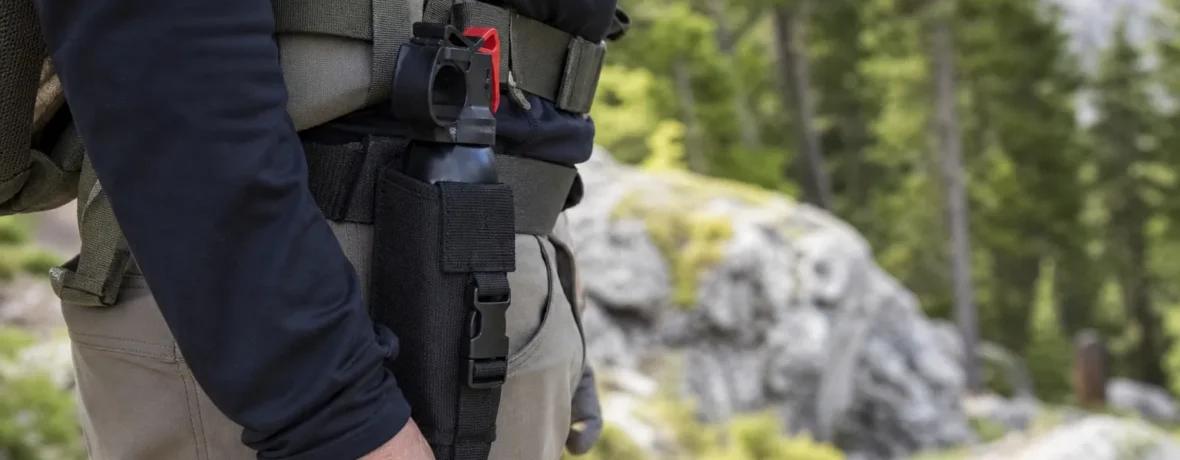
What is bear spray? Bear spray is an EPA-registered aerosol deterrent made for charging or aggressive bears, not people. It sprays a wide cloud of capsaicin-based irritant, usually from 25 feet [7.6 m] or farther. Used correctly, field studies show it stops unwanted bear behavior in more than 90% of documented close encounters.
What is bear spray, exactly?
Bear spray is a last-resort bear deterrent in an aerosol can.
Think of it as a temporary wall between you and a bear that has decided to close distance. It contains capsaicin and related capsaicinoids, the hot compounds derived from oleoresin of capsicum. When the cloud hits a bear’s eyes, nose, mouth, throat, and lungs, it causes intense irritation and gives you a chance to leave.
In the U.S., real bear spray should be EPA-registered and labeled for deterring bears. The Interagency Grizzly Bear Committee’s bear spray guidance recommends buying cans labeled “Bear Spray” or “Bear Deterrent,” with at least 7.9 ounces [225 g] of product and an EPA registration number. Many labels list 1% to 2% capsaicin and related capsaicinoids.
Do not treat it like bug spray. Do not spray it on your pack, tent, dog, clothes, boots, or picnic table. Once it lands on gear, it is no longer a protective cloud. It is just spicy residue, and residue can attract curious wildlife.
How effective is bear spray?
Very effective, when it is real bear spray, within reach, and used before the bear makes contact.
A widely cited Alaska study in the Journal of Wildlife Management reviewed bear spray incidents from 1985 through 2006. Spray stopped undesirable behavior 92% of the time for brown bears, 90% for black bears, and 100% for polar bears in the documented cases. Of all people carrying spray in close-range encounters, 98% were not injured by bears.
That does not make it magic. Nothing you carry turns bear country into a theme park. Spray can be affected by wind, rain, cold, poor aim, a forgotten safety clip, an expired can, or the classic bad move: keeping it buried in a backpack.
The win is speed. A bear can cover ground brutally fast. A can in your hip belt or chest holster is useful. A can in the lid pocket of your pack is decoration.
Does bear spray work if it’s windy or raining?
Yes, but weather can cut its range and blow the cloud where you do not want it.
The National Park Service bear spray guidance says strong wind affects spray distance and direction, and that snow, rain, and cold can reduce distance. That means you should not count on the number printed on the can as a perfect field promise.
Use the terrain. If you have seconds to shift, move so the wind is not driving spray back into your face. Point slightly downward so the cloud hangs in the bear’s path rather than sailing over its head. If the bear keeps coming, spray again. A short burst that misses is not the moment to admire your work.
Bear spray vs. pepper spray vs. firearms: what’s the difference?
Bear spray is built for bears; pocket pepper spray is not.
| Option | Best use | Trail reality |
|---|---|---|
| Bear spray | Creating a wide irritant cloud during a bear charge | EPA-registered cans are designed for distance, volume, and a fog pattern |
| Personal pepper spray | Human self-defense at close range | Usually smaller, narrower, and not labeled for stopping bears |
| Firearm | Lethal defense where legal and properly trained | Requires accuracy under panic, may be restricted, and can injure or kill the bear |
As of November 2026, the National Park Service advises hikers to check local park regulations because some parks do not allow possession or use of bear spray. The same NPS page recommends EPA-approved bear spray where it is allowed and reminds visitors that federal rules prohibit discharging weapons in park areas except in limited circumstances.
How do you choose good bear spray?
Buy the can that is legal, labeled for bears, and easy to carry.
Skip tiny “just in case” sprays. Skip anything that leans on hot-sounding marketing but does not clearly say bear deterrent. Your shopping checklist is simple:
- EPA registration number on the label
- Clearly marked for deterring bears
- At least 7.9 ounces [225 g] of spray
- 1% to 2% capsaicin and related capsaicinoids listed as active ingredients
- Holster included or available separately
- Unexpired date for the full trip
- Spray distance and duration listed on the label
Weight matters on a hike, sure. But this is not the place to shave ounces by carrying a smaller personal-defense can. The volume matters because you may need more than one burst, wind may steal some of the cloud, and a second bear may be involved.
How do you carry bear spray on a hike?
Carry it where either hand can reach it fast.
A hip-belt holster, chest holster, or shoulder-strap mount beats any pocket inside your pack. If you take your pack off for a snack, keep the spray on your body or place it within arm’s reach. Bears do not wait while you unzip compartments.
Before the trailhead, practice the draw with the safety on. Better yet, use an inert training can. You want the movement to feel boring: grab, pull, thumb the safety, aim low, spray. Boring is good. Boring works when your heart is hammering.
How do you use bear spray during a charge?
Use it only when a bear is aggressive, charging, or attacking.
- Get it out early. If a bear is close and focused on you, have the can in hand.
- Remove the safety clip. Keep your finger ready, but do not fire too soon.
- Stand your ground if you can. Backing away slowly may be right; running is not.
- Aim slightly downward. A charging bear’s head is low, and you want a cloud in its path.
- Spray a short burst. Sweep side to side to build a wall between you and the bear.
- Spray again if needed. If the bear keeps coming, keep the cloud between you and it.
- Leave when the bear breaks off. Do not run. Do not stick around for photos. Move away calmly.
NPS guidance says that when an aggressive charging bear is within 60 feet [18 m], that is the time to use it. Read your own can too, because labels vary by model.
What should you do if you get bear spray on yourself?
Get out of the cloud, breathe fresh air, and flush exposed eyes with clean water.
Bear spray hurts. That is the whole design. If you take blowback, move upwind or away from the cloud, avoid rubbing your eyes, and remove contaminated clothing if you can do so safely. The CDC’s chemical irritant guidance recommends leaving the area immediately, flushing eyes with plenty of clean water or saline, and removing contact lenses without reusing them.
If you need help deciding what to do after an exposure, Poison Control’s pepper spray guidance recommends contacting Poison Control at 1-800-222-1222 or using webPOISONCONTROL.
When to see a doctor
Seek medical care right away for breathing trouble, chest pain, wheezing, or eye pain that does not improve.
Do not try to diagnose yourself on the trail. Bear spray exposure is usually temporary, but direct hits, asthma or other lung conditions, contact lenses, eye injuries, or prolonged symptoms deserve real medical evaluation. Call 911 if someone collapses, cannot breathe normally, or cannot be awakened.
Related reading
- Where to Buy Bear Spray and How Much It Costs
- How to Use Bear Spray Correctly
- Does Bear Spray Work on Mountain Lions and Other Animals?
- Bear Spray vs Pepper Spray: What's the Difference?
FAQ
Is bear spray legal everywhere?
No. Rules change by park, land agency, and country. As of November 2026, NPS tells visitors to check local park regulations before a trip because some parks do not allow bear spray possession or use.
Can you fly with bear spray?
Usually no in carry-on, and airline rules can be strict for checked bags too. Check current TSA and airline rules before travel, then plan to buy, rent, or borrow spray near your destination if flying.
Should you carry bear spray in black bear country?
Yes, it can be a smart safety tool in black bear habitat, especially where bears are habituated to people or food. Your first defense is still distance, noise where appropriate, clean food storage, and not surprising a bear.
Does bear spray replace a bear canister?
No. Bear spray is for an aggressive encounter; a bear canister protects food and helps prevent encounters. Use the required food storage method for the area and carry spray where recommended and legal.
Can expired bear spray still work?
Do not rely on it. Propellant pressure and performance can decline over time, so replace expired cans before a trip. Use an expired can only for disposal according to local guidance, not for trail protection.