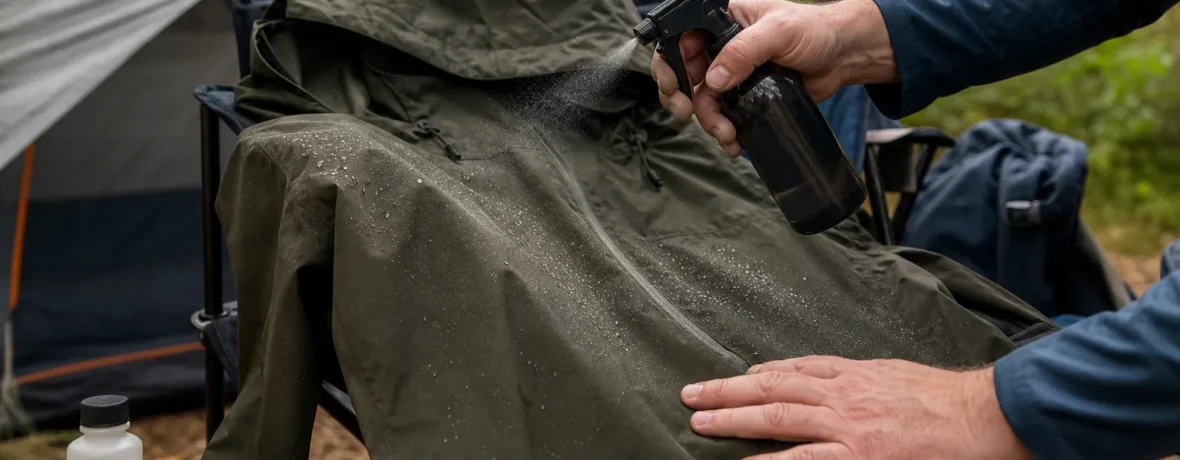
To re waterproof a rain jacket, wash it with technical cleaner, rinse away residue, dry it fully, then apply spray-on or wash-in DWR if water still soaks into the face fabric. Heat-reactivate only if the care label allows it; many shells need 20 minutes of low or medium dryer heat.
Why did my rain jacket stop beading water?
Your jacket’s outer DWR finish is dirty, worn, or both. DWR stands for durable water repellent, the treatment that makes rain bead up and roll off the outside of a shell instead of spreading into a dark, soggy sheet.
Most hiking rain jackets have two jobs happening at once. The waterproof membrane or coating blocks rain. The face fabric and DWR keep the outside from wetting out. When that outer fabric gets saturated, the jacket can feel clammy, heavy, and cold even if the membrane is still blocking liquid water.
Dirt, body oils, sunscreen, smoke, pine sap, sweat, and regular trail grime all interfere with DWR. That is why “re-waterproofing” usually starts with washing, not spraying. The GORE-TEX outerwear care guide recommends washing, drying, and reheating garments to restore DWR performance before adding more treatment.
How do I know if my rain jacket needs DWR or just a wash?
Test it with clean water after washing and drying. If droplets bead and roll, you are done; if water spreads and darkens the fabric, refresh the DWR.
Run this quick check before you reach for a waterproofing product:
- Spray test: Mist the shoulders, hood, and sleeves with clean water.
- Watch the droplets: Good DWR forms round beads that move when you tilt the jacket.
- Look for dark patches: Flat, spreading water means the face fabric is wetting out.
- Check high-wear zones: Backpack straps, cuffs, collar, and hem usually fail first.
- Feel the inside: If the inner coating feels sticky, flaky, or gummy, the problem may be fabric failure, not DWR.
If you came here searching how to re waterproof a jacket, do not skip the test. Plenty of jackets only need a proper wash and a careful dry cycle.
What supplies do you need to refresh a rain jacket’s DWR?
You need a clean washer, technical cleaner, a DWR product, and a way to dry the jacket safely. Skip regular detergent if you can, and never use fabric softener.
Gather this before you start:
- Rain jacket with a readable care label
- Technical outerwear wash or mild liquid cleaner approved by the jacket maker
- Spray-on DWR or wash-in DWR
- Front-loading washer, top-loader without a center agitator, or a clean sink/tub
- Dryer with low or medium heat, if allowed by the care label
- Clean towel for wiping drips and protecting the floor
- Hanger or drying rack
Avoid powdered detergent, bleach, stain removers, dryer sheets, and fabric softeners. Those products can leave residue that blocks water beading and clogs the face fabric.
How to re waterproof a rain jacket step by step?
Wash first, dry second, test third, then add DWR only if the jacket still wets out. That order saves money and keeps excess chemistry off your gear.
-
Read the care label.
Start with the tag inside the jacket. It wins over every internet tip. Look for water temperature, dryer settings, ironing limits, and warnings against dry cleaning or bleach.
-
Prep the jacket.
Empty pockets, close all zippers, fasten hook-and-loop cuffs, loosen drawcords, and brush off dried mud. If the hood has a wire brim, shape it gently before washing.
-
Clean the washer.
Run a rinse cycle if the machine recently held detergent, softener, or heavily perfumed laundry products. Residue is the enemy here.
-
Wash with technical cleaner.
Use a cleaner made for waterproof-breathable outerwear and follow the bottle directions. Patagonia’s waterproof jacket washing guide points to warm water, mild cleaning, and low heat for many shells, but your jacket label still comes first.
-
Rinse thoroughly.
If your washer allows an extra rinse, use it. Cleaner left in the fabric can flatten water beads and make a fresh DWR treatment perform poorly.
-
Dry the jacket.
Dry according to the care label. Many waterproof-breathable shells can handle low or medium dryer heat. GORE-TEX recommends a 20-minute tumble dry after the garment is dry to reactivate DWR when the care label allows it.
-
Test the beading.
Spray clean water on the shoulders, hood, and sleeves. If water beads and rolls off, stop. The DWR was only dirty or dormant.
-
Apply DWR if needed.
If the fabric still wets out, apply spray-on DWR to the outside or use wash-in DWR according to the product instructions. Nikwax says its TX.Direct Wash-In is designed for breathable waterproof garments and should be used after cleaning.
-
Remove excess product.
For spray-on DWR, wipe away drips and puddles with a damp cloth. Pay attention to seams, zipper garages, pocket flaps, and cuffs where liquid collects.
-
Dry or cure the treatment.
Follow the DWR product label. Some treatments need heat. Some do not. If heat is allowed, use the gentlest dryer setting that activates the finish without stressing seam tape.
-
Do one final water test.
Let the jacket cool, then mist it again. You want beads on the face fabric, not dark blotches. If one small zone fails, spot-treat that zone with spray-on DWR rather than soaking the whole shell again.
Should you use spray-on DWR or wash-in DWR?
Use spray-on DWR for most lined jackets and targeted repairs; use wash-in DWR for simple unlined shells when the care label allows it. Both can work, but they are not identical.
| Choice | Best for | Watch out for |
|---|---|---|
| Spray-on DWR | Hoods, shoulders, cuffs, high-wear zones, insulated or lined jackets | Uneven coverage if you rush; drips need wiping |
| Wash-in DWR | Clean, unlined waterproof-breathable shells | Can treat areas you may not want treated, including some liners |
| Wash and heat only | Jackets that bead again after cleaning | Will not replace a DWR finish that is truly worn away |
Spray-on gives you control. That matters on backpacking shells because shoulders, upper back, cuffs, and hood brims take the worst abuse from straps, hands, and weather. Wash-in is tidy and simple, but read the jacket maker’s care page first.
Arc’teryx gives a clear sequence in its DWR care instructions: clean the garment, dry it, use heat to reactivate the coating, then reapply DWR when that no longer works.
Can you put a rain jacket in the dryer to reactivate DWR?
Yes, if the care label allows tumble drying. Heat can revive an existing DWR finish, but too much heat can damage seam tape, trims, laminates, or printed logos.
Use low or medium heat only when approved. Zip the jacket closed, turn it right-side out, and give it room to tumble. Do not bake it with heavy towels, jeans, or cotton hoodies. The goal is gentle, even heat, not punishment.
If the care label says no dryer, air-dry it and use a low iron only if the label allows ironing. Patagonia’s guide says to use a low iron below 230°F [110°C] without steam for certain shells when needed. Put a clean towel between the iron and the jacket face fabric.
What mistakes ruin a DWR refresh?
The biggest mistake is adding DWR to a dirty jacket. The second is cooking the jacket with too much heat.
Avoid these common fails:
- Using fabric softener: It coats fibers and hurts water beading.
- Using bleach: It can damage fabrics, seam tape, and trims.
- Skipping the rinse: Cleaner residue fights the DWR you are trying to restore.
- Spraying too close: Heavy wet patches can dry blotchy and stiff.
- Treating a failing membrane: DWR cannot fix delamination, peeling, or holes.
- Ignoring the care label: Some ultralight shells use delicate face fabrics and adhesives.
- Using tent or boot products: Rain jackets need products made for breathable apparel.
One more trailhead sin: storing a wet shell balled up in a pack pocket for days. Dry it fully before storage. Mildew, odor, and coating damage are harder to fix than tired DWR.
When is re-waterproofing not enough?
DWR will not repair physical damage or a dead waterproof layer. It only restores water repellency on the outside face fabric.
Look closely if your jacket still leaks after a clean wash, correct DWR application, and careful drying. Pinholes, torn seams, worn cuffs, damaged zipper garages, and peeling seam tape can all let water in. A jacket can also fail when the inner coating flakes or the membrane delaminates from the face fabric.
Here is the simple read:
- Water darkens the outside but the inside stays dry: DWR problem.
- Water enters through one spot: Hole, seam, zipper, or abrasion problem.
- Inside feels sticky or flakes: Coating or laminate problem.
- Condensation forms during hard climbs: Ventilation and sweat problem, not always leakage.
If the shell has holes, patch them with a waterproof repair patch before refreshing DWR. If seam tape is peeling across long sections, contact the brand’s repair department. If the whole inside coating is crumbling, replacement may be the only clean fix.
How often should you refresh a rain jacket’s DWR?
Refresh DWR when water no longer beads after a proper wash and dry. Let performance decide, not the calendar.
Heavy use wears DWR faster. Backpack straps grind the shoulders. Hip belts polish the hem. Bushwhacking abrades sleeves. Sunscreen and sweat collect around the collar. A jacket worn on weekly wet hikes will need care sooner than one carried for emergency storms.
A smart rhythm looks like this:
- Wash the jacket when it looks dirty, smells stale, or starts wetting out.
- Dry it according to the label and test the beading.
- Apply DWR only when washing and drying no longer restore beading.
- Store it clean, dry, and loosely hung or folded.
Are PFAS-free DWR treatments different?
Yes, many newer DWR treatments are PFAS-free and may need more frequent care. They can still perform well, but dirt and abrasion can affect them sooner.
For decades, many durable water-repellent finishes used PFAS chemistry. The U.S. Environmental Protection Agency has identified PFAS use in outdoor gear, clothing, and textile water-repellent finishes in its PFAS multi-industry study. Outdoor brands have been moving toward PFAS-free water repellency, and the maintenance habit stays the same: keep the shell clean, dry it correctly, and refresh only when water stops beading.
If your DWR product label says PFAS-free, apply it the same careful way. Clean first. Follow the dose. Cure as directed. Do not over-apply.
Related reading
- How to Wash a Rain Jacket and Keep It Waterproof
- How to Waterproof a Tent: Seams, Rainfly and Floor
- How to Wash a Down Jacket in a Washing Machine
- What Is a Down Jacket? Fill Power, Baffles and Warmth
FAQ
Can I re-waterproof an old rain jacket?
Yes, if the waterproof membrane or coating is still intact. DWR can restore beading on the outside, but it cannot fix peeling seam tape, worn-through fabric, or a flaking inner coating.
Do I need to wash my rain jacket before applying DWR?
Yes, wash it first. Dirt and oils block DWR from bonding evenly, so a dirty jacket can waste the treatment and still wet out on the next hike.
Is spray-on DWR better than wash-in DWR?
Spray-on is better when you want control over the hood, shoulders, sleeves, and other high-wear zones. Wash-in is simpler for some unlined shells, but it treats the whole garment, including areas that may not need it.
Why is my rain jacket still wet inside after re-waterproofing?
It may be condensation from sweat, not rain leaking through. If moisture appears during hard climbs and improves when you vent the jacket, open pit zips, or slow down, breathability is the likely issue.
Can I use Scotchgard or household waterproofing spray on a rain jacket?
Use a product made for breathable waterproof outerwear. Household sprays may reduce breathability, leave a stiff finish, or conflict with the jacket maker’s care instructions.
How do I store a rain jacket after refreshing DWR?
Store it completely dry and loosely hung or folded. Do not leave it compressed in a stuff sack, trunk, or damp pack pocket between trips.