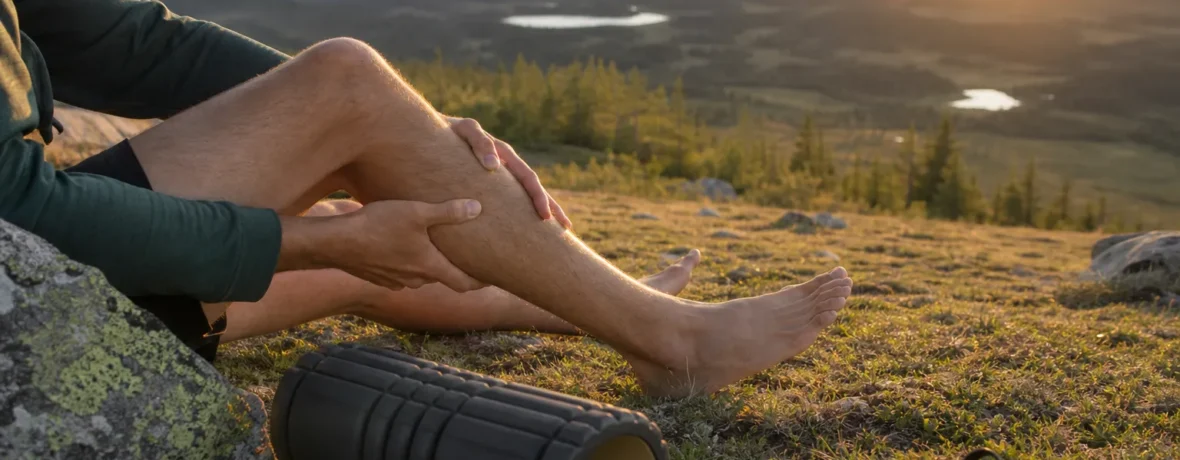
Sore legs after hiking are usually delayed onset muscle soreness, or DOMS, especially if pain starts 12-24 hours later, peaks at 24-72 hours, and fades within 5-7 days. Yes, it is usually normal after steep descents, big elevation gain, or a longer-than-usual trail—unless you have sharp pain, swelling, weakness, dark urine, fever, or symptoms that keep worsening.
Why do my legs hurt after hiking?
Your legs usually hurt because hiking loads your muscles in ways flat walking does not. Climbs hammer your calves and glutes. Descents hit your quads hard because they work while lengthening, which is called eccentric muscle action.
That downhill braking is the classic DOMS trigger. Your quadriceps slow your body with every step, especially on rocky trail, loose gravel, stairs, and switchbacks. Add a loaded pack, trekking poles you barely used, or boots with stiff soles, and your legs get a new assignment fast.
DOMS is not the same as “lactic acid sitting in your legs.” Research summarized by the National Institutes of Health describes DOMS as soreness that typically appears 12-24 hours after unfamiliar eccentric exercise, peaks between 24 and 72 hours, and fades over the next several days.
Common trail reasons include:
- Long descents: Quads brake your body over and over.
- Big step-downs: Knees and hips absorb more force than on smooth trail.
- More elevation than usual: Even 1,000-2,000 ft [305-610 m] of gain can feel spicy if you are not trained for it.
- A heavier pack: Extra weight increases the load on calves, quads, hips, and feet.
- New footwear: Different heel drop, stiffness, or cushioning changes how your muscles work.
- Pace mistakes: Charging early often turns the last downhill into a leg shredder.
Is soreness after hiking DOMS or an injury?
DOMS feels broad, dull, stiff, and muscle-based; injury pain is often sharp, focal, sudden, or one-sided. That difference matters.
With DOMS, both legs may feel wooden when you go downstairs. You may be tender when pressing the muscle. You may move like a creaky gate for a day or two. Annoying? Yes. Usually dangerous? No.
An injury acts differently. A strained calf may grab during the hike. A cranky knee may hurt on one side of the joint. A twisted ankle may swell and bruise. A stress injury may create pinpoint pain that worsens with impact.
| Sign | More like DOMS | More like injury |
|---|---|---|
| Timing | Starts 12-24 hours after hiking | Starts suddenly during the hike or after a twist/fall |
| Location | Large muscle areas: quads, calves, glutes | One small spot, joint line, tendon, bone, or one side only |
| Feeling | Dull ache, stiffness, tenderness | Sharp pain, catching, instability, swelling, bruising |
| Trend | Peaks by 24-72 hours, then improves | Worsens, limits walking, or does not improve |
How long should sore legs after hiking last?
Normal hiking soreness usually improves within 3-5 days and should be clearly fading by day 7. If you are still limping after a week, do not just grit your teeth and call it toughness.
The worst day is often not the day after the hike. Day two can be the monster. That is normal with DOMS because the soreness is delayed. If you did a steep descent on Saturday, Monday stairs may feel personal.
Expect this rough timeline:
- During the hike: muscle fatigue, burning, tired steps.
- 0-12 hours after: heavy legs, mild tightness, general fatigue.
- 12-24 hours after: DOMS starts to show up.
- 24-72 hours after: soreness usually peaks.
- 3-7 days after: stiffness fades and normal strength returns.
What helps sore hiking legs recover faster?
Gentle movement, sleep, food, fluids, and smart rest help most. You cannot hack DOMS away in one hour, but you can stop making it worse.
Use this simple recovery plan:
- Walk easy for 10-20 minutes. Keep it flat. The goal is blood flow, not training.
- Rehydrate steadily. Drink to thirst and include salty foods if you sweated hard. The Wilderness Medical Society warns that overdrinking plain water during long exertion can also be dangerous, so do not force gallons.
- Eat a real meal. Include protein for muscle repair and carbohydrates to refill energy stores. Think eggs and potatoes, rice and beans, yogurt and fruit, or a sandwich with soup.
- Use light mobility. Try ankle circles, easy calf raises, hip hinges, and gentle squats within a pain-free range.
- Try heat or a warm shower. Warmth can make stiff muscles feel less cranky. If something is swollen or freshly injured, skip heat and treat it like an injury.
- Sleep more than usual. One rough night can make soreness feel louder. Recovery is work your body does while you are offline.
- Wait on hard training. If stairs still make you wince, save hill repeats, heavy leg day, and another big descent for later.
Stretching can feel good, but do not yank on sore muscles like you are starting a lawn mower. Keep it mild. If stretching increases pain, stop. The same goes for foam rolling: light pressure, slow passes, no heroic grinding.
Should you hike again if your legs are still sore?
You can do an easy hike if your soreness is mild and your walking mechanics are normal. Skip the big climb if you are limping, compensating, or sore enough that downhill steps change your stride.
Here is a clean decision check:
- Green light: mild stiffness, no limp, pain improves as you warm up, no swelling.
- Yellow light: moderate soreness, stairs hurt, legs feel weak, balance feels off. Choose flat walking instead.
- Red light: sharp pain, swelling, bruising, joint pain, dark urine, fever, dizziness, or worsening weakness. Rest and consider medical help.
If you do hike, shorten the route, reduce pack weight, avoid steep descents, and turn around early. Pride is heavy. Leave it in the car.
How can you prevent sore legs after your next hike?
Build downhill tolerance before the trail builds it for you. The best prevention is gradual exposure to the same forces hiking demands.
Train for hiking with movements that prepare your legs for climbing, descending, and uneven ground:
- Step-downs: Slow lower from an 8-12 in [20-30 cm] step to train downhill control.
- Step-ups: Add pack weight only after bodyweight feels smooth.
- Calf raises: Use both straight-knee and bent-knee versions.
- Split squats: Great for quads, glutes, and balance.
- Loaded walks: Start with a light pack and build slowly.
- Easy hill repeats: Walk down under control instead of stomping.
Progress one thing at a time: distance, elevation, pack weight, or speed. Not all four. If your last hike was 4 miles [6.4 km] with 500 ft [152 m] of gain, jumping to 10 miles [16 km] with 2,500 ft [762 m] is how your quads file a complaint.
When to see a doctor
Get medical help if the pain is severe, unusual, one-sided, worsening, or paired with symptoms beyond normal soreness. Do not self-diagnose a serious problem as DOMS.
The Mayo Clinic recommends urgent care for muscle pain with trouble breathing, dizziness, extreme weakness, high fever with stiff neck, or a severe injury that prevents movement. For hikers, that means a bad fall, a joint that will not bear weight, or pain that comes with systemic symptoms deserves attention.
Also watch for exertional rhabdomyolysis, a rare but serious condition linked with prolonged exertion and heat stress. The CDC lists symptoms including muscle cramps or pain, weakness, exercise intolerance, and tea- or cola-colored urine, and advises immediate medical care if these appear.
Seek help fast if you notice:
- Dark brown, tea-colored, or cola-colored urine
- Severe muscle pain that feels out of proportion
- Extreme weakness or trouble doing normal activities
- Swelling that is getting worse
- Fever, confusion, fainting, or dizziness
- Calf pain with swelling, warmth, or redness
- Pain after a tick bite or a spreading rash
- Symptoms that do not improve after 7 days
Heat changes the picture. The CDC heat guidance says muscle cramping can be an early sign of heat-related illness; if you feel faint or weak, stop activity and get to a cool place.
Related reading
- How to Relieve Sore Muscles After Hiking
- What to Do After a Tick Bite: Removal and Aftercare
- Knee Pain After Hiking: Causes and Fixes
- Headache After Hiking: Common Causes
FAQ
Are sore legs after hiking normal?
Yes, sore legs are normal after a harder, longer, steeper, or more downhill-heavy hike than your body is used to. Normal soreness should feel muscular, peak within 24-72 hours, and improve over the next few days.
Why are my quads so sore after hiking downhill?
Your quads are sore because downhill hiking forces them to brake your body while lengthening. That eccentric work is one of the strongest triggers for DOMS.
Does stretching fix DOMS?
No, stretching does not instantly fix DOMS. Gentle stretching may feel good, but aggressive stretching can irritate already sore tissue.
Is it better to rest or walk with sore legs?
Light walking is often better than total couch time if the soreness is mild. Rest is the better choice if you are limping, weak, swollen, or dealing with sharp pain.
Can dehydration cause leg pain after hiking?
Yes, dehydration and heavy sweating can contribute to cramps and heavy-feeling legs. But delayed soreness that peaks a day or two later is more likely DOMS than simple dehydration.
When is leg soreness after hiking not normal?
Leg soreness is not normal if it is severe, one-sided, sharp, worsening, paired with swelling, or comes with dark urine, fever, dizziness, confusion, or extreme weakness. Those signs need medical attention rather than another recovery hack.