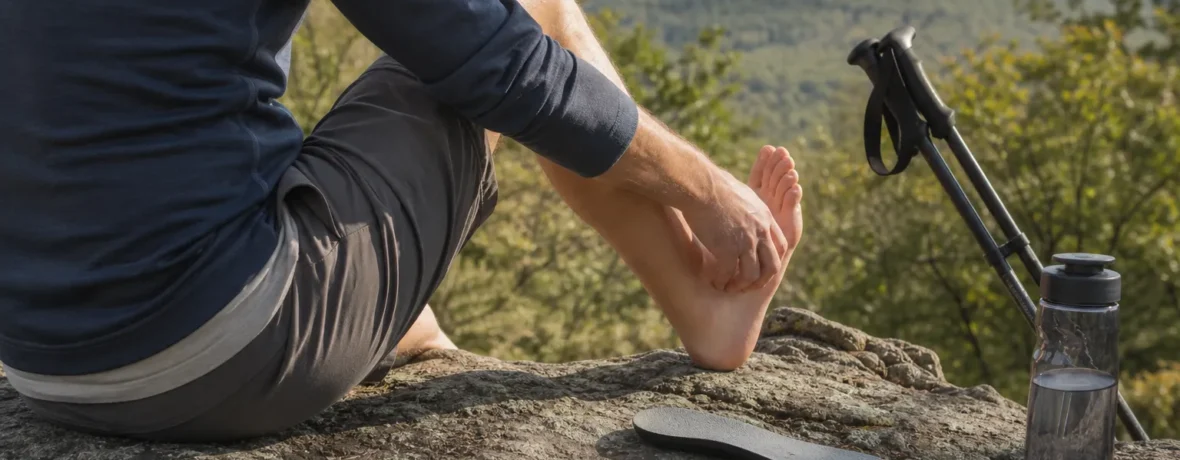
Yes, hiking with plantar fasciitis can be safe if your pain stays mild, your gait stays normal, and symptoms do not worsen during or after the hike. Start with 1-2 miles [1.6-3.2 km], choose flat trails, use supportive footwear, and stop if heel pain changes your stride.
Is plantar fasciitis hiking safe?
Yes, if you keep the load low and listen fast.
Plantar fasciitis usually feels like sharp or stabbing pain near the bottom of the heel, often worse with the first steps after sleep or sitting. That pattern matches descriptions from Mayo Clinic’s plantar fasciitis overview and MedlinePlus plantar fasciitis guidance. Hiking adds three stressors: repeated steps, uneven ground, and pack weight. If your foot is already irritated, those three can turn a pleasant loop into a limp back to the car.
The goal is not to prove toughness. The goal is to keep hiking without feeding the injury. A good trail day with plantar fasciitis is short, boring on paper, and pain-controlled. Flat tread. Soft dirt. No hero miles. No “just one more overlook” if your heel is yelling.
Use a simple traffic-light rule:
- Green: Pain is 0-2 out of 10, warms up within 10 minutes, and your stride stays normal.
- Yellow: Pain is 3-4 out of 10, returns on descents, or you start favoring one side. Turn around early.
- Red: Pain is sharp, rising, causes limping, or feels worse the next morning. Stop hiking and switch to recovery mode.
What does plantar fasciitis feel like on the trail?
It usually feels like heel or arch pain that hates the first steps and hates load.
On trail, plantar fasciitis often shows up in a few predictable ways. Your heel may jab when you step out of the car. It may settle after a few minutes, then creep back during a long downhill. You may feel a tight pulling sensation through the arch, especially when your toes bend upward on rocks, roots, or steep climbs.
That “it went away, so I’m fine” feeling can trick you. Plantar fasciitis pain may ease once the foot warms up, then flare again after harder effort. MedlinePlus notes pain can be worse in the morning, after sitting, when climbing stairs, after intense activity, and during walking or running sports.
Trail clues that your foot is done for the day:
- You shorten your stride to avoid heel strike.
- You walk on the outside edge of the foot.
- You avoid pushing off the big toe.
- Your calf tightens because your foot mechanics changed.
- The pain moves from “annoying” to “commanding.”
How do you choose hiking shoes for plantar fasciitis?
Choose stable, supportive shoes that do not fold under your arch.
For plantar fasciitis, the best hiking shoe is not always the biggest boot. You want support, cushioning, and a shape that works with your foot. A flimsy shoe can force the plantar fascia to work harder. A stiff, clunky boot can rub your heel and change your stride. Both can backfire.
| Footwear option | Best for | Watch out for |
|---|---|---|
| Supportive trail runners | Day hikes, groomed trails, lighter packs | Too much flexibility through the midfoot |
| Light hiking shoes | Rocky paths, moderate support, mixed terrain | Narrow toe boxes that cramp your forefoot |
| Mid-height hiking boots | Loose surfaces, heavier packs, ankle support preference | Heel rubbing and extra weight |
| Minimalist shoes | Only if already adapted and pain-free | Low cushioning and high fascia demand |
Before you buy, do the bend test. Hold the shoe at the heel and toe. It should flex at the forefoot, not collapse in the middle. Twist it gently. A little torsion is fine. A wet-noodle twist is a bad sign for a sore arch.
Fit matters just as much. Leave enough room for toes to spread on descents. Lock the heel with lacing, not by sizing down. If your heel slides, you will grip with your toes and irritate the whole chain from arch to calf.
Do insoles or orthotics help with plantar fasciitis hiking?
They can help if they reduce strain and fit your shoe correctly.
Over-the-counter insoles, heel cups, and custom orthotics can spread pressure more evenly under the foot. Mayo Clinic lists shoe modifications, heel cups, and orthotics among conservative options, and MedlinePlus also points to supportive, cushioned shoes as a common first step.
But do not shove a bulky insole into a low-volume shoe and call it fixed. If the insert lifts your heel too high, jams your toes, or creates arch pressure that feels bruising, it is not helping. Try inserts on a short walk before a hike. Then try them on stairs. Then try them on a 1-mile [1.6-km] easy trail. Earn the longer day.
Good signs:
- Your heel feels more cushioned without feeling unstable.
- Your arch feels supported, not poked.
- Your toes still have space.
- Your stride feels natural after 10 minutes.
Bad signs:
- Numbness, tingling, or burning.
- New knee, hip, or back pain.
- Hot spots under the arch.
- Heel slipping because the insert changed shoe volume.
How should you stretch before hiking with plantar fasciitis?
Warm up first, then stretch gently.
Cold, aggressive stretching right out of the car can irritate an already grumpy foot. Start with easy movement. Walk slowly for 5 minutes on flat ground. Then do gentle mobility work for the calf, Achilles tendon, and plantar fascia.
The NIH Bookshelf guide to plantar fasciitis exercises describes plantar fascia and calf-focused exercises as part of standard care. Keep the trail version simple and controlled.
- Easy walk: Walk 5 minutes on flat ground before the climb starts.
- Calf stretch: Face a tree or car, step one foot back, keep the heel down, and hold a gentle stretch for 20-30 seconds.
- Bent-knee calf stretch: From the same position, bend the back knee slightly to target the lower calf and Achilles area.
- Plantar fascia stretch: Sit down, cross the sore foot over the other leg, and gently pull the toes toward the shin until the arch tightens.
- Toe raises: Stand tall, lift the toes while keeping the heels down, then relax. Repeat slowly.
Stretching should feel like tension, not a knife. If a stretch causes sharp heel pain, back off. You are preparing the foot for hiking, not trying to win a flexibility contest in the parking lot.
How far can you hike with plantar fasciitis?
Hike only as far as you can without limping or worsening symptoms the next day.
There is no magic mileage. Your safe distance depends on your pain level, terrain, footwear, pack weight, and how long symptoms have been hanging around. A smart starting point is 1-2 miles [1.6-3.2 km] on flat terrain with an easy exit. If your pain stays mild during the hike and the next morning is no worse, add distance slowly.
Use this progression:
- Week 1: Flat walks or hikes of 1-2 miles [1.6-3.2 km]. No pack or a very light pack.
- Week 2: Add 0.5-1 mile [0.8-1.6 km] only if symptoms stay stable.
- Week 3: Add mild elevation, not distance and elevation at the same time.
- Week 4: Add pack weight gradually, starting with day-hike essentials only.
Do not increase distance, elevation gain, speed, and pack weight in the same week. Pick one. The plantar fascia likes gradual change. It hates surprises.
What trail terrain is best for plantar fasciitis?
Flat, smooth dirt is your friend.
Choose trails that let you walk naturally. Soft dirt paths, rail trails, meadow loops, and smooth forest roads are better than steep, rocky, off-camber routes. Descents are often worse than climbs because they load the heel and stretch the sole of the foot with every braking step.
Best choices:
- Loop trails with bailout points.
- Out-and-back routes where you can turn around anytime.
- Gentle grades under sustained steep climbs.
- Firm dirt instead of talus, scree, or deep sand.
- Short hikes near home while symptoms are active.
Skip these until the foot calms down:
- Long downhill returns.
- Rock-hopping creek routes.
- Beach hikes in soft sand.
- Heavy backpacking trips.
- Fast group hikes where you cannot control pace.
How do trekking poles help plantar fasciitis?
Trekking poles can reduce impact and help you control descents.
Poles will not cure plantar fasciitis, but they can make a hike less punishing. Use them to share load through your arms, steady your balance, and shorten the braking force on downhill steps. They also help you avoid awkward foot placements when the trail is rocky or wet.
Set pole length so your elbow sits near a right angle on flat ground. Shorten the poles slightly for climbs. Lengthen them slightly for descents. On downhills, plant the poles before you step down, then move with control. Quiet feet. Short steps. No pounding.
If poles make you hike faster, they are not helping. Their job is to slow the chaos.
What should you pack for hiking with plantar fasciitis?
Pack light, but bring foot-care tools.
Every extra pound [0.45 kg] rides through your feet. Keep the pack lean while still carrying the basics for safety. Then add a small foot-care kit. Plantar fasciitis can change your stride, and a changed stride can create hot spots.
- Supportive hiking shoes already tested on shorter walks.
- Spare socks in a dry bag.
- Blister pads or moleskin.
- Medical tape that sticks to your skin.
- A small ball or rounded bottle for gentle rolling at camp or after the hike.
- Lightweight sandals or camp shoes for post-hike relief.
- Trekking poles.
- A turnaround plan.
The Wilderness Medical Society wound management guidance discusses blister prevention through proper footwear and keeping feet dry. That matters here because heel pain can make you land differently, which can make friction worse.
What should you do if heel pain starts during a hike?
Stop early and fix the problem before it owns the day.
Do not wait until lunch. Do not wait until the summit. Heel pain is easier to calm at a 2 out of 10 than at a 7 out of 10.
- Stop walking. Find a safe spot off the trail.
- Check your shoe. Look for a folded sock, loose insole, pebble, or heel slip.
- Shorten the route. Turn around if pain is rising.
- Use poles. Slow down, shorten your stride, and reduce downhill impact.
- Change socks if needed. Dry socks reduce friction.
- Protect hot spots. Cover rubbing areas before they become blisters.
- Stop if you limp. Limping can create knee, hip, and back problems.
The CDC’s guidance on pain during and after exercise recommends adjusting activity when pain increases and seeking medical advice for pain that is severe or does not improve. Trail translation: pain is data. Use it early.
Can you backpack with plantar fasciitis?
Maybe, but only after day hikes are symptom-stable.
Backpacking adds weight, fatigue, rough camps, and back-to-back hiking days. That is a big jump from a day hike. If your heel hurts after a 3-mile [4.8-km] loop, a loaded overnight is not the next step.
Before backpacking, you should be able to:
- Hike your target daily distance without limping.
- Wake up the next morning without increased heel pain.
- Carry a light day pack with no symptom spike.
- Descend comfortably on moderate grades.
- Manage hot spots before they turn into blisters.
When you return to backpacking, cut the first trip down. One night. Low mileage. Easy exit. Light food load. No dry camp that forces extra water carry unless you are already confident your foot can handle it.
When to see a doctor
See a clinician if pain persists, worsens, or changes how you walk.
Plantar fasciitis is common, but heel pain is not always plantar fasciitis. Stress fractures, nerve irritation, tendon problems, and other conditions can feel similar on trail. A health professional can examine your foot and help decide whether imaging, physical therapy, orthotics, or another treatment path makes sense.
Get medical care sooner if you have:
- Heel pain after a fall, twist, or sudden pop.
- Swelling, redness, warmth, or fever.
- Numbness, tingling, or weakness.
- Pain that makes you limp.
- Pain that does not improve after reducing hiking load.
- Diabetes, circulation problems, neuropathy, or immune system concerns.
MedlinePlus says treatment can last from several months to 2 years before symptoms improve, and many people feel better within 6 to 18 months. That does not mean you should ignore it for months. It means patience and load management matter.
How do you return to hiking after plantar fasciitis?
Return in layers: pain control, strength, distance, hills, then weight.
Most hikers rush the last two. They feel decent on flat ground, then add a loaded pack and a steep descent. The heel protests. Back to square one.
Use this cleaner order:
- Calm symptoms. Daily walking should be comfortable before trail hiking returns.
- Build foot and calf capacity. Use clinician-approved stretching and strengthening.
- Add easy trail distance. Start flat and short.
- Add uneven terrain. Rocks and roots come after smooth dirt.
- Add elevation. Climb and descend in small doses.
- Add pack weight. Increase load only after distance and hills feel stable.
Your next-morning test is gold. If the first steps out of bed are worse than usual, the previous hike was too much. Drop the next hike shorter or flatter. If the next morning feels the same or better, you likely chose well.
Related reading
- Best Hiking Shoes for Plantar Fasciitis
- Lyme Disease Symptoms After a Hike
- Hantavirus and Camping: Cabins, Shelters and Risk
- Electrolytes for Hikers: What They Are and How Much You Need
FAQ
Should I hike through plantar fasciitis pain?
No, not if the pain changes your stride or gets worse as you go. Mild discomfort that stays steady may be manageable, but sharp or rising heel pain is a sign to stop or turn around.
Are boots or trail runners better for plantar fasciitis?
The better choice is the one that supports your arch and heel without causing rubbing. Many hikers do well in supportive trail runners for light day hikes, while others need the structure of a hiking shoe or boot.
Does stretching cure plantar fasciitis?
Stretching can help symptoms, but it is not a guaranteed cure. Pair gentle stretching with load management, supportive footwear, gradual mileage, and medical guidance if pain keeps returning.
Can hiking make plantar fasciitis worse?
Yes, hiking can make it worse if you increase mileage, elevation, speed, or pack weight too quickly. Steep descents, hard surfaces, and unsupportive shoes are common flare triggers.
How long should I rest from hiking with plantar fasciitis?
Rest until normal walking does not make symptoms worse, then restart with short, flat hikes. If pain returns quickly or feels worse the next morning, reduce distance and get medical advice.
What is the best quick fix on trail?
The best quick fix is to stop, adjust footwear, shorten your route, and use trekking poles. If you are limping, the hike is over for the day.