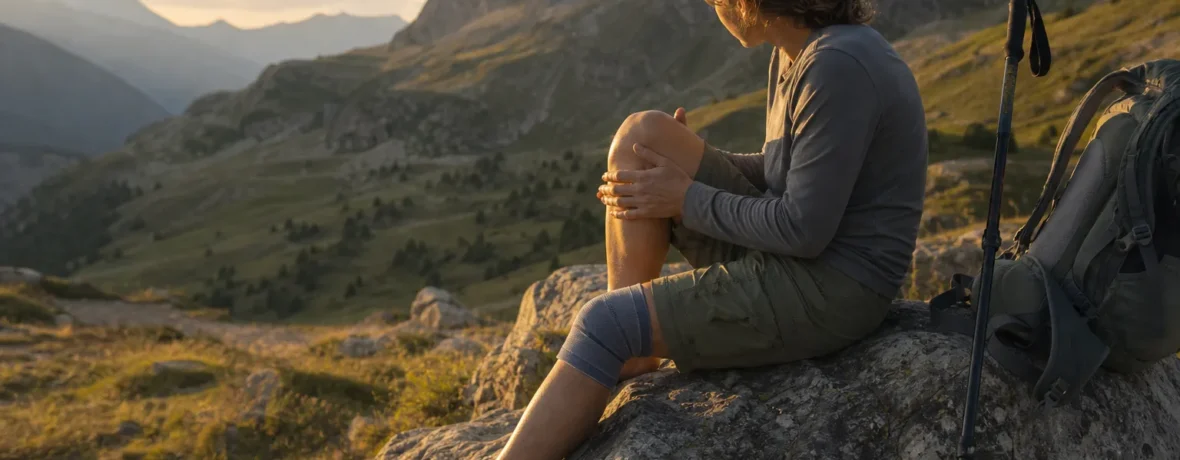
Knee pain after hiking is usually from downhill braking, overuse, poor load control, weak hips or quads, irritated tendons, or an old injury flaring up. Mild soreness should improve within 24 to 72 hours with rest and smart care. Sharp pain, swelling, locking, fever, or trouble bearing weight needs medical help.
Why do I get knee pain after hiking?
Your knee is telling you the trail asked for more than your tissues were ready to handle.
That does not mean you are broken. It means something in the system took a beating: the kneecap, tendons, cartilage, ligaments, surrounding muscles, or even the way your hip and foot are steering each step.
Common hiking triggers include:
- Too much downhill: Descents turn your legs into brakes. Your quads work hard while lengthening, and that can irritate the front of the knee.
- Big mileage jumps: A 4-mile [6.4-km] weekday walk does not fully prepare your knees for a 12-mile [19.3-km] mountain day.
- Heavy pack weight: More load means more force through every step, especially on rock, stairs, and steep grades.
- Weak hips or tired glutes: When your hips stop controlling the leg, the knee often caves inward or twists slightly.
- Stiff ankles or limited mobility: If your ankle cannot move well, the knee may compensate.
- Worn shoes or poor traction: Slipping makes your knee work harder to stabilize you.
- Old injuries or arthritis: Prior knee trauma and overuse can make flare-ups more likely, according to MedlinePlus guidance on knee pain.
Why is knee pain hiking downhill so common?
Downhill hiking hurts because every step is a controlled fall.
On the climb, your muscles push you up. On the descent, they slow you down. That braking job falls heavily on the quadriceps, patellar tendon, and structures around the kneecap. Add loose gravel, stone steps, switchbacks, or a pack that pulls you backward, and the knee gets hammered from awkward angles.
If your pain shows up mostly on descents, look first at stride length. Long downhill steps are knee crushers. They put your foot far in front of your body, slam on the brakes, and ask one leg to absorb the load. Shorter steps keep your center of mass closer to your feet.
Try this on your next descent:
- Shorten your stride. Take quick, quiet steps instead of long lunges.
- Keep a soft knee. Do not lock the joint at heel strike.
- Lean slightly from the ankles. Stay balanced over your feet instead of leaning back.
- Use trekking poles. Plant them before stepping down to share load and improve balance.
- Zigzag when safe. Gentle switchbacking reduces the direct braking force on steep trail.
What kind of knee pain after hiking do I have?
The location of pain can give you clues, but it cannot give you a diagnosis.
Use this table to decide what to adjust first, then get checked if pain is severe, persistent, or changing how you walk.
| Pain location | Common hiking pattern | Smart first fix |
|---|---|---|
| Front of knee or around kneecap | Worse downhill, stairs, squatting, or after sitting | Shorten downhill steps, strengthen quads and hips, reduce steep descents |
| Outside of knee | Shows up after miles of downhill or cambered trail | Check stride, hip strength, shoe wear, and trail surface |
| Inside of knee | May flare with twisting, uneven ground, or poor foot placement | Slow down on technical trail and avoid knee collapse inward |
| Back of knee | Tightness, swelling, or discomfort after long mileage | Back off intensity and get medical advice if swelling or calf symptoms appear |
How do I fix sore knees after a hike?
Start with unloading, cooling, gentle movement, and a short break from painful terrain.
For mild pain that does not involve a fall, deformity, fever, or major swelling, use a simple 72-hour reset:
- Stop poking the bear for 1 to 3 days. Skip steep hikes, running, jumping, and deep squats while symptoms calm down.
- Use ice for short sessions. MedlinePlus suggests applying ice up to 15 minutes at a time and protecting your skin with a towel.
- Elevate if swollen. Put the knee above heart level when you can.
- Use light compression if it helps. A sleeve or elastic wrap can reduce swelling and give support, but it should not cause numbness, tingling, or color change.
- Walk easy on flat ground. If normal walking feels fine, short flat walks can keep things from stiffening up.
- Return gradually. Your next hike should be shorter, flatter, and lighter than the one that caused pain.
Do not use pain medication to force a bad knee through a big route. Pain is data. Covering it up can lead you deeper into trouble, especially in the backcountry.
What trail changes prevent knee pain on the next hike?
The fastest trail fix is to reduce braking force.
That means shorter steps, less pack weight, better pacing, and smarter route choice. You do not need to baby your knees forever. You do need to stop treating every descent like a race.
- Choose routes with gentler descents while symptoms are calming down.
- Cut pack weight. Remove duplicate layers, excess water for well-sourced routes, and “just in case” clutter you never use.
- Use poles correctly. Lengthen them slightly for descents and plant them ahead of your feet.
- Step down, don’t drop down. On rock steps, lower yourself with control instead of hopping.
- Take breaks before your legs are cooked. Tired quads stop absorbing shock well.
- Replace worn footwear. Flattened midsoles and chewed-up tread make descents sloppier.
Which exercises help stop knee pain after hiking?
Strengthen the muscles that control the knee before the trail exposes the weak links.
You want strong quads, glutes, hamstrings, calves, and hips. Keep the moves controlled. No grinding through sharp pain.
- Step-downs: Stand on a low step, lower one heel toward the floor, then come back up. Keep the knee tracking over the middle toes.
- Wall sits: Hold a shallow squat against a wall. Start with 20 to 30 seconds.
- Glute bridges: Lie on your back, knees bent, and lift your hips. Squeeze the glutes at the top.
- Side steps with a band: Keep tension on the band and take slow steps sideways to train hip control.
- Calf raises: Rise onto your toes, pause, and lower slowly. Strong calves help manage descents.
- Single-leg balance: Stand on one foot for 30 seconds. Add uneven ground only after you are steady.
Build gradually. The Physical Activity Guidelines for Americans recommend increasing activity over time to reduce injury risk. That rule fits hiking perfectly: add mileage, elevation, or pack weight one at a time, not all three in one heroic weekend.
Should I wear a knee brace for hiking?
A brace can help some hikers feel more supported, but it is not a fix by itself.
A simple compression sleeve may help mild swelling or give feedback that keeps you moving cleaner. A hinged brace may be useful for some people with instability, but that is a conversation for a clinician. If you need a brace just to finish ordinary hikes, your knee deserves a proper assessment.
Think of braces as support, not permission. If pain climbs during the hike, your plan is not working.
When to see a doctor
Get medical help fast if your knee has red-flag symptoms.
The Mayo Clinic knee pain symptom guidance lists warning signs such as severe pain after injury, visible deformity, sudden swelling or redness, inability to bend the knee or bear weight, a popping or snapping sensation, or pain with fever and chills.
Also make an appointment if pain continues after several days of home care, keeps returning after hikes, changes your gait, or comes with locking, catching, buckling, or swelling. MedlinePlus advises contacting a health care provider if knee pain follows an accident or injury, or if pain remains after 3 days of home treatment.
If you have known osteoarthritis, recurring injuries, or a past knee surgery, get personalized advice before stacking big downhill days. The National Institute of Arthritis and Musculoskeletal and Skin Diseases notes that knee osteoarthritis can involve pain, swelling, stiffness, reduced motion, and a feeling that the joint is unstable.
In remote terrain, treat a knee injury conservatively. The Wilderness Medical Society acute pain guideline update supports protection, rest, ice, compression, and elevation for many acute musculoskeletal injuries when you cannot clearly tell whether the problem is soft tissue injury or something more serious.
Can I hike with knee pain?
Yes, if it is mild, improving, and does not change your stride.
Use the “next-day rule.” If a short, easy hike leaves you worse that evening or the next morning, you did too much. Back off. Try flatter trails, lighter loads, and shorter mileage until your knee is calm for multiple hikes in a row.
Do not hike through:
- Sharp or worsening pain
- Swelling that increases as you walk
- Locking, catching, or giving way
- Pain that makes you limp
- Numbness, tingling, fever, redness, or warmth
- Pain after a fall or twist that does not settle quickly
Related reading
- Hip Pain After Hiking: Causes and Fixes
- Runner's Knee in Hikers: Causes and Fixes
- Can Dehydration Cause Chest Pain?
- What to Do After a Tick Bite: Removal and Aftercare
FAQ
Why do my knees hurt after hiking but not during?
Delayed soreness often shows up after your body cools down. Downhill braking, long mileage, and tired stabilizing muscles can irritate tissues that feel manageable on trail but stiffen later.
Is downhill hiking bad for knees?
Downhill hiking is not automatically bad, but it is harder on the knees than many hikers expect. Short steps, trekking poles, lighter pack weight, and stronger quads and hips make descents much kinder.
How long should knee pain after hiking last?
Mild soreness should usually improve within 24 to 72 hours. If pain is still strong after 3 days of home care, keeps coming back, or affects walking, contact a health care provider.
Do trekking poles really help knee pain?
Yes, trekking poles can help by improving balance and sharing some load with your upper body. They work best when you plant them before each downhill step and keep your stride short.
Should I stretch or strengthen for hiking knee pain?
Do both, but prioritize strength if pain keeps returning. Gentle mobility can reduce stiffness, while stronger quads, glutes, calves, and hips help control the knee under real trail loads.
What is the fastest fix for knee pain on trail?
Slow down, shorten your steps, use poles, and reduce downhill pounding immediately. If pain gets sharper, swelling appears, or you start limping, turn around or plan the safest exit.