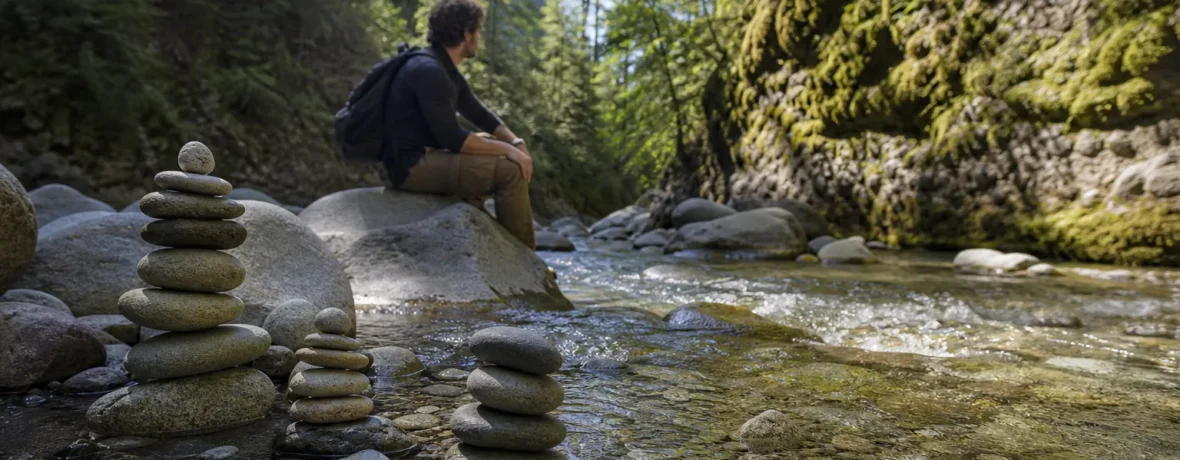
People stack rocks for four main reasons: trail marking, photos, meditation, and “leaving a mark.” Yes, some cairns are useful when land managers build them. But if you are making your own stack on a hike, the right move is simple: don’t. It can mislead hikers, disturb habitat, and damage the wild feel of a place.
Why do people stack rocks on hikes?
People stack rocks because it feels meaningful, playful, or helpful.
That’s the honest answer. A little tower of stone can feel like a tiny sculpture. It can look good in a photo. It can seem meditative. It can also feel like a friendly signal to the next hiker: “I was here. You’re on the right track.”
That last part is where the trouble starts.
Rock stacks, also called cairns, have a real job in some places. On slickrock, alpine slabs, lava fields, beaches, deserts, and faint routes where a dirt tread disappears, official cairns can keep hikers from wandering. The National Park Service explains that cairns are often used to mark hiking routes, and that some parks maintain them carefully.
But a random stack is not the same thing as a trail marker. It is decoration pretending to be information. That’s a bad mix in the backcountry.
Ask yourself this: if a tired hiker sees your stack at dusk, will it help them make a safe choice? Or will it pull them off-route because it looks official enough?
That’s why this column takes a hard line. Build your art at home. Leave the wild rocks where they are.
Is stacking rocks bad for the environment?
Yes, stacking rocks can damage small habitats and increase erosion.
A rock is not just a rock. It can be shade, shelter, moisture, a windbreak, a seed trap, or the roof of something’s house. Lift it and you may expose insects, eggs, roots, lichens, mosses, salamanders, snails, or soil crust that took years to settle in.
In streams, the problem gets even sharper. The NPS warns that removing rocks from waterways can alter streamflow and displace aquatic life such as mayflies and stoneflies in its Glacier National Park Leave No Trace guidance. That is not poetic exaggeration. Stream rocks are structure. They create pockets of current, oxygen, cover, and feeding surfaces.
The U.S. Geological Survey describes stream macroinvertebrates as animals that often live on bottom substrates such as rocks and woody debris. Move enough rocks, and you are rearranging more than scenery.
On dry land, repeated rock moving can loosen soil and make the ground more vulnerable to erosion. In desert country, it can break biological soil crust or expose darker, cooler soil to heat and wind. In alpine zones, where plants grow slowly and the season is short, disturbance can last longer than your memory of the photo.
| Rock stack type | Who made it | What you should do |
|---|---|---|
| Official trail cairn | Park staff, trail crew, or land manager | Leave it alone. Do not add rocks. |
| Random decorative stack | Visitor | Do not copy it. Check local guidance before dismantling. |
| Stream rock tower | Visitor | Do not build one. Leave stream rocks in place. |
| Emergency marker | Someone signaling a specific need | Assess the situation, then report concerns to a ranger or local authority. |
Are rock cairns illegal?
Sometimes, yes, but the rule depends on the land manager and the location.
There is no single rule for every trail in the United States. A national park, state park, city open space, wilderness area, national forest, tribal land, and private preserve may all handle cairns differently. Some routes depend on official cairns. Some places prohibit visitor-built stacks. Some simply ask hikers not to move natural objects.
As of November 2026, the National Park Service says every park has different rules and tells visitors to check the specific park’s website before relying on cairns or building anything. The same NPS page says not to tamper with cairns, not to build your own, and not to add to existing ones.
Arches National Park gives the same practical advice in its Leave No Trace guidance: cairns mark routes in the park, and visitors should not change existing cairns or build new ones because that can confuse and mislead other hikers.
So don’t play lawyer on the trail. If you did not place that cairn as part of an authorized trail crew, it is not yours to improve.
What is the difference between cairns and stacked rocks?
A cairn is a rock stack with a purpose; a decorative rock stack is usually just a trace left behind.
The word “cairn” gets tossed around for any pile of rocks, but hikers should make a sharper distinction. An official cairn is a navigation tool. It is placed in a specific spot, shaped to be visible, and maintained as part of a route. A random stack is personal expression.
That difference matters. If you add a stone to an official cairn because “bigger is better,” you may make it unstable. If you build a new one nearby, you may create a false route. If you knock down a real one because you think all rock stacks are bad, you may remove the very marker another hiker needs.
This is where humility helps. You may not know the local system. In Acadia, for example, some trails use distinctive Bates cairns. In desert parks, cairns may guide hikers across rock where footsteps leave little sign. In other parks, cairns may not be used at all.
The rule is not “kick every stack over.” The rule is “don’t make yourself the trail crew.”
Why do rock stacks bother other hikers?
Rock stacks bother other hikers because they turn wild places into message boards.
You may see one cute tower. The next person sees 40. Then 80. Then a whole creekbed stripped for Instagram shrines. What felt harmless at one scale becomes visual clutter at another.
Most hikers head outside to get away from human noise. Not just engine noise and phone noise. Human insistence. Names carved into trees. Painted rocks. Stick forts. Fire rings in the wrong place. Cairns on every boulder. Tiny proof that someone couldn’t pass through without editing the scene.
That is the deeper problem. Rock stacking says, “This place needed my touch.” Often, it didn’t.
Take the photo without moving the rocks. Sit beside the creek without rearranging it. Let the place be older, stranger, and less obedient than your feed.
What should you do if you see stacked rocks on a trail?
Leave official cairns alone and resist building new ones.
What you do next depends on where you are. In a national park or on a marked route, don’t dismantle cairns unless a ranger or sign specifically tells you to. You could remove a needed marker. In a fragile stream, desert, alpine, or archaeological area, don’t start “fixing” the whole landscape either. Good intentions can still cause damage.
Use this simple trail judgment:
- Look for context. Are you on a faint route, slickrock, lava, snow-free alpine slab, or signed cairn route?
- Check the map. If the stack lines up with the official route, treat it as possible navigation and leave it.
- Do not add rocks. Bigger does not mean better. Stable, intentional markers can collapse when visitors pile on.
- Do not build a new stack. Your helpful marker may send someone the wrong way.
- Report confusing areas. If false cairns are sending people off trail, tell a ranger, land manager, or trail organization.
When in doubt, do less. That advice works in more wild places than people want to admit.
How can hikers follow Leave No Trace with rocks?
Keep rocks where you found them.
That’s the clean version of Leave No Trace here. The Leave No Trace principle “Leave What You Find” asks hikers to preserve natural and cultural objects, not rearrange them for decoration. The Leave No Trace Center’s cairn guidance also tells hikers not to build unauthorized cairns and not to alter existing ones.
Here’s the field checklist:
- Do not build decorative rock stacks.
- Do not add to official cairns.
- Do not remove rocks from streams, shorelines, ruins, walls, or fragile soil.
- Do not paint, carve, scratch, or chalk rocks.
- Do not use rocks to spell names, arrows, hearts, or messages.
- Do take photos of natural patterns, shadows, textures, and unaltered scenes.
The best outdoor ethic is not complicated. Pass through cleanly. Let the next person meet the place on its own terms, not yours.
What should you do instead of stacking rocks?
Make memories without moving the landscape.
You still get to be creative outside. You just don’t need to leave the evidence behind.
- Sketch the scene in a notebook.
- Take a photo of natural rock patterns.
- Practice route-finding with a map and compass.
- Sit still for 5 minutes and watch what moves.
- Pick up litter instead of building something.
- Teach kids to notice lichens, insects, tracks, and shade pockets without touching them.
If you want to stack rocks, do it in your yard, on a desk, or in a place where the rocks are already landscaping material. Wild land is not a craft table.
Related reading
- Why Do People Climb Mountains?
- Why Do People Walk the Camino?
- Why Do People Hike? What Hikers Say
- Why National Parks Matter
FAQ
Why do people stack rocks in rivers?
People stack rocks in rivers for photos, play, meditation, or art. The problem is that stream rocks provide habitat and structure, so moving them can disturb aquatic insects and change small flow patterns.
Should I knock down rock stacks when hiking?
Usually, no. You may not know whether a cairn is official, so leave trail markers alone and report confusing or excessive stacks to the land manager.
Are cairns always bad?
No. Official cairns can be valuable trail markers in places where the route is hard to follow, such as slickrock, lava, talus, or alpine terrain.
Can I add one rock to an existing cairn?
No. Adding rocks can make an official cairn unstable or change its intended shape, and adding to a random stack encourages more stacking.
Why is rock stacking against Leave No Trace?
Rock stacking conflicts with Leave No Trace because it moves natural objects and leaves visible human impact. It can also confuse navigation, disturb habitat, and make wild places feel less wild.
What is the best rule for hikers?
If you didn’t find the rock stacked by an official trail crew, don’t stack it yourself. Leave rocks, cairns, streams, and fragile ground exactly as you found them.