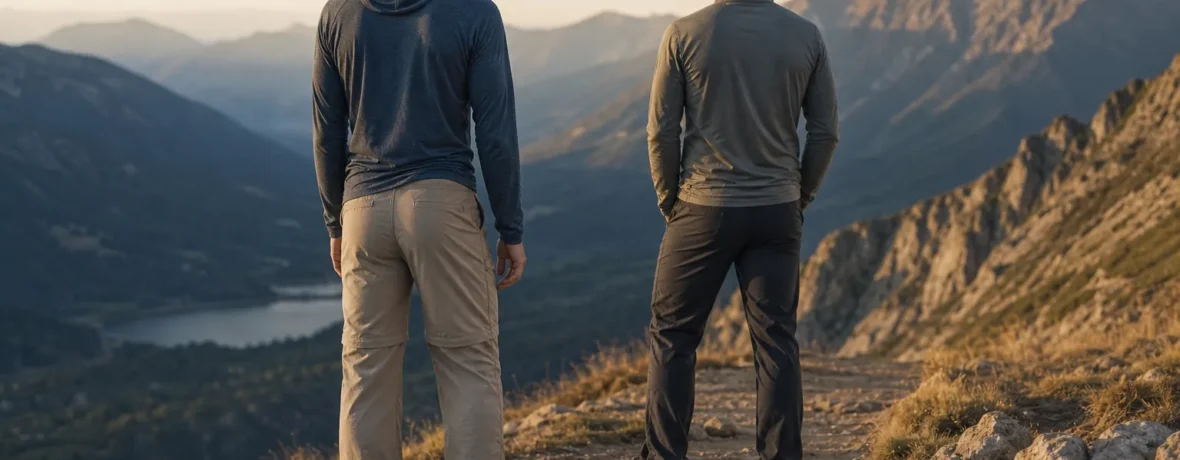
What pants should men hike in? Most men should hike in lightweight nylon or polyester hiking pants with 2-way or 4-way stretch, a gusseted crotch, UPF-rated fabric, and a slim-but-not-tight fit. Choose 6-8 oz pants for hot trails, softshell pants for cold wind, and rain pants when storms are likely.
What pants should men hike in for most trails?
Wear synthetic hiking pants that move, dry fast, and protect your legs.
For the average day hike, weekend backpacking trip, or mountain trail, the best men’s hiking pants are not jeans, not gym joggers, and not heavy canvas work pants. You want trail pants made from nylon or polyester, usually with a little spandex or elastane for stretch. That mix gives you the three things that matter on foot: durability, quick drying, and freedom of movement.
A solid all-around pair usually has a fabric weight in the middle range, enough structure to handle granite, brush, and sitting on rough logs, but not so heavy that your legs cook on a climb. If the label says “softshell,” expect more wind resistance and warmth. If it says “trail,” “trekking,” or “convertible,” expect lighter fabric and better warm-weather comfort.
Fit matters more than most guys think. Pants that are too baggy flap in wind, snag on branches, and bunch under a hip belt. Pants that are too tight bind when you step over blowdowns or climb steep switchbacks. Aim for room through the thighs, a waistband that does not dig under your pack, and cuffs that sit cleanly over your hiking shoes or boots.
Are jeans okay for hiking?
No, jeans are a poor choice for most hikes.
Denim is tough, but toughness alone does not make a good hiking pant. Cotton denim absorbs sweat and rain, dries slowly, and gets cold when the temperature drops. Wet jeans also rub hard against your skin, especially at the thighs, knees, and waistband. That is how a mellow hike turns into a chafing march.
The National Park Service tells hikers to choose moisture-wicking clothing and avoid cotton because it retains water, especially when dressing for changing conditions. You can read the advice in the Great Smoky Mountains National Park hiking safety guide.
There are exceptions. A flat, dry, 1-mile [1.6 km] nature trail near town? Jeans will not ruin your day. But for real trail miles, elevation gain, rain, heat, cold mornings, creek crossings, or backpacking, leave denim at home.
What fabric is best for men’s hiking pants?
Nylon is usually the best all-around fabric for hiking pants.
Nylon handles abrasion better than most lightweight polyester. That helps when you brush against rock, kneel on dirt, slide over a log, or push through scrub oak. Polyester still works well, especially in hot-weather pants, and it often feels softer against the skin. Many good hiking pants blend nylon, polyester, and spandex to balance durability, comfort, and stretch.
Look for these fabric traits before you buy:
- Nylon or polyester main fabric: better drying and trail durability than cotton.
- Spandex or elastane: 3-12% stretch is common in hiking pants and helps with big steps.
- DWR finish: a durable water repellent treatment sheds light rain, dew, and splashes.
- UPF rating: useful for desert trails, alpine routes, and long days above treeline.
- Ripstop weave: helps limit tearing if you scrape rock or snag a branch.
Do not overbuy stiffness. Pants that feel bombproof in the store can feel miserable after 8 miles [13 km]. If you hike mostly on maintained trails, a lighter nylon blend is usually better than burly expedition fabric.
Should hiking pants be loose or tight?
Hiking pants should fit close enough to avoid snagging, but loose enough for full stride.
The sweet spot is athletic, not skinny. You should be able to squat, kneel, climb a high step, and sit on the ground without the fabric pulling across your thighs or seat. Try that before you cut the tags. If you feel tension at the crotch or knees in your living room, the pants will feel worse on trail.
The waistband needs special attention. A belt loop system is fine, but a low-profile integrated belt or elastic side panels can feel better under a backpack hip belt. Big belt buckles and thick waist seams create pressure points after a few hours.
For inseam, avoid cuffs that drag under your heel. Too-long pants collect mud, catch on heel lugs, and fray fast. Too-short pants expose your ankles to sun, ticks, brush, and scree. With hiking shoes, the hem should touch the top of the shoe and break lightly. With boots, it should cover the boot collar without dragging.
Are convertible hiking pants worth it?
Convertible hiking pants are worth it if your hikes swing from chilly mornings to hot afternoons.
Zip-off legs give you pants and shorts in one piece. That is useful for spring desert hikes, shoulder-season backpacking, travel, and routes with big temperature changes. Start in full pants at 45°F [7°C], zip down when the sun hits, and zip the legs back on when wind or bugs show up.
The tradeoff is comfort. The zipper can rub some hikers above the knee, and the leg opening often looks baggier than regular hiking pants. Also, if you zip the legs off and stuff them loose in your pack, they are easy to misplace. Use the same pocket every time.
Convertible pants make the most sense when you care more about function than clean style. If you already carry hiking shorts and rain pants, you may not need them.
| Pant type | Best for | Main drawback |
|---|---|---|
| Standard hiking pants | Most day hikes and backpacking trips | Less ventilation than shorts |
| Convertible pants | Variable weather and travel | Zippers can rub or feel bulky |
| Softshell pants | Cold, windy, rocky trails | Too warm for summer hiking |
| Rain pants | Wet, windy, exposed routes | Can feel clammy during hard climbs |
Are joggers good for hiking?
Some joggers are fine for easy hikes, but most are not ideal for rugged trails.
Trail joggers made from nylon or polyester can work well if they have stretch, secure pockets, and cuffs that do not ride up. They feel comfortable, move well, and pack small. For mellow forest trails or dry summer hikes, they can be a good pick.
Cotton sweatpants are a different story. They soak up sweat, sag when wet, and dry slowly. Fleece joggers can be cozy around camp, but they are usually too warm for steady uphill hiking and can snag on brush. Thin running joggers may also shred fast if you sit on rock or push through rough vegetation.
If you like joggers, choose a hiking-specific pair with a smooth synthetic face, zippered pockets, and enough ankle coverage to keep grit out. Skip anything that feels like lounge wear.
What pants should men wear hiking in hot weather?
Wear lightweight, breathable, light-colored hiking pants or shorts with sun protection.
Hot-weather hiking is a balancing act. Shorts feel breezy, but pants block sun, brush, bugs, and grit. For desert, alpine, and exposed summer trails, lightweight pants often beat shorts because they reduce direct sun on your skin while still allowing airflow.
The CDC recommends loose, lightweight, light-colored clothing during extreme heat. See the CDC guidance on heat and outdoor activity for heat-safety basics that also apply to long, exposed hikes.
For hot trails, look for:
- Thin nylon or polyester fabric in the 4-7 oz range.
- Light colors such as tan, gray, khaki, or pale green.
- Mesh-lined pockets or thigh vents.
- A relaxed fit through the thighs for airflow.
- UPF-rated fabric for long sun exposure.
Dark pants can still work if they are thin and breathable, but they absorb more heat in direct sun. In humid heat, ventilation matters more than almost anything. If the pants feel like a plastic bag when you climb stairs at home, they will feel worse on a muggy trail.
What pants should men wear hiking in cold weather?
Wear softshell pants or hiking pants layered over a synthetic or wool base layer.
Cold-weather hiking pants need to block wind, shed light snow, and move moisture away from your legs. That usually means softshell pants when it is cold and breezy, or regular hiking pants over long underwear when conditions are cool but not severe.
For active hiking, avoid dressing like you are standing still at a football game. You will heat up fast on climbs. A good cold-weather system lets you adjust without soaking your base layer in sweat. The National Park Service recommends wool or synthetic materials over cotton for winter conditions in its winter weather preparation guidance.
Use this simple temperature framework:
- 50-65°F [10-18°C]: regular hiking pants, no base layer for most hikers.
- 35-50°F [2-10°C]: hiking pants plus light synthetic or merino base layer if you run cold.
- 20-35°F [-7-2°C]: softshell pants or hiking pants over a warmer base layer.
- Below 20°F [-7°C]: softshell pants, warm base layer, and backup insulation or shell depending on wind and exposure.
These are starting points, not laws. Wind, sun, elevation, snow, and your hiking pace change everything. If your pants wet out in cold weather, stop and fix the problem early. Wet fabric against your legs steals heat fast.
Do men need rain pants for hiking?
You need rain pants when wet weather, cold wind, or long exposure could make soaked legs dangerous.
For a short summer hike in warm rain, rain pants may stay in the closet. Wet legs are annoying, not always risky. But when the forecast includes cold rain, wind, alpine exposure, or hours far from the trailhead, rain pants earn their place.
Rain pants are not mainly about comfort. They are about keeping wind and water from stripping heat from your body. Even breathable waterproof pants can feel sweaty during steep climbs, so use side zips if you have them. Open the zips before you overheat, not after your base layer is soaked.
Choose rain pants with:
- Full or half side zips so you can pull them over shoes.
- A quiet, flexible fabric that does not feel like a trash bag.
- An elastic or adjustable waist that fits over hiking pants.
- Cuffs wide enough for boots if you hike in them.
If you hike in the Pacific Northwest, Northeast shoulder season, Rockies above treeline, or any cold wet mountain zone, pack them more often than not.
How do you choose hiking pants step by step?
Start with your weather, then match fabric, fit, and features.
- Pick the season first. Hot weather calls for thin breathable pants. Cold weather calls for softshell fabric or room for a base layer.
- Match the trail surface. Smooth dirt paths allow lighter fabric. Granite, desert brush, and off-trail travel need tougher nylon or ripstop.
- Check the stretch. Squat, raise a knee, and take a long step. If the pants pull, size up or choose more stretch.
- Test the waistband with a pack. Put on your backpack and tighten the hip belt. Avoid bulky buttons, thick belts, and hard seams under pressure.
- Look at pocket security. At least one zippered pocket is useful for keys, card, or lip balm.
- Check the cuffs. Narrow cuffs work with trail runners. Wider cuffs work better over boots.
- Decide on extras. Roll-up tabs, vents, zip-off legs, reinforced knees, and ankle zips are useful only if they match your hikes.
Do not buy hiking pants only because they have many pockets. Extra pockets add bulk and can slap against your thighs when loaded. Clean design usually hikes better.
What features actually matter in men’s hiking pants?
The best features are the ones that reduce friction, weather problems, and fuss.
Hiking pants can get overbuilt fast. Some look ready for a military supply catalog. You do not need twelve pockets and a hammer loop for a 6-mile [10 km] trail. Focus on the pieces that help your body move comfortably for hours.
- Gusseted crotch: Adds a diamond-shaped fabric panel so the pants do not bind when you step high.
- Articulated knees: Pre-shaped knees improve comfort on climbs and scrambles.
- Zippered thigh pocket: Good for a phone, map, or snack without using pack pockets.
- Integrated belt: Helpful if it lies flat under a hip belt.
- Roll-up snaps or tabs: Useful for creek crossings and hot climbs.
- Reinforced cuffs: Worth it if you hike in rocky terrain or wear boots often.
One warning: heavy cargo pockets can get annoying. A phone in a low cargo pocket swings with every step. Keep heavier items in your pack or hip belt pockets.
What should men avoid wearing on their legs while hiking?
Avoid cotton denim, heavy sweatpants, stiff work pants, and anything that rubs when damp.
Bad hiking pants usually fail in one of four ways: they stay wet, restrict movement, overheat, or chafe. You may not notice the problem in the parking lot. You notice it 3 miles [5 km] in, when the climb steepens and the fabric starts fighting you.
Skip these for most hikes:
- Jeans: slow drying, cold when wet, restrictive on climbs.
- Cotton sweatpants: baggy, absorbent, and poor in rain or brush.
- Heavy canvas work pants: durable but stiff, hot, and slow drying.
- Tight gym tights without abrasion panels: comfortable, but vulnerable to rock and brush.
- Baggy cargo pants: snaggy and sloppy under a pack belt.
If you are choosing between imperfect options, pick the one that dries fastest and moves best. Those two traits solve more problems than extra pockets ever will.
When to see a doctor
Get medical help right away for signs of hypothermia, heat illness, or skin damage that does not settle down.
Pants are gear, not medical protection. Still, the wrong legwear can contribute to overheating, chilling, sun exposure, and severe chafing. The CDC lists shivering, exhaustion, confusion, fumbling hands, memory loss, slurred speech, and drowsiness as signs of hypothermia and says to seek immediate medical attention for signs of it in its hypothermia guidance.
Also stop hiking and seek help if someone becomes faint, confused, unusually weak, or stops sweating in dangerous heat. For chafing, blisters, or rashes, get medical care if the area becomes increasingly painful, swollen, warm, draining, or if red streaks appear. Do not try to diagnose yourself on trail.
Related reading
- How Should Hiking Pants Fit?
- How Should Hiking Boots Fit? The Thumb Rule and Other Checks
- What Are Hiking Pants? Fabrics and Features That Matter
- How Should a Hiking Backpack Fit? Measuring Torso Length
FAQ
Are hiking pants better than shorts?
Hiking pants are better when you need sun, bug, brush, wind, or cold protection. Shorts are better for ventilation on warm, low-risk trails. Many hikers use pants for exposed or rough terrain and shorts for mellow summer routes.
Can men hike in leggings or tights?
Yes, men can hike in synthetic tights if they are comfortable and weather-appropriate. They work best in cool weather or under shorts, but thin running tights can tear on rock and brush.
Should hiking pants be waterproof?
No, everyday hiking pants should not be fully waterproof. They should be breathable and quick drying, with a light DWR finish for drizzle and dew. Carry separate rain pants when sustained rain, cold wind, or exposed terrain is likely.
What color hiking pants are best?
Light colors are best for hot, sunny hikes because they reflect more heat and make ticks easier to spot. Dark colors hide dirt better and can feel warmer in cool weather. Tan, gray, olive, and charcoal are the most practical all-around choices.
How many pairs of hiking pants do men need?
Most men need one good all-around pair and one weather-specific option. A simple setup is lightweight hiking pants for three-season use and softshell or rain pants for cold, wet, or windy trips.
Are expensive hiking pants worth it?
They can be worth it if the fit, fabric, and construction are better. Pay for comfort, durability, stretch, and pocket design, not branding. A mid-priced pair that fits perfectly beats a premium pair that binds at the knees.