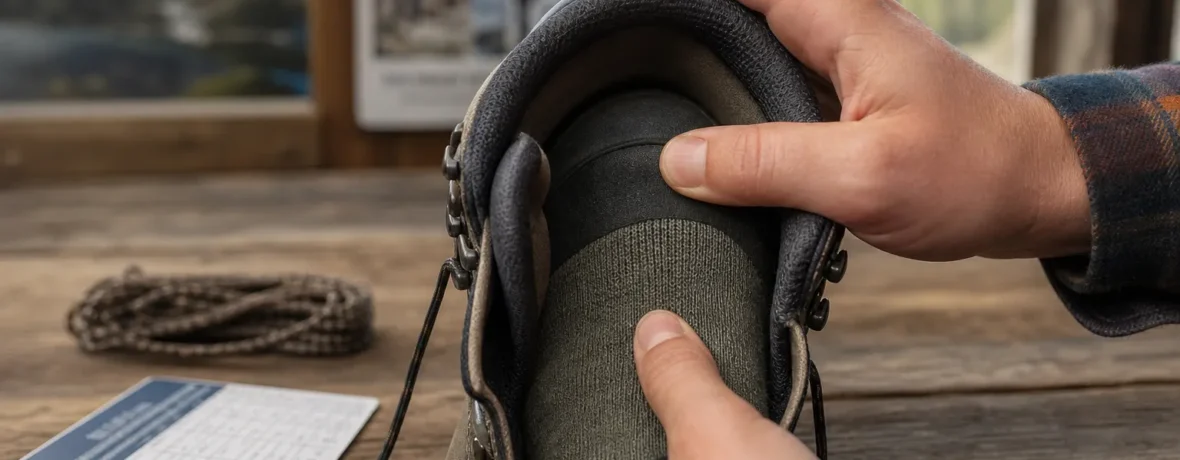
How should hiking boots fit? Your heel should stay locked, your midfoot should feel secure, and your toes should have a thumb’s width of space in front—usually 1/2 to 3/4 inch [13 to 19 mm]. They should not pinch, crush, rub, or let your foot slide forward on descents.
How should hiking boots fit? What is the thumb rule?
The thumb rule means you want one thumb’s width of space between your longest toe and the front of the boot.
The easiest way to check it is to remove the insole, stand on it with your full weight, and look at the gap past your longest toe. REI’s hiking boot fitting advice uses this same insole check: a thumb’s width of space between the longest toe and the end of the insole. REI’s hiking boot fitting guide explains this length check for trail footwear.
That space is not luxury room. It is working room. Your feet spread under load, swell during long days, and slide slightly forward when you hike downhill. If your toes are already close to the front in the store, they will pay for it on the trail.
Use this quick fit target:
| Fit Zone | Good Fit | Bad Sign |
|---|---|---|
| Toes | Thumb-width space in front; toes can wiggle | Toes hit the end or curl |
| Heel | Held down with slight lift only | Heel pops, rubs, or slides |
| Midfoot | Snug and stable | Foot swims side to side |
| Width | No squeezing at the forefoot | Pinching, numbness, hot spots |
How tight should hiking boots be?
They should be snug, not tight.
Think firm handshake, not a vise. Your boot should hold your foot over the sole so you are not sliding around on rocks, roots, and loose dirt. But tight boots cause trouble fast: numb toes, burning forefeet, black toenails, and friction blisters.
Check tightness after lacing both boots with your actual hiking socks. Stand up. Walk. Squat. Step onto a stair. Your toes should still move, your arch should not cramp, and the widest part of your foot should not bulge over the midsole.
Use this pressure checklist:
- No numbness after 5 minutes of standing and walking.
- No sharp pressure on the outside of the little toe or big toe joint.
- No lace bite across the top of the foot.
- No heel rubbing that feels like sandpaper.
- No need to “hope they stretch.”
Leather can soften. Fabric can relax slightly. The shape of the boot will not magically become the shape of your foot. If the toe box is wrong, choose another model or a wide size.
Should hiking boots be a size bigger?
Sometimes, yes—but fit beats the number on the box.
Many hikers end up a half size larger than their street shoes because hiking socks, foot swelling, and downhill movement all need space. Some need the same size. Some need a wide width instead of extra length. Do not buy a longer boot to fix a narrow boot. That gives you heel slip and toe bang at the same time. Terrible combo.
Try boots late in the day if you can, when your feet are naturally a little larger. Bring the socks you hike in. If you use aftermarket insoles or orthotics, bring those too. A thicker insole can steal volume from the boot and make a good fit feel cramped.
How do you test hiking boot fit in the store?
Run a real fit test, not a carpet stroll.
- Put on your hiking socks and both boots.
- Loosen the laces fully, seat your heel back, then lace from the toes upward.
- Stand with full body weight in the boots.
- Wiggle your toes. They should move without hitting the front.
- Walk for 5 to 10 minutes, not 30 seconds.
- Use an incline ramp or stairs. Uphill checks heel lift. Downhill checks toe bang.
- Kick the toe lightly into the floor. Your toes should not slam the front.
- Remove the insoles and do the thumb-width length check.
If one foot is larger, fit the larger foot. You can fine-tune the smaller side with lacing, sock choice, or a volume shim, but you cannot make a short boot longer.
How much heel slip is normal in hiking boots?
A tiny amount is normal; rubbing is not.
New boots may allow slight heel movement, especially before the sole flexes naturally. But your heel should not lift hard with every step. If your heel rises and drops enough to create heat, that spot can become a blister.
MedlinePlus says blisters commonly happen when pressure or rubbing affects one spot, including from shoes that do not fit right. MedlinePlus blister guidance also says to stop the rubbing or friction. (medlineplus.gov)
Try this before rejecting the boot:
- Use a heel-lock lacing pattern.
- Tighten the ankle hooks while keeping the toe box looser.
- Try a slightly thicker hiking sock.
- Check if the boot volume is too high for your foot.
If heel lift continues after lacing changes, the boot shape is wrong for you.
How much toe room do you need for downhill hiking?
You need enough room that your toes never hit the front of the boot.
Downhill hiking is the brutal fit test. Gravity pushes your foot forward. A backpack adds more force. If your lacing does not hold your heel back, your toes take the hit.
On a descent test, your toes can move forward slightly, but they should not jab, curl, or bang. One bump in the store becomes hundreds of bumps on a trail. That is how you get bruised nails and sore toe joints.
If the boot feels good on flat ground but fails downhill, try this:
- Tap your heel back before lacing.
- Snug the lower laces over the midfoot.
- Use a surgeon’s knot before the ankle hooks to lock tension.
- Leave the toe box comfortable, not crushed.
Should hiking boots feel comfortable right away?
Yes, they should feel basically right right away.
Stiff boots may need break-in time so the upper and midsole flex more naturally. That does not mean pain is normal. Break-in can reduce stiffness. It does not fix bad length, bad width, or a heel cup that chews your skin.
Wear new boots around the house before taking them outside, especially if you may need to return them. Then take short walks with the same socks and pack weight you plan to use. Increase time only if your feet stay calm.
What are the signs your hiking boots are too small?
Toe pressure, numbness, and pinching mean the boots are too small or too narrow.
Look for these red flags:
- Your longest toe touches the front while standing.
- Your toes hit the end when walking downhill.
- Your forefoot feels squeezed from both sides.
- Your toes go numb or tingle.
- You get hot spots on the outside of the big toe or little toe.
- Your toenails feel sore after short walks.
Tight shoes can contribute to foot problems, including corns and pressure issues, according to the American Academy of Orthopaedic Surgeons. AAOS foot and ankle resources discuss problems linked to tight footwear. (preview.orthoinfo.org)
What are the signs your hiking boots are too big?
Sliding, heel lift, and sloppy edging mean the boots are too big or too high-volume.
Too-big boots are sneaky. They feel comfy in the store because nothing presses. Then the trail starts, and your foot moves inside the boot like cargo in a loose truck bed.
Watch for these signs:
- Your heel lifts more than slightly on climbs.
- Your foot slides forward on descents even with firm lacing.
- You have to overtighten the laces to feel secure.
- The upper wrinkles deeply when laced.
- You get blisters under the ball of the foot or behind the heel.
If length is right but the boot feels sloppy, try a lower-volume model, a different brand, or a supportive insole. Do not rely on thick socks to rescue a poor match unless the fit is only slightly loose.
When to see a doctor
See a doctor when pain, skin damage, or infection signs do not settle quickly.
A boot fit problem is usually solved with different footwear, lacing, socks, or insoles. But your feet are not test equipment. Stop hiking and get medical advice if you have spreading redness, warmth, pus, increasing swelling, severe pain, or red streaks near a blister. Mayo Clinic’s blister first-aid guidance lists expanding skin color changes, increasing pain, pus, and warm skin as infection warning signs. Mayo Clinic blister first aid gives more detail. (mayoclinic.org)
If you have diabetes, poor circulation, nerve problems, or reduced feeling in your feet, get professional care early for blisters, sores, or pressure wounds. Do not push through foot numbness or open skin on a hike.
Related reading
- How Should Hiking Pants Fit?
- How Should a Hiking Backpack Fit? Measuring Torso Length
- How to Clean Hiking Boots Without Ruining Leather or Membranes
- Hiking Shoes vs Hiking Boots: Which Should You Buy?
FAQ
Should my toes touch the end of my hiking boots?
No. Your toes should not touch the end while standing, walking, or hiking downhill. Aim for a thumb’s width of space in front of your longest toe.
Is heel lift bad in hiking boots?
Small movement can be normal, especially in stiff new boots. Repeated rubbing, popping, or heat at the heel means the fit or lacing is wrong.
Should hiking boots be tight around the ankle?
They should be secure around the ankle, not restrictive. You want support and heel hold without cutting off movement or causing lace pressure.
Can thick socks fix loose hiking boots?
Only slightly. Thick socks can fine-tune a near-good fit, but they cannot fix a boot that is too long, too wide, or too high-volume.
How do I know if I need wide hiking boots?
You likely need wide boots if the length feels right but your forefoot is pinched, your toes are squeezed together, or the sides of your feet bulge over the sole. Try the same model in wide before sizing up in length.