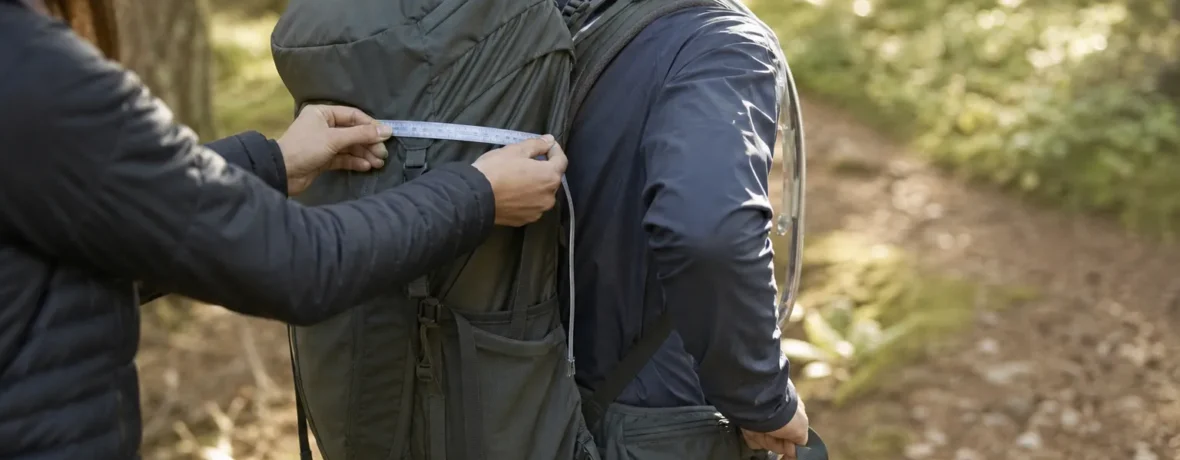
A hiking backpack should fit with the hip belt centered over your iliac crest, the shoulder straps wrapping smoothly over your shoulders, and the load lifters angled roughly 30-45 degrees. Your torso length—not your height—sets the pack size. If the belt slips, straps gap, or weight rides on your shoulders, the fit is wrong.
How should a hiking backpack fit on your body?
The pack should carry most of its weight on your hips, not your shoulders.
That is the whole trick. A good hiking backpack fit feels planted, close, and balanced. The pack should not swing behind you like a sack of potatoes. It should not yank your shoulders backward. It should not crush your collarbones, dig into your neck, or slide down your backside every mile.
For framed hiking and backpacking packs, the hip belt is the load-transfer engine. Osprey says hipbelt fit affects how the load transfers from the pack and carries on the hips, while REI’s fit guide focuses on measuring torso length and checking hipbelt, shoulder strap, sternum strap, and load-lifter position. Osprey’s pack sizing guide and REI’s backpack fit guide both point to the same basic idea: match the pack to your torso, then fine-tune the straps.
A correctly fitted backpack usually looks like this:
- Hip belt: centered over the top of your hip bones, not around your waist like a pants belt.
- Shoulder straps: curved over your shoulders with no hard gap and no pinching.
- Load lifters: running from the shoulder straps up toward the pack at a clean upward angle.
- Sternum strap: snug enough to steady the shoulder straps, not so tight that it restricts breathing.
- Pack body: close to your back, with the heaviest weight riding near your spine.
If you are asking “how should a hiking backpack fit” because your shoulders ache after 20 minutes, start with torso length and hip belt position. Those two pieces solve more problems than any amount of strap-yanking.
How do you measure torso length for a backpack?
Measure from your C7 vertebra to the line between the tops of your hip bones.
This is the key sizing number. Not your jacket size. Not your inseam. Not your overall height. Two hikers can both be 5 ft 10 in. [178 cm] and need different pack sizes because one has a longer torso and shorter legs.
Here is how to measure cleanly:
- Grab a soft tape measure and a helper. You can do it alone, but a second person makes the number cleaner.
- Find your C7 vertebra. Tilt your head forward. The bony knob at the base of your neck is C7.
- Find your iliac crest. Put your hands on your hips with thumbs pointing backward. The top ridge of your hip bones is the iliac crest.
- Create an imaginary line across your back. Your helper should picture a level line connecting the top of both hip bones.
- Measure down your spine. Run the tape from C7 to that hip-bone line. That number is your torso length.
- Write it down in inches and centimeters. Pack brands often list ranges in inches, centimeters, or both.
Most pack makers use this same C7-to-iliac-crest method. Granite Gear’s fitting instructions, for example, define torso length as the distance between the seventh cervical vertebra and the crest of the hipbones. Granite Gear’s fitting guide uses that measurement to match hikers to frame sizes.
Do not measure from your neck to your pants belt. Pants rise varies. Trail pants, leggings, rain pants, and jeans all sit differently. Your bones are better landmarks.
What size backpack do you need from your torso measurement?
Choose the pack size whose torso range includes your measured torso length.
Backpack sizing is brand-specific. A “medium” in one brand may not match a “medium” in another, and adjustable packs can cover overlapping ranges. Always check the maker’s size chart before buying.
| Torso length | Common pack size starting point | Fit check |
|---|---|---|
| Under 16 in. [41 cm] | Extra small or short torso | Check that shoulder straps do not sit too wide or rub the neck. |
| 16-18 in. [41-46 cm] | Small or small/medium | Often fits compact frames; confirm hip belt lands on the iliac crest. |
| 18-20 in. [46-51 cm] | Medium or medium/large | Common adult range; try loaded fit before removing tags. |
| 20 in. [51 cm] and up | Large or tall torso | Make sure load lifters still angle upward from the shoulder straps. |
Treat that table as a starting point, not a verdict. Brand charts win. Adjustable suspension can also blur the line. If your measurement lands between sizes, try both with 15-25 lb [7-11 kg] inside the pack. Empty packs lie.
Women’s-specific packs, extended-fit packs, and plus-size hip belts can also matter. The right torso length still has to pair with the right hip belt shape and shoulder harness width. If the frame length is right but the hip belt cannot wrap your hips securely, the pack still does not fit.
How do you fit a hiking backpack step by step?
Load the pack first, then adjust from the hips upward.
Learning how to fit a hiking backpack is much easier when the pack carries real weight. Use your normal trail load or add pillows and dense items until the pack has enough weight to settle. For a day pack, 10-15 lb [4.5-7 kg] is enough. For a backpacking pack, use the kind of load you expect to carry.
- Loosen every strap. Start with the hip belt, shoulder straps, sternum strap, load lifters, and hip-belt stabilizers loose.
- Put the loaded pack on. Lean forward slightly and settle the pack onto your back.
- Set the hip belt first. Center the padded wings over the top of your hip bones. Buckle it and tighten evenly.
- Tighten the shoulder straps. Pull down and back until they wrap your shoulders. Stop before they lift the hip belt off your hips.
- Set the load lifters. Pull them until the top of the pack moves closer to your body. Do not crank them flat.
- Clip the sternum strap. Slide it to a comfortable height across your chest and snug it lightly.
- Adjust hip-belt stabilizers. These small straps near the hip belt pull the lower pack closer or give it more movement.
- Walk for five minutes. Use stairs, bends, and turns. Then fine-tune. A real fit shows up when you move.
Deuter gives similar adjustment order: position the hip fins over the top of the hip bone, secure the waist belt, set the shoulder straps, and use the sternum strap to stabilize the harness. Deuter’s backpack adjustment guide also points out that waist belt stabilizer straps can shift how much load transfers or how freely the pack moves.
One warning: tighter is not always better. Overtightened shoulder straps can pull weight off your hips and jam the pack into your neck. Overtightened load lifters can make the shoulder straps float above your shoulders. Snug is good. Strangled is bad.
Where should the hip belt sit on a backpack?
The hip belt should sit over the top of your hip bones, with the padding wrapping forward around your pelvis.
Think “hips,” not “waist.” Your waist is soft tissue. Your hip bones can carry weight. If the belt rides too high, the pack may feel top-heavy and press into your stomach. If it rides too low, it can limit your stride and slide down as you walk.
A clean hip-belt fit has three signs:
- The middle of the padded belt covers the iliac crest.
- The buckle closes with room to tighten and loosen.
- The pack weight feels supported before you tighten the shoulder straps.
If the hip belt bottoms out before it gets snug, you may need a smaller belt or a different pack. If the padded wings barely reach around your sides, you may need a larger belt or extended-fit model. Many backpackers obsess over liters and pockets, then ignore the belt. Bad trade.
Where should shoulder straps sit on a hiking backpack?
Shoulder straps should wrap smoothly over your shoulders without carrying the full load.
Look at the side of the pack while it is loaded. The shoulder straps should leave the pack just below or near the top of your shoulders, then curve over them. A small, natural contact zone is right. A big daylight gap is wrong. So is a strap anchor that starts way too low and pulls backward across your shoulder blades.
If the straps dig into the tops of your shoulders, first loosen them a touch and check that the hip belt is tight enough. If the straps still grind down, the torso may be too short or the load may be packed too low and far back.
If the straps float above your shoulders, the torso may be too long, or the load lifters may be over-tightened. Loosen the load lifters and check again.
What angle should backpack load lifters be?
Load lifters should usually angle upward from your shoulder straps to the pack at roughly 30-45 degrees.
That angle helps pull the upper pack toward your body, keeping the load from leaning backward. Osprey’s fitting material describes an optimum load-lifter angle of around 45 degrees. Osprey’s pack fit instructions use that angle as a target for keeping the pack close to your back.
Load lifters are not shoulder elevators. If you tighten them until your shoulder straps lift off your body, back off. If they run flat or downward from the shoulder straps to the pack, they cannot do their job well. That often means the torso length is too short, the pack size is wrong, or the shoulder harness is set too low.
For small day packs, load lifters may be missing or less dramatic. That is normal. For larger framed packs, poor load-lifter angle is one of the fastest ways to spot a bad fit.
How tight should the sternum strap be?
The sternum strap should be lightly snug, not cinched hard.
Its job is simple: keep the shoulder straps from sliding outward. It is not there to haul the pack forward. It is not a chest compression device. If you have to reef on the sternum strap to make the pack feel stable, something else is off.
Set the sternum strap at a height that feels natural across your chest. Then tighten it just enough to steady the shoulder straps. You should still breathe freely, swing your arms, and turn your upper body without feeling pinned.
How do you know if your backpack torso length is wrong?
Your torso length is probably wrong if the hip belt and shoulder straps cannot both sit correctly at the same time.
That is the big clue. One area can look fine while another goes haywire. The hip belt may sit perfectly, but the shoulder straps gap. Or the shoulders may feel great, but the belt rides too low. A good pack fit lines up the whole system.
Watch for these bad-fit signals:
- Torso too short: load lifters run flat, shoulder strap anchors sit too low, or the pack pulls backward.
- Torso too long: shoulder straps float, the frame bumps the back of your head, or the belt gets pushed down.
- Hip belt too small: buckle straps are maxed out and the padded wings do not wrap your hips.
- Hip belt too large: belt bottoms out before it gets tight.
- Harness too narrow: straps rub your neck.
- Harness too wide: straps slide toward the outside of your shoulders.
Try one adjustment at a time. Move the torso setting, reload the pack, and walk again. Random strap-pulling turns into a mess fast.
Can you adjust torso length on every hiking backpack?
No, some hiking backpacks have adjustable torso systems, and others come in fixed sizes.
Many backpacking packs let you slide the shoulder harness up or down with hook-and-loop panels, ladder systems, rails, or marked suspension settings. Some lightweight packs use fixed torso lengths to save weight. Some day packs come in one size with limited adjustment.
| Pack type | Torso adjustment | Best use |
|---|---|---|
| Fixed-size ultralight pack | Usually none | Hikers who already know their torso length and carry lighter loads. |
| Adjustable backpacking pack | Shoulder harness moves up or down | Most backpackers, growing teens, and anyone between sizes. |
| One-size day pack | Limited or none | Short hikes with lighter gear, if the pack feels stable. |
If you are buying online, check the torso range before you fall in love with the color. Pretty packs do not get prettier when they chew up your shoulders.
How should you test backpack fit before a hike?
Test it loaded, indoors, with enough time to return or exchange it.
Do not cut off tags and head straight for a 12-mile [19 km] day. Load the pack with your real gear. Use full water bottles. Add your tent, food bag, bear canister if you carry one, and the layers you actually bring. Then walk around your home, yard, stairs, or block.
Use this quick checklist:
- Can you tighten the hip belt without maxing out the webbing?
- Does the belt stay on your hip bones after walking?
- Do the shoulder straps wrap without gaps?
- Do the load lifters angle upward?
- Can you look up without hitting the frame or lid?
- Can you breathe normally with the sternum strap clipped?
- Does the pack stay close when you turn, squat, or step up?
- Can you loosen and tighten key straps while wearing it?
Now walk for 20-30 minutes. Small irritations get louder with time. A rub near your collarbone at minute five can become a hot, angry spot by lunch.
What packing mistakes can ruin a good backpack fit?
Bad packing can make a correctly sized backpack feel wrong.
Fit and load work together. If the heaviest items sit far from your back, the pack pulls away from you. If dense gear sits too low, the pack sags. If everything heavy rides high and loose, the pack can feel tippy on uneven trail.
Pack dense items close to your spine and near the middle of your back. Keep soft, light gear lower or farther out. Tighten compression straps so the load does not shift. A sloppy load can mimic bad torso fit, especially on descents and rocky trail.
Before blaming the pack, repack it once. Then refit from the hip belt upward. If the same problems remain, the pack likely needs a size change or different harness shape.
Related reading
- How Should Hiking Boots Fit? The Thumb Rule and Other Checks
- How Should Hiking Pants Fit?
- How to Pack a Hiking Backpack: Weight Zones and a Simple Diagram
- How to Choose a Hiking Backpack: Volume, Torso Length and Fit
FAQ
Should a hiking backpack sit high or low?
It should sit high enough that the hip belt centers over your hip bones and the pack stays close to your upper back. It should not hang low over your butt or tower so high that it hits your head when you look up.
How much weight should be on your hips versus shoulders?
Most of the weight should ride on your hips. Your shoulders should stabilize the pack and keep it close, not carry the full load all day.
Is backpack size based on height or torso length?
Backpack size is based mainly on torso length. Height can give a rough clue, but the C7-to-iliac-crest measurement is the number that matters.
What if I am between two backpack sizes?
Try both sizes loaded. Pick the one that lets the hip belt sit correctly, shoulder straps wrap cleanly, and load lifters angle upward without forcing any strap to its limit.
Should my hiking backpack touch my shoulders?
Yes, the shoulder straps should touch and wrap your shoulders. They should not float above them, and they should not press down so hard that your hips stop carrying the load.
Can a bad backpack fit cause pain?
Yes, a poor fit can cause sore shoulders, rubbed skin, and general trail misery. If you feel sharp pain, numbness, weakness, or symptoms that continue after removing the pack, stop using it and talk with a qualified medical professional.