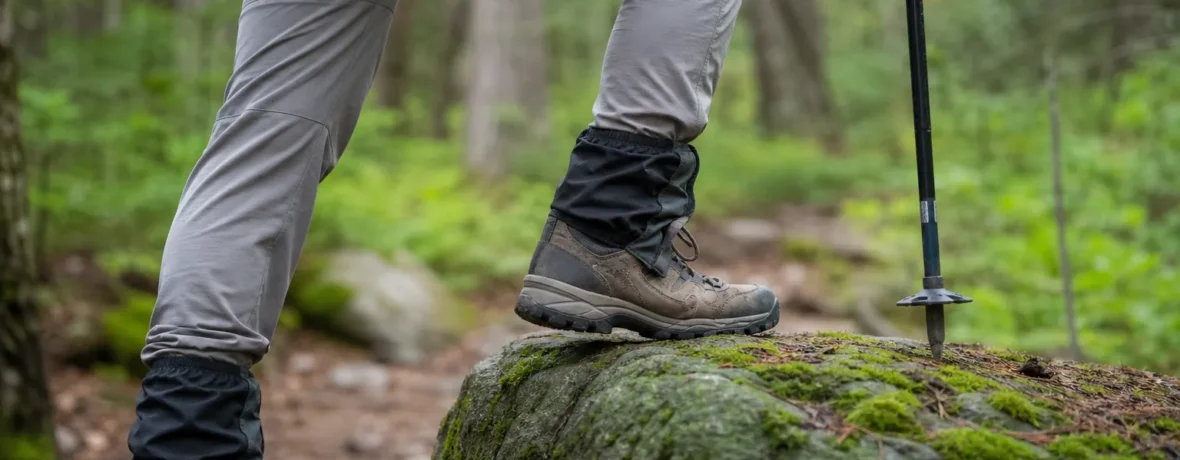
What muscles does hiking work? Hiking works your quads, hamstrings, glutes, calves, hip flexors, adductors, abductors, core, lower back, ankles, feet, and, with poles or a pack, shoulders, arms, and upper back. Uphill hiking stresses glutes and calves; downhill hiking loads quads through braking.
The short version: hiking is a full-body effort disguised as a walk in the woods. Flat trail uses steady endurance. Climbing asks for power. Descending asks for control. Add rocks, roots, sand, snow, mud, switchbacks, and a loaded pack, and suddenly your body is doing strength work, balance work, and cardio at the same time.
That’s why a 4-mile [6.4-km] hike can feel easy on one trail and brutal on another. Grade, footing, elevation gain, pack weight, and pace all change which muscles take the hit.
What muscles does hiking work the most?
Hiking works your legs the most, especially the quads, glutes, hamstrings, and calves.
Your lower body drives the movement, absorbs the impact, and keeps you upright when the trail gets messy. Here’s the main crew:
- Quadriceps: The front thigh muscles straighten your knee, power step-ups, and control downhill braking.
- Hamstrings: The back thigh muscles help bend the knee, extend the hip, and stabilize your stride.
- Glutes: Your gluteus maximus, medius, and minimus push you uphill and keep your hips from wobbling side to side.
- Calves: Your gastrocnemius and soleus lift your heel, help you climb, and work hard on steep grades.
- Hip flexors: These lift your thigh when you step over logs, climb stairs, or grind up switchbacks.
- Adductors and abductors: Inner and outer thigh muscles help with balance, side-stepping, and uneven footing.
- Core: Your abs, obliques, and deep trunk muscles resist twisting and help transfer force between your upper and lower body.
- Lower back: The spinal erectors help you stay tall, especially under a backpack.
- Ankles and feet: Small stabilizer muscles work every time your boot lands on tilted rock, loose gravel, or a root.
Does hiking build muscle or just cardio?
Hiking builds muscular endurance more than maximum muscle size.
If your goal is bodybuilding-style leg growth, hiking alone will not replace squats, deadlifts, lunges, or step-ups. But hiking can absolutely make your legs, hips, and core stronger for repeated effort. Think thousands of low-to-moderate resistance reps spread over 1, 3, 8, or 15 miles [1.6, 4.8, 12.9, or 24.1 km].
Steep climbs, stairs, scrambling, and backpack weight increase the strength demand. Long descents increase eccentric loading, which means your muscles lengthen while resisting force. That’s one reason downhill miles can leave your thighs sore the next day.
Hiking also counts toward aerobic activity when the pace raises your breathing and heart rate. The CDC adult physical activity guidelines call for 150 minutes of moderate-intensity activity each week, plus 2 days of muscle-strengthening activity. A brisk hike can help with the aerobic side, but dedicated strength training still fills gaps.
Which muscles work uphill versus downhill?
Uphill hiking is mostly power; downhill hiking is mostly control.
| Trail condition | Muscles hit hardest | What your body is doing |
|---|---|---|
| Uphill | Glutes, calves, hamstrings, quads | Driving the body upward with each step |
| Downhill | Quads, glutes, calves, ankles | Braking, absorbing impact, protecting joints |
| Uneven terrain | Core, hips, ankles, feet | Balancing, correcting, and stabilizing |
| Loaded backpack | Glutes, core, lower back, traps, shoulders | Supporting extra weight and posture |
On climbs, shorter steps usually feel better than giant lunges. A step height of 8 to 12 inches [20 to 30 cm] already asks plenty from your glutes and quads, especially if the grade keeps going. On descents, bent knees and controlled foot placement reduce the pounding. Lock your knees and your quads will complain fast.
What does carrying a backpack change?
A backpack turns hiking into more of a total-body strength session.
Your legs still do the main work, but the load shifts the job upward. Your core braces to keep your torso from collapsing forward. Your lower back works to maintain posture. Your traps and shoulders support the shoulder straps. Your hips carry load through the belt when the pack is fitted well.
The heavier the pack, the more you need strong glutes and core control. A loose, bouncing pack wastes energy and can make your shoulders feel wrecked. A snug hip belt, stable load, and tight compression straps help your body move as one unit instead of fighting a swinging sack.
How can you train the muscles hiking uses?
Train for hiking with step-ups, lunges, calf raises, hip work, core bracing, and loaded walking.
- Build your step-up engine. Use a box, bench, or stair 8 to 16 inches [20 to 41 cm] high. Step up with control, stand tall, then step down slowly.
- Add lunges and split squats. These train single-leg strength, which matters because hiking is one leg at a time.
- Train your calves. Do standing calf raises, then try them on one leg when both-leg raises feel easy.
- Strengthen your hips. Side steps with a band, side lunges, and single-leg balance drills help your knees track better on uneven trail.
- Brace your core. Planks, side planks, dead bugs, and loaded carries teach your trunk to resist wobble.
- Practice descents. Slow step-downs train your quads for downhill braking. Control the lowering phase instead of dropping.
- Walk with weight gradually. Start with a light daypack, then build load, distance, and elevation one variable at a time.
Warm up before harder efforts. The NIH MedlinePlus guide to avoiding exercise injuries recommends starting slowly for the first few minutes before picking up pace. For hikers, that can be as simple as walking easy for 10 minutes, then climbing harder.
Why are my muscles sore after hiking?
Your muscles get sore after hiking because they handled more load, more downhill braking, or more uneven terrain than usual.
Downhill hiking is the classic quad-burner. Your quads act like brakes with every step, especially on steep trail, rock stairs, or loose dirt. If you also carried a pack, your hips, calves, and low back may feel it too.
Soreness that shows up the next day is common after new or harder exercise. Sharp pain during the hike is different. Pain that changes your gait, causes swelling, or keeps getting worse is not a training badge. Back off.
For ordinary muscle aches, MedlinePlus says muscle pain is often linked to tension, overuse, or muscle injury from exercise. Easy walking, gentle mobility, food, fluids, and sleep usually beat heroics. Hammering another hard hike on trashed legs is a clean path to sloppy footwork.
When to see a doctor
See a healthcare professional if pain is severe, persistent, unexplained, or linked with swelling, weakness, chest symptoms, heat illness signs, or a possible fracture.
This is health territory, so don’t guess your way through red flags. You don’t need a doctor for every tired calf, but you do need help when symptoms point beyond normal soreness.
- Call 911 or seek emergency help for chest pain, trouble breathing, fainting, confusion, seizure, or signs of heat stroke.
- Get medical care if you cannot bear weight, cannot move a joint normally, or think you broke a bone.
- Contact a healthcare professional if muscle pain lasts more than 3 days, is severe and unexplained, or comes with redness or swelling.
- Stop hiking and cool down fast if heat symptoms appear. The CDC heat illness guidance lists confusion, altered mental status, and slurred speech as heat stroke symptoms requiring emergency care.
- For sprains, the Mayo Clinic first aid guidance says to call a healthcare professional if a sprain does not improve after 2 or 3 days.
Related reading
- What Muscles Does the StairMaster Work?
- Bulgarian Split Squats for Hikers
- Step-Ups for Hikers: Muscles Worked and Form
- How to Relieve Sore Muscles After Hiking
FAQ
Does hiking work your abs?
Yes, hiking works your abs, but mostly as stabilizers. Your core resists twisting, helps control your pelvis, and becomes more active on uneven ground, steep climbs, and backpacking trips.
Does hiking make your legs bigger?
Hiking can make your legs stronger and more defined, especially if you climb hills or carry a pack. For major muscle size, pair hiking with progressive strength training such as squats, step-ups, lunges, and calf raises.
Why do my quads hurt after hiking downhill?
Your quads hurt after downhill hiking because they brake your body on every step. That eccentric loading is harder on muscle tissue than steady flat walking, especially on long descents.
Do trekking poles work your upper body?
Yes, trekking poles add work for your shoulders, triceps, chest, upper back, and grip. They also help share effort on climbs and improve balance during descents and stream crossings.
Is hiking enough leg training?
Hiking is strong leg endurance training, but it is not complete leg strength training. Add 2 focused strength sessions each week if you want better knee control, stronger descents, and more power on climbs.
What muscles should I strengthen before a hard hike?
Prioritize quads, glutes, hamstrings, calves, hips, core, ankles, and feet. Step-ups, split squats, calf raises, side steps, planks, and loaded walks cover the trail muscles that matter most.