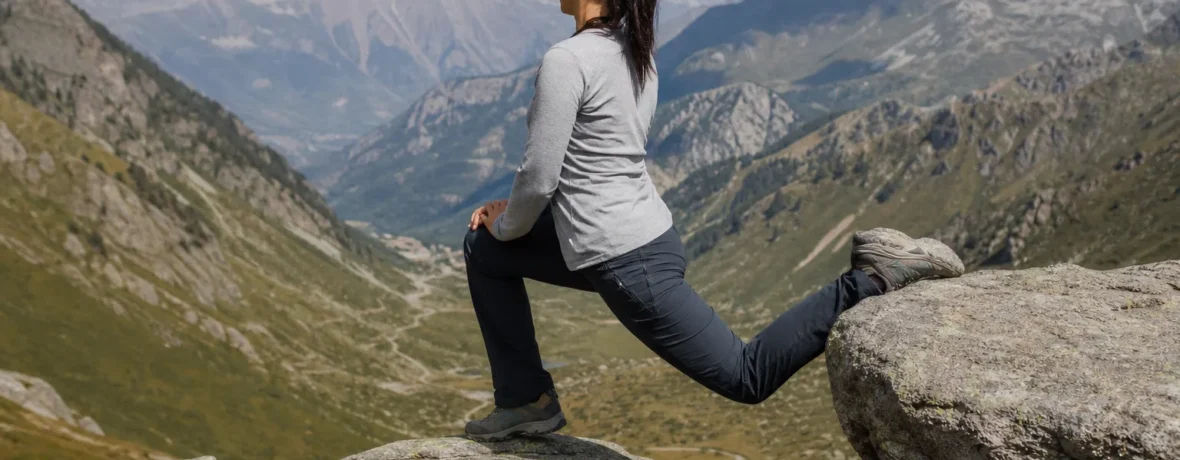
What do bulgarian split squats work? They mainly work your quads, glutes, hamstrings, adductors, calves, and core stabilizers, one leg at a time. For hikers, 2–3 sets of 6–12 controlled reps per leg can build useful strength for climbs, descents, step-ups, and uneven trail.
What do Bulgarian split squats work for hikers?
They work the same muscles you use to climb, brake downhill, and stay steady on rough ground.
A Bulgarian split squat is a rear-foot-elevated split squat. One foot stays on the floor. The other rests behind you on a bench, box, couch, or trail-height rock. That setup loads the front leg hard while asking your hips and trunk to keep you from wobbling.
The main movers are your quadriceps on the front of your thigh and your glutes on the back and side of your hip. Your hamstrings help control the descent. Your calves help stabilize the ankle. Your adductors, the inner-thigh muscles, help keep the knee and hip tracking. Your abs, obliques, and spinal stabilizers work quietly to keep your torso from tipping.
For hiking, that matters because the trail rarely asks both legs to do the same thing at the same time. One foot steps up. One foot catches your weight on a downhill. One hip fights a side slope. Bulgarian split squats train that one-leg-at-a-time demand without needing a loaded barbell.
Are Bulgarian split squats good for hiking?
Yes, they are excellent for hikers when your form is controlled and your knees, hips, and ankles tolerate them.
Hiking strength is not just “strong legs.” It is single-leg strength, hip control, balance, and the ability to lower your body under control when the trail drops. Bulgarian split squats hit all four.
The exercise is especially useful for:
- Steep climbs: your front leg drives through a deep bend, similar to stepping onto a high rock or root.
- Long descents: your quads learn to control lowering instead of collapsing into each step.
- Pack weight: your glutes and trunk resist tipping when your center of mass shifts.
- Side-to-side balance: each leg has to stabilize without the other leg bailing it out.
- Left-right differences: training one leg at a time shows you which side is weaker or less steady.
The CDC recommends muscle-strengthening activities at least 2 days per week for adults, working all major muscle groups. For hikers, lower-body strength work is not vanity. It is trail preparation.
How do you do Bulgarian split squats correctly?
Set your stance first, then lower slowly and drive through the whole front foot.
- Choose a low support. Start with a step, bench, or sturdy box 12–18 inches [30–46 cm] high. Lower is friendlier than higher.
- Stand 2–3 feet [0.6–0.9 m] in front of it. Place the top of your back foot on the support. If that cramps your ankle, try resting on the ball of the foot.
- Find your front-foot position. Hop the front foot forward or back until you can lower without your heel lifting.
- Brace your ribs over your hips. Think “tall torso,” not stiff soldier.
- Lower for 2–3 seconds. Bend the front knee and hip. Let the back knee drop toward the floor.
- Keep the front knee tracking over the toes. It can move forward, but do not let it cave sharply inward.
- Stop before form breaks. You do not need to touch the floor.
- Push the floor away. Drive through the heel and ball of the front foot to stand.
- Finish the set, then switch legs. Match the weaker side. Do not let the stronger leg collect bonus reps.
Use a wall, trekking pole, countertop, or squat rack upright for balance at first. That is not cheating. It lets the working leg train harder instead of turning every rep into a circus act.
How many Bulgarian split squats should hikers do?
Start with 2 sets of 6–8 reps per leg, then build to 3 sets of 8–12 reps per leg.
Do them 1–2 times per week during regular training. Leave at least 48 hours before your hardest hike or long downhill day. Sore quads are funny in the kitchen. They are less funny 3 miles [4.8 km] into a rocky descent.
| Goal | Sets and reps | Load | Trail focus |
|---|---|---|---|
| Learn form | 2 x 6 per leg | Bodyweight, hand support | Balance and knee tracking |
| Build hiking strength | 3 x 8–10 per leg | Bodyweight or light dumbbells | Climbs and step-ups |
| Prepare for descents | 3 x 6–8 per leg | Slow 3-second lowering | Downhill control |
| Train with pack demands | 2–3 x 8 per leg | Light pack or goblet hold | Loaded stability |
Warm up before you load them. The NIH National Institute on Aging recommends warming up for muscle-strengthening activity with lighter movement. For this exercise, try 5 minutes of brisk walking, 10 bodyweight squats, 10 reverse lunges, and 6 easy split squats per side.
What are the best Bulgarian split squat variations for trail training?
The best variation is the one you can do with clean reps and no sharp pain.
Do not rush to heavy dumbbells. Hikers get plenty from simple tweaks.
- Assisted Bulgarian split squat: Hold a wall or pole. Best for learning balance.
- Bodyweight Bulgarian split squat: Hands on hips or out front. Best for general strength.
- Goblet Bulgarian split squat: Hold one dumbbell at your chest. Best before using two dumbbells.
- Slow-lowering Bulgarian split squat: Lower for 3–5 seconds. Best for downhill control.
- Front-foot-elevated split squat: Put the front foot on a 2–4 inch [5–10 cm] plate or step. Best if ankle mobility limits depth.
- Regular split squat: Keep the back foot on the floor. Best if rear-foot elevation bothers your hip flexor or knee.
The American Council on Exercise lists the Bulgarian split squat as an advanced exercise, which fits how it feels: simple on paper, spicy in real life. Earn the harder versions.
What mistakes make Bulgarian split squats hurt?
Most problems come from a rushed setup, too much depth, too much load, or sloppy knee tracking.
Check these before blaming the exercise:
- Your front foot is too close. If your heel pops up or your knee feels jammed, step farther forward.
- Your back foot is too high. A tall bench can crank the hip flexor. Use a lower support.
- You drop straight down without control. Slow the descent and stop short of your ugliest rep.
- Your knee dives inward. Aim the kneecap toward the second or third toe.
- You push only through the toes. Keep pressure through the heel, big toe, and little toe.
- You add weight too soon. If bodyweight reps wobble, dumbbells will not fix them.
- You train them right before a big hike. Put hard leg strength work earlier in the week.
A mild muscle burn is normal. Sharp pain, joint catching, swelling, or pain that changes your walking pattern is not something to grind through.
When to see a doctor
See a medical professional if Bulgarian split squats cause sharp pain, swelling, instability, or symptoms that do not settle with rest.
This article is training guidance, not a diagnosis. Stop the exercise and get medical advice if knee, hip, ankle, or back pain is severe, follows a fall or twist, or makes normal walking difficult. The Mayo Clinic advises medical care for knee pain after forceful impact or injury, and urgent care for serious injury signs.
If you have a current injury, recent surgery, balance disorder, nerve symptoms, or a condition that affects exercise safety, ask a clinician or physical therapist before adding rear-foot-elevated split squats.
How should hikers add Bulgarian split squats to a weekly plan?
Place them after your warm-up and before easier accessory moves.
A simple hiking-focused strength session can look like this:
- Warm-up: 5–8 minutes easy walking, mobility, and light squats
- Bulgarian split squats: 2–3 sets per leg
- Step-ups: 2–3 sets per leg
- Romanian deadlifts or hip hinges: 2–3 sets
- Calf raises: 2–3 sets
- Side plank or dead bug: 2–3 sets
Keep 1–3 reps “in the tank” on most sets. You should finish feeling trained, not wrecked. Add weight only after you can hit the same depth and tempo on both legs for every rep.
Related reading
- What Muscles Does the StairMaster Work?
- Step-Ups for Hikers: Muscles Worked and Form
- What Muscles Does Hiking Work?
- Does Bear Spray Work on Mountain Lions and Other Animals?
FAQ
Do Bulgarian split squats work glutes or quads more?
They work both, but your stance changes the emphasis. A slightly longer stride and forward torso lean usually hit the glutes more, while a more upright torso and shorter stride usually feel more quad-heavy.
Should hikers do Bulgarian split squats with weights?
Yes, but only after bodyweight reps look steady. Start with one dumbbell held at your chest or two light dumbbells at your sides, then increase load in small jumps.
Are Bulgarian split squats better than lunges for hiking?
Neither is always better. Bulgarian split squats build deep single-leg strength and control, while walking lunges add more forward movement and rhythm; many hikers benefit from using both at different points in training.
Why do Bulgarian split squats feel so hard?
They feel hard because one front leg does most of the lifting while your hips, ankles, and core fight to keep you balanced. The long range of motion also keeps tension on the working leg for more of each rep.
Can beginners do Bulgarian split squats?
Yes, beginners can do them if they use support and keep the range of motion small. If the setup feels awkward or painful, start with regular split squats, step-ups, or assisted reverse lunges first.