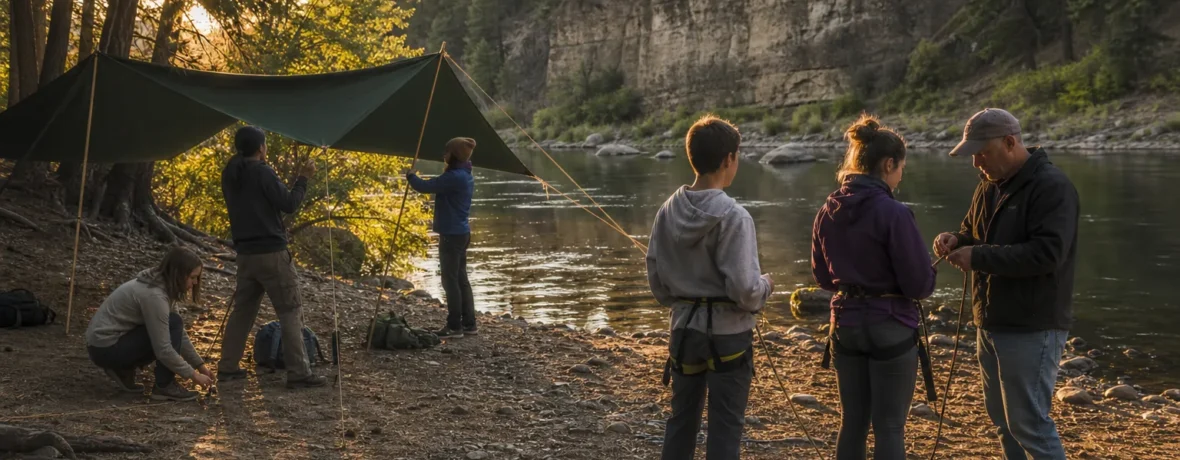
What is Outward Bound? Outward Bound is a nonprofit outdoor education network that teaches leadership, resilience, teamwork, and outdoor skills through guided expeditions. Students backpack, paddle, climb, sail, or camp in small crews with trained instructors. The first school opened in Wales in 1941; the U.S. network began in Colorado in 1962.
What is Outward Bound in simple terms?
Outward Bound is school, but the classroom has dirt, weather, maps, boats, ropes, and a crew that has to work together.
The core idea is learning by doing. You don’t just hear a talk about leadership. You take a turn leading the group to the next campsite. You don’t just read about resilience. You get up when it’s cold, pack your wet shelter, and keep moving with your team.
Outward Bound International describes it as “experiential, adventurous outdoor learning” built to develop personal growth and social skills through real outdoor challenge. As of November 2026, the global network lists 37 schools in 34 countries across 6 continents, with 84 years of history. You can read the organization’s own overview at Outward Bound International.
In the U.S., Outward Bound runs through a national network of regional schools. Its courses include backpacking, canoeing, sailing, climbing, mountaineering, urban expeditions, school programs, adult courses, veterans courses, and longer outdoor educator tracks.
Where did Outward Bound come from?
Outward Bound began during World War II on the Welsh coast.
The first Outward Bound school opened in Aberdovey, Wales, in 1941. Educator Kurt Hahn helped shape the model, and the name came from a nautical phrase for a ship leaving the safety of harbor for the open sea. That image still fits. A course is built around leaving comfort behind, not for drama, but for growth.
Outward Bound USA traces its American start to 1962, when Joshua L. “Josh” Miner helped open the first U.S. program in Colorado. As of November 2026, the U.S. network lists nine schools across the country. The official history is laid out on Outward Bound USA’s history page.
That history matters because the program was never just “go camping.” The old design still shows: challenge, service, skill-building, reflection, and responsibility. You carry gear. You cook. You make decisions. You look after the person next to you.
What happens on an Outward Bound course?
You travel through an outdoor setting with a small crew and trained instructors.
Most courses start with instruction, then hand more responsibility to students as the days go on. Outward Bound USA describes a typical expedition as a crew traveling through a natural environment while building technical skills like navigation and camp craft, plus team skills like communication and problem-solving. Its course overview gives a good official snapshot at What Does a Course Look Like?.
A normal day may look like this:
- Wake up, eat breakfast, and break camp.
- Check the route, weather, water, and group plan.
- Travel by foot, canoe, sea kayak, sailboat, raft, or rope system, depending on the course.
- Stop for lessons, lunch, water, and group problem-solving.
- Reach camp, set shelters, cook, clean, and debrief the day.
- Rotate leadership roles so students practice making real decisions.
Some expeditions also include solo time for reflection, a final challenge event, or service work. No, it is not a spa trip. Good. That is the point.
Who is Outward Bound for?
Outward Bound is for students, adults, schools, groups, veterans, and people who want structured challenge outdoors.
You do not need to arrive as a polished outdoorsperson. Many courses are designed for beginners. Others are demanding and better suited for people with stronger fitness, more comfort outside, or professional goals in outdoor education.
Common participants include:
- Middle school and high school students building confidence and independence
- Young adults taking a gap year or looking for direction
- Adults who want a serious reset outside
- Teachers, schools, and youth organizations
- Veterans and service members in dedicated programs
- Future outdoor educators who need field time and leadership practice
The best fit comes down to maturity, medical readiness, motivation, and the specific course. A short frontcountry program and a multi-week wilderness expedition are not the same animal.
What skills do you learn at Outward Bound?
You learn outdoor skills, but the bigger lessons are leadership, judgment, teamwork, and self-trust.
Yes, you may learn how to read a map, paddle in wind, set a tarp, pack a backpack, tie knots, manage group gear, or cook on a camp stove. Those are useful. But the deeper work happens when the route gets messy, the group gets quiet, or someone needs help and you have to respond like a crew member instead of a passenger.
| Skill area | What it looks like outside | What it can build |
|---|---|---|
| Leadership | Taking a turn planning the day or making a route call | Confidence, accountability, clear communication |
| Teamwork | Sharing chores, carrying group gear, solving friction | Patience, trust, follow-through |
| Outdoor craft | Camping, navigation, layering, cooking, Leave No Trace habits | Competence and better decision-making outdoors |
| Reflection | Debriefs, journals, solo time, group feedback | Self-awareness and stronger choices after the course |
Is Outward Bound the same as wilderness therapy?
No, Outward Bound is not the same thing as wilderness therapy.
Outward Bound is an outdoor education program. It uses challenge, instruction, group travel, and reflection to teach skills and build character. Wilderness therapy is a clinical treatment model that should involve licensed mental health professionals, treatment plans, and clinical oversight.
That difference matters. If you are looking for therapy, ask direct questions about licensing, clinical staff, treatment goals, emergency procedures, and aftercare. If you are looking for outdoor education, Outward Bound may be the better search lane.
How hard is Outward Bound?
Outward Bound can be physically and mentally hard, but difficulty depends on the course.
A three-day school program near town is different from a 30-day alpine or desert expedition. Read the course description closely. Look for daily travel, terrain, elevation, temperature swings, pack weight, swimming requirements, and the level of previous experience expected.
A solid prep checklist looks like this:
- Walk or hike several days a week before your course.
- Break in boots before you show up.
- Practice carrying a loaded pack if your course is backpacking-based.
- Get comfortable being away from your phone.
- Tell the truth on medical and fitness forms.
- Ask course advisors what gear is provided and what you must bring.
Outward Bound USA says courses include risks that can be managed but not eliminated, and that instructors teach students to identify and address hazards with preparation and care. Their official safety page is here: Safety and Risk Management.
How do you choose the right Outward Bound course?
Choose by goal first, then by activity, length, season, and support needs.
Don’t pick only by scenery. A gorgeous mountain course can be the wrong fit if you hate cold nights or are not ready to carry weight uphill for days. A canoe course may teach the same leadership lessons with less impact on your knees. A shorter course may be smarter than forcing a long expedition before you are ready.
- Define your goal. Confidence, leadership, school credit, outdoor skills, reset, or career training?
- Pick the right age group. Youth, young adult, adult, family, veterans, or professional program.
- Match the activity to your body. Backpacking, paddling, climbing, sailing, or mixed travel.
- Check the season. Heat, snow, bugs, storms, and daylight all change the trip.
- Read the medical and gear details. Ask questions early, not the week before.
- Look for funding options. Outward Bound USA lists scholarships and funding information at Scholarships and Funding.
Related reading
- A Walk in the Woods: Bill Bryson's AT Story vs Reality
- Kids' Hiking Boots: How to Size and When to Buy
- Mountain Porters: The People Who Carry Expeditions
- Teaching Leave No Trace to Kids
FAQ
What does “Outward Bound” mean?
“Outward bound” is a nautical term for a ship leaving harbor for the open sea. The name fits the program’s purpose: leaving comfort, taking on challenge, and learning through real responsibility.
Is Outward Bound only for teenagers?
No, Outward Bound is not only for teenagers. Programs serve youth, adults, schools, groups, veterans, and future outdoor educators, depending on the regional school and course calendar.
Do you need camping experience for Outward Bound?
No, many courses do not require previous camping experience. You should still read the course details carefully because some expeditions are more demanding and may require stronger fitness or comfort in remote settings.
Are phones allowed on Outward Bound?
Usually, personal tech is limited or kept off course by design. Families typically receive emergency contact instructions through the base or course provider instead of texting students in the field.
Is Outward Bound safe?
No outdoor expedition is risk-free. Outward Bound uses trained instructors, risk management systems, medical forms, emergency communication plans, and student preparation to manage hazards rather than pretend they do not exist.
Is Outward Bound worth it?
Outward Bound can be worth it if you want structured challenge, real outdoor learning, and a crew-based experience rather than a guided vacation. It is a poor fit if you only want comfort, entertainment, or a low-effort sightseeing trip.