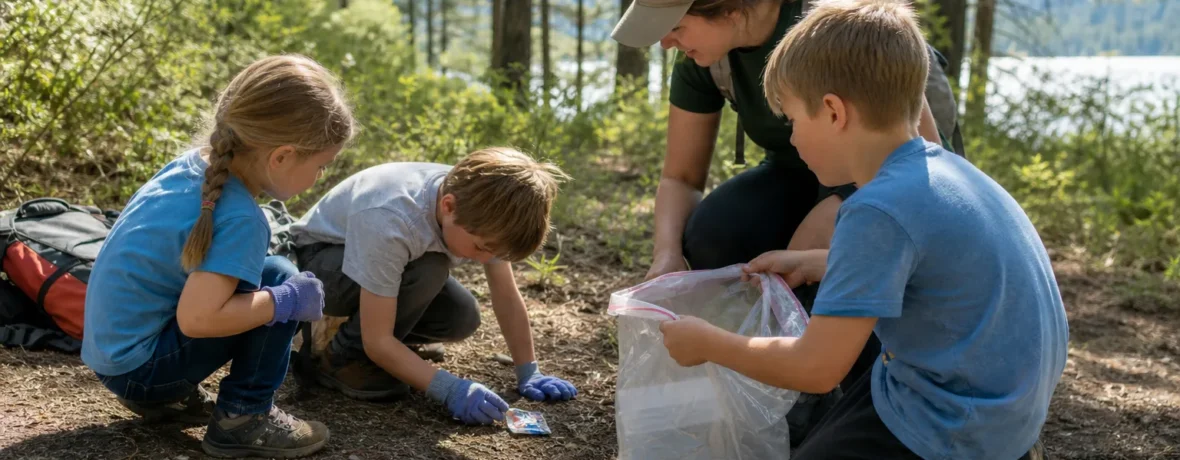
The Leave No Trace principles for kids are seven outdoor habits: plan ahead, stay on durable surfaces, pack out trash, leave nature in place, be careful with fires, respect wildlife, and share the trail. Teach them with short phrases, repeatable jobs, and real choices on every hike.
What are the 7 Leave No Trace principles for kids?
They are the same seven Leave No Trace principles adults use, taught in kid-sized language. The official Leave No Trace 7 Principles are guidelines for lowering your impact outside, not a test your child has to pass.
Here are the seven principles, with a simple kid translation you can use on the trail. The principle names are from Leave No Trace; the kid phrasing is yours to say out loud.
| Leave No Trace principle | Kid-friendly version | Trail habit to practice |
|---|---|---|
| Plan Ahead and Prepare | Know before you go. | Pack water, snacks, layers, and a small trash bag. |
| Travel and Camp on Durable Surfaces | Walk where feet belong. | Stay on the trail, rocks, gravel, or established areas. |
| Dispose of Waste Properly | Pack out what you pack in. | Carry out wrappers, peels, tissues, and pet waste. |
| Leave What You Find | Take a picture, not a souvenir. | Leave rocks, flowers, feathers, antlers, and old objects in place. |
| Minimize Campfire Impacts | Fire is a grown-up job. | Use a stove when possible and follow local fire guidance. |
| Respect Wildlife | Give animals space. | Watch quietly and never feed wildlife. |
| Be Considerate of Others | Share the outdoors. | Use trail voices, step aside, and let faster hikers pass. |
© Leave No Trace: www.LNT.org
The National Park Service Leave No Trace overview uses the same seven-part framework and gives concrete examples for parks, trails, campsites, and wildlife areas. That consistency helps kids. They hear the same ideas at a national park, a forest trail, a scout outing, and a backyard nature walk.
How do you teach Leave No Trace principles for kids without lecturing?
Teach one principle at a time, then give your child a job. Kids learn Leave No Trace faster through doing than through a parking-lot speech.
Start before the hike. Hand them a small responsibility they can actually handle. Not “protect the ecosystem.” Too big. Try “you are the wrapper captain today” or “you get to check if everyone has water.” That turns an abstract outdoor ethic into a task with a beginning and an end.
- Pick one focus for the day. On a short hike, choose “pack it out” or “stay on trail.” Save the full list for later.
- Use a short phrase. Try “rocks stay, trash goes” or “feet on trail.” Repeat it without turning it into a scold.
- Show the right move. Step around mud only if you can stay on a durable surface. If the trail is narrow, walk through the center instead of widening it.
- Let kids make small decisions. Ask, “Where should this apple core go?” or “Which side should we step to when hikers pass?”
- Praise the behavior you want repeated. Say, “Good catch packing out that corner of the granola wrapper.” Specific praise sticks.
- Review at the car. Ask one question: “What was one Leave No Trace thing we did well today?” Then stop. Keep it light.
The trick is to avoid making Leave No Trace feel like a long list of “don’ts.” Kids hear plenty of those already. Frame it as trail craft. A skilled hiker knows how to move through a place without leaving a mess behind.
What age should kids start learning Leave No Trace?
Start as soon as they can walk on a trail. Toddlers will not understand land management, but they can learn simple outdoor habits through repetition.
For very young kids, use body-based instructions. “Feet on dirt.” “Hands gentle.” “Snack wrapper in pocket.” You are building muscle memory before you are building ethics.
By early elementary age, kids can connect actions to outcomes. They can understand that a flower left in the ground can feed insects, drop seeds, and be seen by the next person. They can understand that animals become less wild when people feed them. Keep the explanation short, then let the trail provide the example.
Older kids can handle nuance. They can learn why a switchback matters, why food scraps are still litter, why a social trail gets worse each time someone follows it, and why local rules change by season or land agency. Let them help check the trailhead sign, a park website, or the map before the hike.
| Age range | Best teaching style | Good trail job |
|---|---|---|
| 2-4 | Short phrases and copying adults | Put snack trash in a pocket or bag |
| 5-7 | Games, choices, and simple cause-effect | Spot durable surfaces and stay on trail |
| 8-11 | Questions, responsibility, and trail signs | Check the group for dropped items at breaks |
| 12+ | Planning, leadership, and judgment | Research local guidance before the trip |
How can you make Leave No Trace fun for children?
Turn it into a game, not a lecture. Kids will remember a mission better than a speech.
Try a few of these on your next hike:
- Trash detective: Each child looks for micro-trash at rest stops: tiny wrapper corners, twist ties, fruit stickers, and tissue scraps. Use gloves or a grabber if you bring one.
- Durable surface challenge: Ask kids to point out sturdy places to step: trail, rock, gravel, sand, snow, or established campsite surfaces.
- Wildlife quiet zone: When you spot an animal, everyone freezes and watches silently from a distance. No chasing. No feeding. No yelling.
- Photo souvenir hunt: Kids take photos of five cool finds instead of collecting them: a pinecone, a track, a flower, a pattern in bark, a weird rock.
- Trail kindness count: Count each considerate move: stepping aside, lowering voices, greeting another hiker, keeping snacks contained, or waiting at a junction.
Games work best when they are brief. Five minutes is enough. If the game starts to drag, drop it and let the hike be a hike. You are planting seeds, not running an outdoor ethics seminar.
How do you explain “pack it in, pack it out” to kids?
Tell kids that anything brought from home goes back home. That includes wrappers, peels, cores, nutshells, tissues, wipes, broken gear, and pet waste.
Food scraps are the big sticking point. Kids see an orange peel or apple core and think, “It came from nature.” Fair. But it did not come from that trail. It can attract animals, change their behavior, look ugly to the next hiker, and take longer to break down than kids expect. Keep the rule clean: if it came from your pack, it goes back in your pack.
Give every child a small “trash pocket” system. A resealable bag works. So does a side pocket on a daypack. For sticky wrappers, use a dedicated bag so the rest of the pack does not become a syrupy disaster.
Before leaving any rest spot, do a 10-second sweep:
- Look under where everyone sat.
- Check pockets for loose corners of wrappers.
- Pick up dropped snack pieces.
- Scan for tissues, wipes, and fruit stickers.
- Make sure the dog bag, if you have one, is actually leaving with you.
The U.S. Fish and Wildlife Service Leave No Trace guidance also emphasizes packing out waste and reducing impact on wildlife. That message is easy for kids to grasp: clean camps and trails help animals stay wild.
How do you teach kids to leave rocks, flowers, and sticks behind?
Use the “everyone gets to see it” reason first. Kids respond well when they understand that leaving a feather, flower, or shiny rock gives the next person the same chance to discover it.
Do not make curiosity the enemy. Kids touch things. They crouch. They turn leaves over. They ask if every rock is a crystal. That curiosity is gold. The goal is to guide it without turning the trail into a collection bin.
Try this script:
“You found something cool. Let’s look at it, take a picture, and put it back where it belongs.”
That is better than “Don’t touch that.” It keeps the wonder and redirects the action.
For children who love collecting, give them allowed alternatives:
- Take photos of treasures and make a “trail finds” album at home.
- Draw one object in a pocket notebook.
- Collect memories with a checklist: bird call, rough bark, red leaf, smooth stone.
- Bring one object from home as a trail mascot, then bring it home again.
There is one extra layer for cultural objects. If you see pottery pieces, old tools, bones, historic items, carvings, or anything that looks like an artifact, leave it exactly where it is and tell a ranger or land manager if needed. Kids do not need a long archaeology talk. Just say, “Some things are part of the story of this place, and they need to stay here.”
How do you teach children to respect wildlife?
Teach kids to watch wildlife quietly from a distance and never feed animals. A fed animal can become bold, sick, or dangerous.
Kids love animals, which is exactly why this lesson matters. “Respect” can sound vague to a child, so translate it into visible actions:
- Use quiet voices when an animal is nearby.
- Never chase, corner, poke, or throw food to wildlife.
- Keep snacks sealed when not eating.
- Stay with the group instead of creeping closer for a better look.
- Use binoculars, a camera zoom, or the “thumb trick”: if you can cover the animal with your thumb at arm’s length, you are usually giving it more space than if it fills your view.
The National Park Service gives the same core message in its Leave No Trace material: observe wildlife from a distance and do not feed animals. Pair that with a simple line kids can repeat: “Wild animals eat wild food.”
If a child wants to help animals, give them better jobs than feeding them. They can keep crumbs off the ground, close snack bags, keep dogs controlled where dogs are allowed, and remind the group to move along when wildlife appears stressed.
How do you handle campfires and Leave No Trace with kids?
Tell kids that fire is a grown-up job, then teach them what safe, low-impact behavior looks like. Children can help gather knowledge, not take over fire decisions.
Campfire guidance changes by place, season, weather, and current fire restrictions. Before you go, check the official website for the park, forest, campground, or managing agency. If fires are allowed, keep them small, use existing fire rings where provided, and never let kids burn trash, food packaging, foil, cans, or plastic.
For children, the best Leave No Trace fire lesson is often this: you do not need a fire to have a good night outside. A warm layer, a headlamp, a stove-cooked meal, and a sky full of stars can do the job with less impact.
Give kids clear boundaries around flame:
- No running near a fire ring.
- No throwing sticks, rocks, leaves, or trash into flames.
- No poking the fire unless an adult specifically allows and supervises it.
- No stepping inside old fire rings, even when cold.
- No assuming fires are allowed just because a ring exists.
That last point is key. Old fire rings remain in places where current restrictions may still ban fires. The ring is not permission.
What should you pack to help kids practice Leave No Trace?
Pack a few simple tools that make the right behavior easy. Kids do better when the system is already in their hands.
You do not need a fancy kit. Add these to your family daypack:
- Small resealable bags for wrappers and sticky trash
- One larger trash bag for group waste
- Hand sanitizer
- Extra snacks with minimal packaging
- Water in reusable bottles
- A bandana or small towel for messy hands
- Binoculars or a camera for wildlife watching
- A small notebook and pencil for “leave it here” nature finds
- Weather layers so kids are not tempted to cut trips short in a sloppy way
- A map, downloaded map, or printed trail info so planning becomes visible
Let kids help pack. Ask, “What do we need so we do not leave trash behind?” or “What should we bring so we can look at animals without getting too close?” You are training them to think before the trailhead.
How do you model Leave No Trace when other hikers are not doing it?
Model the behavior without turning your child into the trail police. Kids notice what other people do, but your job is to teach judgment, not public shaming.
If someone cuts a switchback, leaves trash, plays loud music, or feeds wildlife, keep your response calm. Say something like, “We are going to stay on the trail because that protects the plants.” Then do it. No drama needed.
Sometimes kids will ask why another family gets to do something they do not. Give a straight answer: “Different people make different choices. Our group packs out trash and gives animals space.”
If you find trash, pick it up only when it is safe and sanitary. Do not ask children to handle broken glass, sharp metal, toilet paper, dog waste, or anything questionable. Carry gloves or a grabber if your family likes cleanup hikes.
How do you turn Leave No Trace into a family habit?
Repeat the same simple routines every time. One hike will not do it. Ten hikes with the same habits will.
Build a rhythm kids can predict:
- Before the hike: Check the weather, trail conditions, and local guidance. Let kids help choose layers and snacks.
- At the trailhead: Read signs together. Point out one local concern, such as mud, wildlife, fire restrictions, or restoration areas.
- During the hike: Give each child one Leave No Trace job. Keep it specific.
- At snack stops: Eat in one spot, keep food contained, and do the 10-second trash sweep.
- When you find something cool: Look, photograph, draw, and leave it.
- Back at the car: Empty trash bags, check pockets, and ask one quick reflection question.
Kids like being trusted. If you always do the cleanup yourself, they learn that Leave No Trace is your job. If you give them a real role, they start to own it.
What mistakes do parents make when teaching Leave No Trace?
The biggest mistake is making it too heavy. A guilt trip can smother the joy right out of a hike.
Watch for these common traps:
- Teaching all seven principles at once. Pick one or two per outing.
- Using fear as the main tool. Explain consequences, but do not make every footprint sound catastrophic.
- Correcting constantly. If every stick, step, and snack becomes a lecture, kids tune out.
- Being inconsistent. Kids catch it when adults toss pistachio shells, cut muddy corners, or leave dog bags behind.
- Ignoring local guidance. The same habit may need adjusting by desert, alpine, forest, beach, canyon, or wetland setting.
- Forgetting fun. A child who loves the outdoors is more likely to protect it later.
The U.S. Forest Service and other land managers often post current local guidance for trails, forests, fire restrictions, closures, and seasonal concerns. Check the specific site for the area you are visiting rather than relying on memory from a past trip.
Related reading
- The 7 Leave No Trace Principles Explained
- Kids' Hiking Boots: How to Size and When to Buy
- Hiking With Kids: Distances, Games and Gear
- Hiking Games for Kids
FAQ
What is the easiest Leave No Trace principle to teach first?
“Pack it in, pack it out” is usually the easiest place to start. Kids can see trash, carry a small bag, and understand that wrappers from home should go back home.
Should kids pick up trash on hikes?
Yes, if the trash is safe to handle and an adult approves it. Children should not touch glass, sharp metal, toilet paper, dog waste, needles, or anything that looks unsafe.
Is it okay for kids to collect rocks or flowers on public land?
Teach kids to leave natural objects where they find them unless the land manager clearly allows collecting. Photos, drawings, and nature journals give kids a way to remember the find without removing it.
How do you explain Leave No Trace to a toddler?
Use tiny phrases and repeat them often. “Trash in bag,” “feet on trail,” and “gentle hands” work better than long explanations.
Are banana peels and apple cores considered litter?
Yes, treat them as litter on the trail. Even natural food scraps can attract animals, look messy, and come from plants that do not belong in that habitat.
Do kids need to memorize all seven Leave No Trace principles?
No, kids do not need to memorize the list to practice it well. Focus on repeatable habits first; the names of the seven principles can come later as their hiking skills grow.