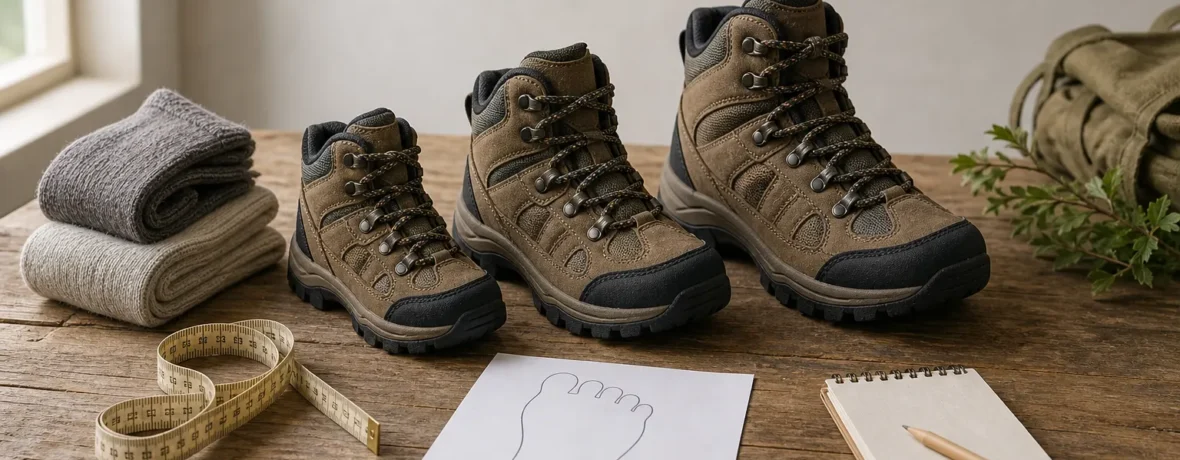
Kids hiking boots should fit with ⅜-⅝ inch [10-15 mm] of space in front of the longest toe while your child stands. Buy the larger-foot size, test them with hiking socks, and replace them when toes touch, heels slip badly, tread is smooth, or hikes start causing pain.
How should kids hiking boots fit?
The boot should feel snug at the heel and midfoot, roomy at the toes, and comfortable right away.
Kids do not need a stiff leather boot that feels like a cast. For most day hikes, a lightweight boot or mid-cut hiking shoe gives enough traction and ankle coverage without making every step clunky. The fit matters more than the label on the box.
Start with the toes. The American Podiatric Medical Association recommends 10-15 mm of toe room in front of the longest toe and a toe box at least as wide as the widest part of the foot. That lines up well with trail use: enough room for swelling and downhill movement, not so much that the foot slides around. See the APMA’s children’s footwear guidance for fit basics.
Check these zones:
- Toe box: toes can wiggle, spread, and sit flat. No curling. No pinky-toe squeeze.
- Length: ⅜-⅝ inch [10-15 mm] in front of the longest toe while standing.
- Heel: light movement is fine; lifting more than ¼ inch [6 mm] usually means the boot is too loose or the shape is wrong.
- Midfoot: secure when laced, with no hard pressure across the top of the foot.
- Ankle collar: supportive but not biting into the ankle bone.
Fit the bigger foot. Many kids have one foot that measures longer or wider than the other, and the smaller foot can be managed with lacing or a slightly thicker sock. The bigger foot cannot be negotiated with.
How do you measure a child’s foot for hiking boots?
Measure both feet while your child is standing, late in the day, wearing the socks they’ll hike in.
Feet spread under body weight. They also tend to swell after a day of school, running, and play. Measuring in the morning with bare feet gives you a number, but not the number you need for boots on trail.
- Put on hiking socks. Use the same sock thickness your child will wear on hikes. Thin cotton school socks will throw off the fit.
- Stand on paper. Tape the paper to the floor so it does not slide.
- Trace both feet. Keep the pencil straight up and down, not angled under the foot.
- Mark the longest toe and heel. The longest toe is not always the big toe.
- Measure heel to toe. Use inches, then convert if needed. Add ⅜-⅝ inch [10-15 mm] for toe room.
- Measure width. Mark the widest part of the forefoot. A wide foot in a narrow boot will not “break in” enough to fix pressure.
- Try boots in that size and the next half size. Shoe sizes are not perfectly consistent between brands.
After measuring, do a real fit check in the boots. Have your child stand, bend knees, march in place, climb stairs, and walk down a ramp if the store has one. If shopping online, keep the tags on and do the same test indoors on clean flooring.
What size hiking boots for kids should you buy?
Buy the smallest size that gives safe toe room, not the largest size you think they might grow into.
That sounds hard on the wallet. It is still the better move. Oversized boots can cause heel lift, toe gripping, sloppy footing, and blisters. On rocky trails, a loose boot makes kids work harder because every step needs extra correction.
Use this fit table as a quick guide:
| Fit check | What you want | What it means if wrong |
|---|---|---|
| Toe room | ⅜-⅝ inch [10-15 mm] | Less means cramped toes; more can mean sliding |
| Heel movement | Slight lift only | Big lift can rub blisters |
| Width | Forefoot lies flat | Bulging or pinching means wrong width |
| Downhill test | Toes do not hit front | Toe bump means too short or poorly laced |
If your child is between sizes, use the downhill test to decide. Lace the boot firmly, then have them walk down stairs or a sloped driveway. Toes should not bang the front. If they do, try a half size up, a different lacing pattern, or a boot with a different shape.
Do not assume “youth size 4” in one brand equals “youth size 4” in another. Kids’ hiking footwear can vary in length, width, volume, arch shape, and heel hold. The number gets you to the shelf. The foot decides the boot.
Should hiking boots for kids be waterproof?
Waterproof boots help in mud, snow, wet grass, and cold rain, but they are not always the best choice.
For shoulder-season hikes, shallow stream edges, and wet campsites, waterproof membranes can keep kids warmer and drier. That matters when temperatures drop and breaks get long. Wet feet lose heat fast, and unhappy feet can end a hike faster than a steep climb.
In hot weather, waterproof boots can feel sweaty. Once water gets in over the cuff, it also drains slowly. On summer trails, dry-climate hikes, or fast-moving kids who splash anyway, breathable non-waterproof hiking shoes may be more comfortable.
Here is the straight call:
- Choose waterproof boots for cold mud, snow patches, rain, wet grass, and slow family hikes with long stops.
- Choose breathable boots or shoes for hot days, dry trails, desert routes, and kids who sweat heavily.
- Pack dry socks either way. One spare pair can save the afternoon.
Waterproofing does not fix poor fit. A dry blister is still a blister.
Do kids need hiking boots or are sneakers fine?
Sneakers are fine on smooth, dry, easy trails, but boots help when terrain gets rough, wet, cold, or rocky.
Do not overbuild the setup. A three-year-old walking a flat nature loop does not need a heavy boot with a stiff shank. A ten-year-old carrying a daypack on a rocky trail may benefit from better tread, toe protection, and side support.
Pick the shoe for the trail, not for a catalog photo.
- Sneakers work well for: dry park paths, packed dirt, short nature trails, school field trips, and casual camping.
- Low hiking shoes work well for: warm-weather day hikes, faster kids, and trails with roots or loose dirt.
- Mid-cut boots work well for: muddy trails, colder weather, rocky paths, light backpacking, and kids who like ankle coverage.
- Insulated winter boots work well for: snow play and winter walks, but they can be too warm and bulky for regular hiking.
The sole matters. Look for grippy rubber with defined lugs, especially if your hikes include gravel, wet wood, slick rock, or steep dirt. Fashion boots with flat soles are not trail boots, even if they look rugged.
When should you buy new kids’ hiking boots?
Buy new boots when the fit, tread, or comfort fails; do not wait for the boot to fall apart.
Kids often outgrow footwear before they destroy it. Check fit before the first hike of each season, before any trip with big mileage, and anytime your child says their feet hurt. Younger kids may not explain the problem clearly. They may just slow down, trip more, ask to be carried, or get cranky.
Replace boots when you see any of these signs:
- Toes touch the front while standing or walking downhill.
- Your child’s toes are curled, cramped, or pressing sideways.
- Red marks appear across the toes, top of foot, heel, or ankle after a hike.
- The heel slips even when the boot is laced correctly.
- The sole is smooth where lugs used to grip.
- The upper is cracked, torn, or separating from the sole.
- The boot leaks through the upper, not just over the cuff.
- Your child starts refusing hikes in boots they used to wear without complaint.
A good habit: do a five-minute boot check two weeks before a planned trip. That gives you time to order, exchange, and let your child wear the boots around the neighborhood before trail day.
How much growing room should kids’ hiking boots have?
Give them ⅜-⅝ inch [10-15 mm] of room beyond the longest toe, not a full size “for later.”
The Canadian Paediatric Society gives similar advice for children’s footwear: leave roughly a thumb’s width between the longest toe and shoe tip while the child stands, and have the child try shoes on before buying. Their children’s footwear guide is a useful plain-language reference.
Trail footwear has a narrow sweet spot. Too small means toe bang, blackened toenails, pressure, and complaints. Too big means sliding, rubbing, tripping, and unstable footing. Growth room should be measured in fractions of an inch, not wishful thinking.
If you want the boots to last longer, look for models with:
- Half sizes, if available.
- Wide sizes for wide feet.
- Removable insoles, which make drying easier and allow a clearer fit check.
- Secure lacing or hook-and-loop straps that actually hold the heel.
- A roomy toe box that matches your child’s foot shape.
Do not use thick socks to make an oversized boot “work.” Thick socks can fill volume, but they cannot shorten the boot or lock the heel in place.
How do you tell if kids’ hiking boots are too small?
Small boots show up as toe pressure, red marks, changed walking, and downhill complaints.
Kids may not say, “My forefoot is compressed.” They may say, “I hate these,” or they may say nothing until the car ride home. Watch how they move.
Signs the boots are too small include:
- Toes hitting the front on descents.
- Toenails pressing into the upper.
- Redness on toe tips after removing socks.
- Complaints near the big toe, pinky toe, or top of the foot.
- Refusing to lace boots snugly because pressure hurts.
- Blisters on toe tips, between toes, or under toenails.
- A new habit of walking flat-footed or taking shorter steps downhill.
Pull out the insole if it is removable. Have your child stand on it with the heel lined up at the back. If toes spill over the front or sides, the boot is too small or too narrow. This is not a perfect measurement, but it is a quick visual check that catches many bad fits.
How do you prevent blisters in kids’ hiking boots?
Prevent blisters by fixing friction early: correct sizing, good socks, snug lacing, and fast attention to hot spots.
Blisters usually come from rubbing, moisture, pressure, or some combination of the three. Mayo Clinic’s blister first-aid guidance recommends protecting blisters and seeking care if signs of infection appear.
For hiking, the goal is to stop the blister before it forms. Teach kids the phrase “hot spot.” If part of the foot starts feeling warm, sharp, or rubbed, stop right then. Not at the viewpoint. Not after one more mile. Right then.
Pack a small foot kit:
- Spare wool or synthetic socks.
- Blister bandages or moleskin.
- Small scissors.
- A clean bandage.
- A small plastic bag for wet socks.
Skip cotton socks for longer hikes. Cotton holds moisture and can bunch up. Wool and synthetic hiking socks manage sweat better and hold their shape longer inside a boot.
Lacing helps, too. If the heel slips, use a heel-lock lacing method when the boot has suitable eyelets. If the top of the foot feels squeezed, loosen the lower laces slightly and snug the ankle. Small changes can turn a miserable boot into a workable one, as long as the size and shape are right.
How do you break in kids’ hiking boots?
Break them in with short, ordinary wear before the first real hike.
Modern kids’ boots should not need weeks of suffering. If the boot hurts in the living room, it will not become magical on granite. Still, even good boots need a few wear sessions so the upper flexes and your child learns how the laces should feel.
- Day 1: Wear them indoors for 20-30 minutes with hiking socks.
- Day 2: Walk around the block for 15-20 minutes.
- Day 3: Try stairs, a park path, or a short hill.
- Day 4: Check feet for red marks after wearing.
- First hike: Keep it short, bring spare socks, and stop for hot spots.
Do not send brand-new boots straight onto a full-day hike. That is how small fit problems become tears, blisters, and a long carry back to the trailhead.
What features matter most in kids’ hiking boots?
Fit comes first, then traction, weight, flexibility, protection, and easy closure.
Kids move differently from adults. They scramble, hop, drag toes, stomp in puddles, and forget to retie laces until someone trips. The best boot is the one that supports all of that without feeling like punishment.
Look for:
- Flexible forefoot: The boot should bend where the toes bend, not in the middle of the arch.
- Grippy outsole: Deep enough lugs for dirt, gravel, and roots.
- Toe bumper: Useful for rocky trails and kids who kick every stone on the path.
- Secure heel cup: Helps control rubbing and sloppy movement.
- Reasonable weight: Heavy boots tire small legs faster.
- Simple closure: Laces give adjustability; bungees and hook-and-loop closures help younger kids manage their own footwear.
- Removable insole: Speeds drying and helps with fit checks.
Avoid boots that are stiff from heel to toe, sharply narrow at the front, or hard to tighten evenly. If your child cannot walk naturally in the store, the trail will not improve things.
When to see a doctor
See a doctor if foot pain is severe, keeps returning, changes how your child walks, or comes with swelling, redness, warmth, drainage, numbness, or an open wound.
Boot fit can cause rubbing and soreness, but not every foot problem is a gear problem. MedlinePlus advises contacting a medical professional for foot pain in several situations, including severe pain, signs of infection, inability to walk, or foot problems in people with diabetes or circulation issues. Use MedlinePlus foot pain guidance as a general reference, not a diagnosis tool.
Get medical help sooner if your child has a blister that looks infected, a toenail injury with worsening pain, a puncture wound, or pain that does not improve with rest and a footwear change. If your child has a medical condition that affects circulation, sensation, skin healing, or gait, ask their clinician what footwear features they need before buying trail shoes or boots.
Related reading
- Hiking as a Family: Kids’ Boots, Realistic Distances and Keeping It Fun
- Teaching Leave No Trace to Kids
- Hiking With Kids: Distances, Games and Gear
- Hiking Games for Kids
FAQ
Should kids size up in hiking boots?
Yes, but only slightly. Aim for ⅜-⅝ inch [10-15 mm] of toe room while standing; sizing up more than that can cause sliding, heel rub, and tripping.
Are kids’ hiking boots supposed to feel tight at first?
No. They should feel secure, not tight. A little stiffness is normal, but pinching, toe pressure, numbness, or ankle rubbing means the size or shape is wrong.
Can kids wear regular sneakers for hiking?
Yes, on short, dry, smooth trails. Choose hiking boots or trail shoes when the route is rocky, muddy, steep, cold, or long enough that traction and foot protection matter.
How often should I check my child’s boot size?
Check before every hiking season, before bigger trips, and anytime your child complains or changes how they walk. For fast-growing kids, a quick monthly fit check during active seasons is smart.
What socks should kids wear with hiking boots?
Choose wool or synthetic hiking socks that fit smoothly without bunching. Avoid cotton for longer hikes because it holds moisture and can increase rubbing inside the boot.
Are used hiking boots okay for kids?
Used boots can work if the tread is solid, the upper is not warped, and the footbed has not molded heavily to another child’s foot. Skip used boots with uneven sole wear, crushed heel counters, odor that will not wash out, or any fit problem.