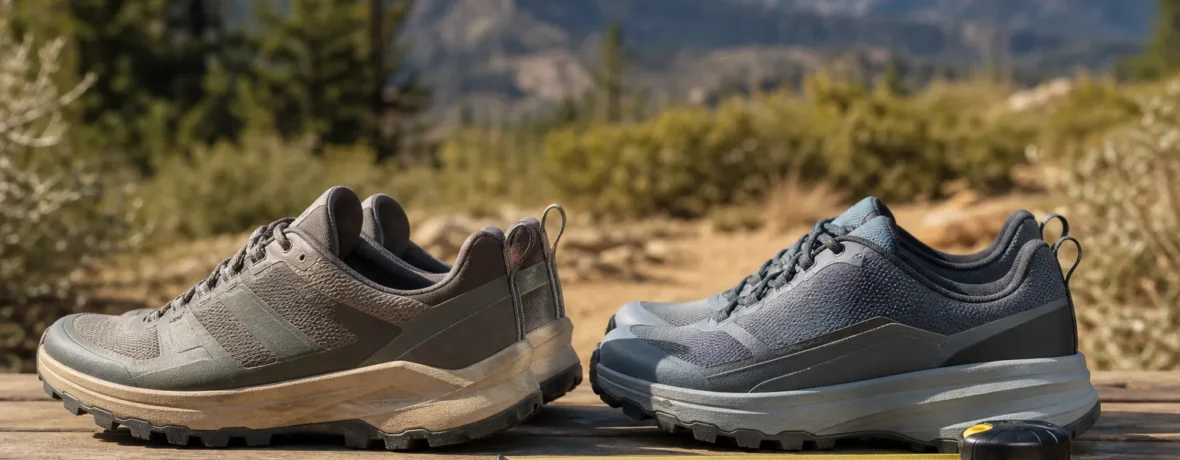
What is heel drop? Heel drop is the height difference between the heel and forefoot of a shoe. A zero-drop shoe keeps both at the same level; a 0.39 in [10 mm] drop puts your heel 0.39 in [10 mm] higher than your toes. For most hikers, 0.16-0.39 in [4-10 mm] works best.
What is heel drop in hiking shoes?
Heel drop is the slope inside your shoe from heel to toe. Brands may call it “heel-to-toe drop,” “offset,” or just “drop,” but they mean the same thing: the difference between the heel stack height and forefoot stack height. REI defines heel-to-toe drop as the difference in stack height between the heel and toe, measured in millimeters on footwear specs like trail runners and hiking shoes. REI’s trail-running shoe guide
Here’s the simple version. If the heel has 1.18 in [30 mm] of material under it and the forefoot has 0.87 in [22 mm], the shoe has a 0.31 in [8 mm] drop.
Heel drop is not the same as cushioning. A shoe can be thick and zero-drop. A shoe can also be thin and have a steep drop. Drop is the angle. Cushioning is the amount of foam, plate, rubber, and structure under your foot.
How is heel drop measured?
Heel drop is measured by subtracting forefoot stack height from heel stack height. The formula is:
Heel stack height – forefoot stack height = heel drop
Use the brand’s published number when you can. Measuring at home gets messy because outsoles, removable insoles, compressed foam, and rocker shapes can distort the result. Still, the concept is clean:
- Find the listed heel stack height.
- Find the listed forefoot stack height.
- Subtract the forefoot number from the heel number.
- Convert if needed: 0.16 in [4 mm], 0.24 in [6 mm], 0.31 in [8 mm], 0.39 in [10 mm].
One catch: your “real” drop changes under load. Softer foam compresses more under your heel if you land hard there, especially with a pack. That does not change the listed spec, but it can change how the shoe feels on trail.
What does zero drop mean in hiking shoes?
Zero drop means your heel and forefoot sit at the same height. In numbers, that is 0.00 in [0 mm] of heel-to-toe drop.
Zero-drop hiking shoes are often linked with a flatter, more natural stance. Altra, one of the best-known zero-drop footwear brands, describes its fit platform as using zero-to-low drop with a roomy toe box. Altra’s fit guide
But zero drop does not automatically mean barefoot. A zero-drop shoe can still have a thick midsole, a rock plate, a grippy outsole, and plenty of underfoot protection. The key detail is level geometry, not minimal cushioning.
| Drop range | How it feels | Best for |
|---|---|---|
| 0.00 in [0 mm] | Flat, level platform | Hikers used to zero-drop shoes or minimalist footwear |
| 0.04-0.16 in [1-4 mm] | Low, trail-sensitive stance | Hikers who want less heel lift but not a huge jump to zero |
| 0.20-0.31 in [5-8 mm] | Balanced and familiar | Most day hikers, backpackers, and trail-shoe converts |
| 0.35-0.47 in [9-12 mm] | More heel lift, less calf stretch | Hikers coming from traditional boots or who prefer a raised heel |
Is low heel drop better for hiking?
Low heel drop is better only if your body likes it and your trails match it. A lower drop can feel stable because your heel is not perched as high above the forefoot. On uneven ground, that can give some hikers a more planted feel.
But lower is not automatically better. Drop changes how your ankles, calves, Achilles tendons, knees, and hips share load. Drop also interacts with pack weight, stride length, slope, terrain, and your current footwear habits.
A low-drop shoe may suit you if you:
- Already wear low-drop running shoes or casual shoes.
- Prefer a shorter, quicker stride.
- Want more ground feel on technical trails.
- Have no current calf, Achilles, or plantar fascia pain.
- Are willing to transition slowly.
A higher-drop shoe may suit you if you:
- Are used to traditional hiking boots.
- Carry a heavy backpack.
- Have tight calves that complain on climbs.
- Prefer more heel cushioning on long descents.
- Want a familiar feel with less transition time.
How much heel drop should hiking shoes have?
Most hikers should start with a moderate drop: 0.20-0.31 in [5-8 mm]. That range gives you some heel lift without feeling as steep as many traditional boots.
If you already hike in boots with a raised heel, jumping straight to 0.00 in [0 mm] can be rough. Your calves and Achilles may need time to adapt because a flatter shoe asks them to lengthen more during walking, especially uphill.
Use your current shoes as the baseline. If your daily shoes and old hikers have a higher drop, move down in small steps. If you already wear flat shoes all day, zero-drop hiking shoes may feel normal fast.
How does heel drop affect your calves, Achilles, and knees?
Heel drop shifts stress around your lower body. Lower drop usually asks more from your calves and Achilles tendon; higher drop usually reduces that stretch but may feel less natural to hikers who prefer a flatter stance.
That does not mean a specific drop causes or fixes an injury. Bodies are not that simple. Foot strength, training load, pack weight, terrain, stride, shoe fit, and past injuries all matter.
If your Achilles is already irritated, be cautious with sudden changes. Mayo Clinic describes Achilles tendinitis as pain, tenderness, and stiffness along the tendon, and says worn-out or inappropriate footwear can contribute. Mayo Clinic on Achilles tendon pain
Heel pain under the foot can also come from plantar fascia irritation. MedlinePlus lists poor arch support and soft soles among risk factors for plantar fasciitis. MedlinePlus on plantar fasciitis
Bottom line: treat heel drop as a fit and comfort variable, not a magic cure.
How do you switch to a lower heel drop safely?
Switch slowly. Your feet and lower legs adapt better when you give them short, repeatable exposure instead of one big sufferfest.
- Check your current drop. Look up the specs for the shoes you wear most.
- Move down one step. If you are in 0.47 in [12 mm], try 0.31 in [8 mm] before 0.00 in [0 mm].
- Start with easy walks. Wear the new shoes around town before taking them on rocky trails.
- Keep hikes short at first. Use the lower-drop shoes for short day hikes, not your longest backpacking trip.
- Watch your calves. Mild muscle work is expected. Sharp pain is not.
- Rotate shoes. Alternate old and new pairs while your legs adapt.
- Add load last. Do not combine a new low-drop shoe, heavy pack, steep climb, and big mileage on the same day.
When to see a doctor
See a medical professional if pain changes your gait, keeps returning, or does not settle with rest and shoe changes. Do not try to self-diagnose tendon, heel, arch, or nerve pain from footwear alone.
Get checked sooner if you have sharp pain, swelling, bruising, numbness, tingling, sudden weakness, pain after a pop, or trouble bearing weight. For foot and ankle injuries, a clinician can examine range of motion, strength, tenderness, and whether imaging is needed.
If you have diabetes, circulation problems, neuropathy, or a history of foot ulcers, be more conservative with new footwear and pressure points. A small rubbing spot can become a bigger problem fast.
What should you look for besides heel drop?
Heel drop matters, but it is only one part of hiking shoe fit. A great drop number will not save a bad shoe.
- Toe room: Your toes need space to spread and room for descents.
- Heel hold: Your heel should stay planted without rubbing.
- Midfoot security: The shoe should lock your foot without crushing it.
- Traction: Match the outsole to dirt, granite, mud, roots, or mixed trail.
- Protection: Rocky trails may call for a rock plate, firmer foam, or toe rand.
- Cushioning: More stack can help on long days, but too much softness can feel wobbly.
- Flex: Stiffer shoes help with edging and load carrying; flexible shoes feel nimble.
Try hiking shoes late in the day or after a walk, when your feet are slightly swollen. Wear your real hiking socks. Test them on an incline if the shop has one. Your toes should not slam the front on descents.
Related reading
- How to Use a Compass for Hiking
- How to Waterproof a Tent: Seams, Rainfly and Floor
- How to Choose a Sleeping Bag: Temperature Ratings, Fill and Shape
- What Is Merino Wool and Why Hikers Swear By It
FAQ
Is heel drop the same as stack height?
No. Stack height is the total material under your foot, while heel drop is the difference between heel height and forefoot height. A shoe can have high stack and zero drop if both ends are equally tall.
Is zero drop good for backpacking?
Zero drop can work for backpacking if you are adapted to it. If you are not, start with day hikes first because a heavy pack increases the demand on your calves, Achilles, and feet.
What heel drop is best for beginners?
A moderate 0.20-0.31 in [5-8 mm] drop is a smart starting point for many beginners. It feels less extreme than zero drop and less steep than many traditional boots.
Can heel drop cause foot pain?
A sudden change in heel drop can contribute to foot or lower-leg pain, especially if you switch too fast. Pain can have many causes, so persistent or sharp pain deserves a medical check.
Do hiking boots have more heel drop than hiking shoes?
Many traditional hiking boots feel more raised at the heel than low-cut trail shoes, but the number depends on the model. Always check the listed heel-to-toe drop instead of judging by looks.
Should you choose heel drop based on terrain?
Yes, but terrain is only part of it. Lower drop can feel stable on uneven ground, while higher drop can feel familiar and supportive on long descents or with a pack.