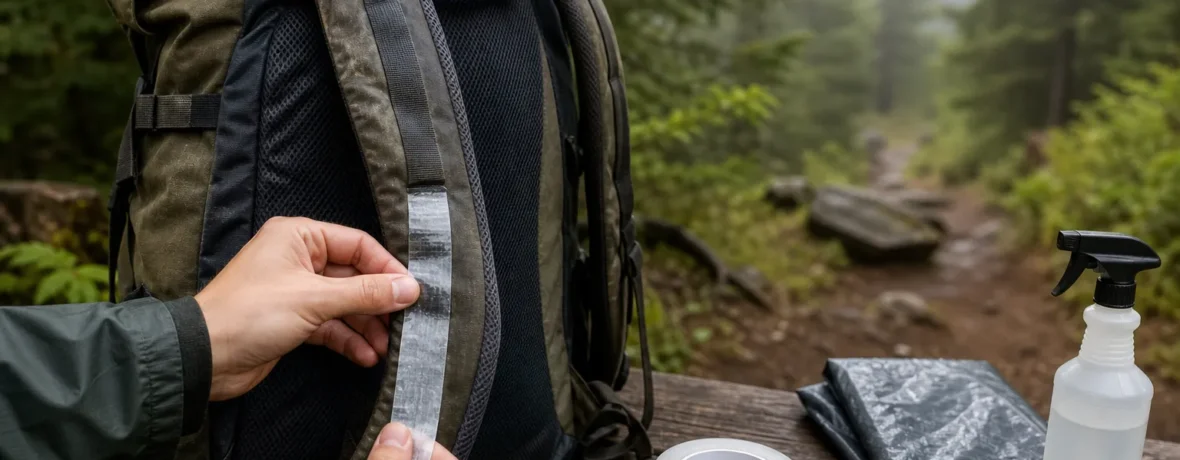
To waterproof a backpack, use three layers: a pack liner inside, a fitted rain cover outside, and refreshed water-repellent treatment on clean fabric. Seam-seal worn stitching and repair holes first. This setup will handle steady rain, wet brush, and splash, but not full submersion.
Can you really waterproof a backpack?
Yes, you can make a backpack highly rain-resistant, but most hiking packs will never be truly waterproof.
That sounds picky. It matters. A dry bag can survive dunking. A standard hiking backpack usually has stitched seams, zippers, hydration ports, stretch mesh, foam panels, and fabric that wets out after enough rain. Water finds those weak points.
Your goal is not magic. Your goal is a layered system that keeps your insulation, electronics, first-aid kit, and sleep gear dry through real trail weather. The best setup is simple:
- A waterproof liner inside the main compartment
- Dry bags or zip bags for must-stay-dry items
- A rain cover for exterior protection
- Clean, treated pack fabric so rain beads instead of soaking in
- Sealed seams and repaired holes where water can sneak through
That system beats trusting the pack fabric alone. It also gives you backup if wind flips a rain cover, water runs down your back, or you set the pack in wet grass during lunch.
How do you waterproof a backpack step by step?
Start inside the pack, then work outward.
This is the trail-tested order because internal protection matters most. If the outside fails, the liner still saves your down jacket and sleeping bag.
- Empty every pocket. Shake out grit, crumbs, pine needles, and old snack dust. Check the lid, hipbelt pockets, side pockets, and hydration sleeve.
- Clean the pack by hand. Use warm water, mild soap, and a soft brush. Osprey’s pack care guidance says not to machine wash packs and recommends cleaning them in a tub or large sink with mild detergent and warm water. Read Osprey’s backpack cleaning advice.
- Rinse until no soap remains. Soap residue can interfere with water-repellent treatments and make fabric attract grime faster.
- Air-dry the pack. Hang it in shade or a ventilated room. Do not cook it beside a heater. Heat can damage foam, coatings, glue, and buckles.
- Inspect the damage zones. Look at the bottom panel, shoulder-strap anchors, haul loop, side seams, zipper stitching, and any abrasion spots.
- Patch holes first. Use a fabric repair patch on pinholes and tears. Round the patch corners so they do not peel.
- Seal leaky seams. Apply a thin bead of seam sealer along worn or uncoated seams, especially near the bottom and lid. Gear Aid’s Seam Grip WP is made to seal and repair outdoor gear seams and waterproof fabrics. See Gear Aid’s seam sealer guidance.
- Refresh the DWR. Spray water-repellent treatment on the clean outer fabric, focusing on high-wear panels. Let it cure according to the product label.
- Add a pack liner. Line the main compartment with a trash compactor bag, purpose-built pack liner, or roll-top dry bag.
- Use smaller dry bags for critical gear. Sleeping bag, puffy jacket, spare socks, phone, battery bank, and first-aid supplies deserve their own protection.
- Fit a rain cover. Pull it over the loaded pack, cinch it tight, and make sure it wraps the corners without blocking your shoulder straps.
- Test it at home. Spray the loaded pack with a hose or shower for 3 minutes. Then open it and check every layer.
Do the test before the trip. Finding a leak in your garage is boring. Finding it at 10 p.m. with wet socks and a damp quilt is a full-body regret.
What is the best way to keep gear dry inside a backpack?
A waterproof liner is the most reliable way to keep gear dry inside a backpack.
Rain covers help, but they do not protect the back panel. They can also shift in wind, snag on brush, or let water run between your rain jacket and pack. A liner sits inside the main compartment and protects the gear that matters most.
You have three good liner choices:
| Method | Best for | Tradeoff |
|---|---|---|
| Trash compactor bag | Cheap, light, strong internal lining | No roll-top closure unless you twist and fold it well |
| Roll-top pack liner | Backpacking in steady rain | Costs more than a plastic liner |
| Individual dry bags | Organizing sleep gear, clothing, electronics, and food | More pieces to manage during packing |
The cleanest setup is one large liner for the main compartment, then smaller dry bags only for the gear that cannot get wet. Do not dry-bag every single item unless you like wrestling a pile of slippery footballs every morning.
Pack soft items low and tight. Twist or roll the liner closed above them. Keep the closure facing down or tucked against the pack body so water cannot pool inside the fold.
Do backpack rain covers work?
Yes, backpack rain covers work well against falling rain and wet brush, but they are not enough by themselves.
A rain cover protects the outer shell of the pack. That reduces wet-out, keeps the pack lighter, and shields zipper lines and exterior pockets. Osprey rain covers, for example, use taped seams and a drawcord fit on its ultralight models. See Osprey’s rain cover features.
Still, a cover has gaps. Your shoulder straps and back panel stay exposed. Rain can run down your jacket and into the space between you and the pack. Wind can lift the cover. Brush can pull it sideways. If you bushwhack, scramble, or hike above treeline in gusts, treat a cover as your outer shield, not your only shield.
Fit matters. A floppy oversized cover catches wind. A tiny cover leaves corners exposed. Choose a cover that matches your loaded pack volume, not the number printed on the empty pack. A 50-liter pack with a foam pad, wet tent, and sandals strapped outside may need more coverage than a tidy 50-liter load inside the pack body.
- Use a bright cover if you hike roads, hunting areas, or storm-dark trails.
- Choose a cover with a cinch cord so it stays wrapped around the bottom.
- Dry the cover completely after a trip to prevent mildew.
- Carry it where you can grab it fast, not buried under your food bag.
Should you use waterproofing spray on a backpack?
Yes, use waterproofing spray on a clean backpack when water no longer beads on the fabric.
Most hiking packs use durable water repellent treatment, often called DWR, on the outside fabric. DWR does not make a sewn backpack dunk-proof. It helps rain bead and roll away instead of soaking the face fabric.
Patagonia’s care guidance for waterproof gear explains that dirt, body oil, sunscreen, and smoke can reduce DWR performance, and that washing and drying can help restore water repellency on some fabrics. Read Patagonia’s product care guidance.
For packs, spray-on treatment is usually the better choice than wash-in treatment. A wash-in product can coat padding, mesh, straps, and foam that do not need it. Spray lets you target the pack body, lid, side panels, and bottom.
Use this quick spray routine:
- Start with a clean, damp pack unless the product label says dry fabric.
- Spray evenly on the pack body from 6 inches [15 cm] away.
- Focus on the lid, front panel, bottom panel, and side pockets.
- Wipe excess treatment off buckles, foam, and mesh.
- Let the pack dry fully before storing or loading it.
Nikwax TX.Direct Spray-On is designed for breathable waterproof clothing, while Nikwax also makes tent and gear treatments. Match the product to the fabric and read the label before using it on a pack. See Nikwax’s TX.Direct product guidance.
How do you seal backpack seams and zippers?
Seal seams with a thin, even layer of seam sealer, and protect zippers with covers instead of glue.
Backpack seams leak because stitching punches holes through fabric. Some packs have bound or taped internal seams. Many do not. The leakiest spots are usually the bottom, lid, hydration port, side compression strap anchors, and any seam that rubs against rock or dirt.
Before sealing, clean the seam and let it dry. Lay the pack so the seam is flat. Apply a thin bead with a small brush or applicator. More is not better. Thick globs stay tacky, collect dirt, and look like a field repair done during a raccoon attack.
Do not smear seam sealer into zipper teeth. It can gum up the slider. For zippers, use water-resistant zipper garages, a rain cover, and smart packing. Keep electronics and paper maps inside a liner or zip bag, not in the top pocket during a downpour.
If your pack has a roll-top closure, inspect the fold line. Cracked coatings there are common on older waterproof-style packs. A patch may work for small wear spots. If the coating is flaking across large panels, replacement is usually smarter than chasing leaks forever.
What gear do you need to waterproof a backpack?
You need cleaning supplies, a liner, dry bags, seam sealer, repair patches, DWR spray, and a rain cover.
You do not need a workbench full of specialty tools. A kitchen sink, tub, or garage floor is enough.
- Mild soap or technical gear wash
- Soft brush or sponge
- Clean towel
- Fabric repair patches
- Seam sealer compatible with nylon or polyester gear
- Spray-on water-repellent treatment
- Trash compactor bag or roll-top pack liner
- Small dry bags or zip bags
- Fitted backpack rain cover
- Disposable gloves for seam sealer
Skip heavy household waterproofing sprays unless the label clearly says they are safe for outdoor fabrics. Some coatings stiffen fabric, stink for days, or damage breathable membranes. If the pack has a warranty you care about, check the brand’s care page before spraying anything aggressive.
How do you pack a backpack for heavy rain?
Pack the gear that must stay dry inside the liner, then assume every exterior pocket will get wet.
That mindset fixes most rain problems. Exterior storage is convenient, but it is not secure weather protection. Side pockets, shove-it pockets, hipbelt pockets, and lid pockets see direct rain, splash, and runoff.
Use this wet-weather packing plan:
- Inside the liner: sleeping bag, quilt, sleep clothes, insulating jacket, dry socks, gloves, and electronics.
- In small dry bags: first-aid kit, battery bank, headlamp, paper maps, repair kit, and medications.
- Outside the liner but inside the pack: cook kit, fuel, food, tent body, and items that can handle dampness.
- Exterior pockets: rain jacket, water bottles, wet tarp, tent stakes, snacks for the next mile, and items you can dry later.
Keep your shelter accessible. If rain is already falling when you hit camp, you do not want to unload your dry sleep system before pitching the tent. In nasty weather, pack the shelter where you can grab it first.
Line the pack before loading it. Stuffing a liner around gear after the pack is full leaves folds, gaps, and trapped water channels. Put the liner in first, load dry gear, then close it with several rolls or a tight twist.
Can you waterproof an old backpack?
Yes, you can improve an old backpack, but damaged coatings and failing fabric set the limit.
Older packs often leak for three reasons: worn DWR, abraded fabric, and cracked internal coatings. DWR is easy to refresh. Small holes are easy to patch. Seam leaks can be sealed. A sticky, peeling interior coating is harder. Once the coating sheds flakes across the whole pack, you can still use a liner, but the pack shell itself will not be reliably waterproofed again.
Use this decision rule: repair small, localized failures; retire widespread material failure. A few pinholes on the bottom? Patch them. One leaky seam? Seal it. Crumbling coating from top to bottom? Make it a dry-weather hauler or replace it before a long wet trip.
Also check the comfort parts. Waterproofing the fabric will not save a pack with torn shoulder straps, failing hipbelt foam, or cracked buckles. Rain is one problem. Carry failure is a bigger one.
What mistakes make backpacks leak?
The biggest mistake is relying on one layer of protection.
A rain cover alone is not enough. DWR alone is not enough. A dry bag thrown loosely into an unlined pack is better than nothing, but water can still soak clothing and food around it. Build redundancy.
- Spraying a dirty pack: grime blocks treatment from bonding well.
- Forgetting the bottom panel: wet ground soaks packs faster than falling rain.
- Leaving the liner open: an open liner is just a crinkly decoration.
- Overstuffing the rain cover: exposed corners invite water in.
- Storing gear damp: mildew can damage fabric and make your pack smell permanent.
- Putting phones in lid pockets: lid pockets get hammered by rain and runoff.
After each wet trip, unpack everything at home. Open every pocket. Pull out the liner. Hang the pack and rain cover until completely dry. Store the pack loose, not compressed under a stack of bins.
Related reading
- How to Waterproof a Tent: Seams, Rainfly and Floor
- How to Pack a Hiking Backpack: Weight Zones and a Simple Diagram
- How to Choose a Hiking Backpack: Volume, Torso Length and Fit
- How to Attach a Sleeping Bag to a Backpack
FAQ
What is the fastest way to waterproof a backpack before a hike?
Use a pack liner and a rain cover. That gives you immediate protection without waiting for sprays or seam sealer to dry.
Can I use a garbage bag as a backpack liner?
Yes, but a trash compactor bag is stronger than a standard kitchen garbage bag. Twist the top tightly or fold it down several times so water cannot spill inside.
Is a waterproof backpack better than a rain cover?
A waterproof backpack is better for paddling, canyons, and very wet travel, but a rain cover plus liner is more flexible for hiking. Standard waterproof packs can be heavier, less breathable against your back, and less pocket-friendly.
How often should I reapply waterproofing spray?
Reapply it when water stops beading on clean fabric. If rain darkens the pack fabric quickly instead of rolling off, clean the pack and refresh the treatment.
Will seam sealing make my backpack fully waterproof?
No, seam sealing reduces leaks but does not seal zippers, back panels, hydration ports, or every stitch hole. Use it with a liner and rain cover for dependable trail protection.
Can I put my backpack in the dryer after waterproofing?
Usually no. Many backpack brands recommend air drying because heat can damage foam, coatings, adhesives, and plastic hardware. Follow the care label and the waterproofing product instructions.