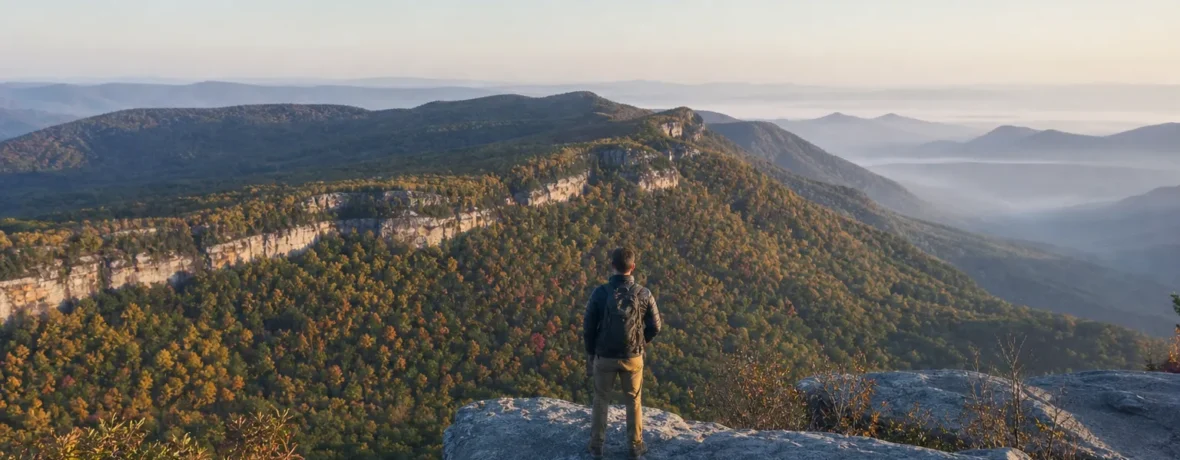
The history of the Appalachian Trail starts with Benton MacKaye’s 1921 vision, becomes organized work in 1925, reaches a continuous footpath in 1937, gains federal protection in 1968, and still depends on volunteers today. The A.T. is not one person’s monument. It is a public promise, rebuilt every season.
What is the history of the Appalachian Trail?
It is the story of a big idea made real by local hands.
The Appalachian Trail began as a proposal, not as a shovel in the dirt. In 1921, forester and regional planner Benton MacKaye published “A Project for an Appalachian Trail,” arguing for a long Appalachian ridgeline route that would give Eastern city dwellers access to wild country, camps, and a saner relationship with work and leisure. You can read the original proposal through the National Park Service history archive.
That idea could have stayed on paper. Plenty do. What saved it was organization. The Appalachian Trail Conference, now the Appalachian Trail Conservancy, formed on March 2-3, 1925, to turn MacKaye’s plan into a marked footpath. The first A.T.-specific sections were completed in New York at Bear Mountain, and by the early 1930s the project had shifted from dream to route-finding, blazing, clearing, mapping, and relentless persuasion.
Here is the point hikers should keep in their heads: the A.T. was never just “built.” It was negotiated. Across farms, forests, state parks, national forests, ridgelines, gaps, roads, towns, and private land. A trail this long does not happen because one visionary has a good afternoon. It happens because clubs, agencies, landowners, and volunteers keep saying yes.
Who built the Appalachian Trail?
Private citizens, hiking clubs, public agencies, and Depression-era crews built it.
If you ask who built the Appalachian Trail, the clean answer is this: Benton MacKaye imagined it, the Appalachian Trail Conference organized it, Myron Avery drove much of the early execution, and local trail clubs did the hard work on the ground.
The National Park Service describes the A.T. as “conceived in 1921, built by private citizens, and completed in 1937.” That sentence matters. It pushes back against the easy myth that the Trail was a top-down federal project. It was not. The federal government later became central to protecting it, but the original push came from civic muscle: club meetings, hand tools, maps, blazes, letters, scouting trips, and sweat.
Myron Avery deserves a hard nod. He took over leadership of the ATC in 1931 and pushed the work forward with a practical system: organize clubs for sections, settle the route, clear and mark the tread, then publish reliable data and maps. That sounds dry. It is not. That is how a dotted line becomes a path you can actually follow.
The Civilian Conservation Corps also helped in key areas, especially on public lands. But the deeper truth is that the A.T. was built by a culture of shared responsibility. That culture is still the Trail’s backbone.
When was the Appalachian Trail completed?
The A.T. was first fully connected in 1937.
By 1937, the footpath ran continuously from Maine to Georgia. Today, the official 2026 length is 2,197.9 miles [3,537 km], running from Springer Mountain in Georgia to Katahdin in Maine, according to the Appalachian Trail Conservancy’s A.T. basics.
But “completed” is a slippery word on a living trail. A hurricane broke continuity soon after the 1937 milestone, and World War II pulled people and attention away. The route was restored by 1951. Since then, the Trail has kept changing through relocations, land protection, erosion control, storm repairs, bridge work, and reroutes.
That is not a flaw. That is the nature of a footpath almost 2,200 miles long. A road gets paved and pretends to be finished. A trail admits the truth: weather, land ownership, ecology, and people keep moving.
| Year | What happened | Why it mattered |
|---|---|---|
| 1921 | Benton MacKaye proposed an Appalachian Trail. | The idea joined recreation, conservation, and regional planning. |
| 1925 | The Appalachian Trail Conference formed. | The dream gained an organization. |
| 1937 | The route was fully connected from Maine to Georgia. | The A.T. became a continuous long-distance footpath. |
| 1968 | The National Trails System Act made the A.T. a national scenic trail. | The Trail gained federal protection and a national model. |
Why was the Appalachian Trail created?
It was created as an antidote to crowded, industrial life.
MacKaye did not pitch the Trail as a sport route for fast hikers chasing big mileage. His vision was wider and, frankly, more radical. He saw the Appalachian ridgeline as a place where people from Eastern cities could recover perspective, build outdoor skills, and experience a different rhythm from factory and office life.
That part of the history can feel quaint until you look around. The old pressures have new clothes. Screens, traffic, burnout, noise, and shrinking attention spans have replaced some of the smokestacks, but the need is the same. People still need a strip of land where the deal is simple: walk, carry your own kit, read the weather, and be decent to the people behind you.
Here is the position: the Appalachian Trail’s greatest achievement is not its length. Length is impressive, sure. But the true achievement is that the Trail gives ordinary people access to a continuous public corridor of Appalachian mountains, towns, forests, farms, and culture. It is a democratic piece of wildness, not a private playground.
How did the Appalachian Trail become federally protected?
Federal protection came through the National Trails System Act of 1968.
The A.T. was one of the first two national scenic trails designated under that act. That changed the Trail’s future. Before federal protection, relocations and road walks were constant threats, because the footpath often crossed private land through informal permission or fragile agreements.
The Appalachian Trail Conservancy history timeline tracks the next major leap: 1976 amendments to the National Trails System Act helped launch a massive land-acquisition effort to protect the A.T. corridor. In plain English, the country decided the Trail needed more than paint on trees. It needed land beneath the blazes.
That shift matters every time you step from a road crossing back into trees. The protected corridor is what keeps the Trail from becoming a long series of disconnected scenic scraps. The A.T. survived because people stopped treating it as a line and started treating it as a landscape.
How has the Appalachian Trail changed since 1937?
It has become better protected, better managed, and far more popular.
The first connected A.T. was rougher, looser, and less secure than the Trail hikers know now. Some early sections went straight up and down mountains. Some crossed land by temporary goodwill. Some were vulnerable to roads, development, storms, and neglect.
The modern Trail is still rugged, but it is managed through a partnership among the National Park Service, U.S. Forest Service, Appalachian Trail Conservancy, state agencies, local communities, and thousands of volunteers. It passes through 14 states and 25 federally designated wilderness areas. White blazes mark the main route; in some wilderness areas, blazes are intentionally less frequent to preserve wild character.
The Trail also now carries cultural weight. Earl Shaffer’s reported 1948 thru-hike helped make end-to-end hiking part of the A.T. story. Later hikers, guidebook writers, clubs, ridge runners, maintainers, hostel owners, and trail towns added layers to that culture. Some of it is beautiful. Some of it is messy. All of it is human.
The risk now is loving the Trail to death while forgetting who keeps it open. The tread under your boots is not self-maintaining. Water bars clog. Blowdowns fall. Shelters rot. Privies fill. Paint fades. Easements need defending. Every thru-hike rests on work the hiker will never fully see.
What can hikers learn from the history of the Appalachian Trail?
You should treat the A.T. like inherited work, not just a backdrop.
The A.T. teaches a blunt lesson: public goods survive when people participate. Posting summit photos is fine. Walking from Georgia to Maine is fine. But if hikers want the Trail to exist for the next century, the culture has to tilt toward care.
That means doing the small stuff well:
- Stay on the marked tread instead of widening muddy sections.
- Use established campsites where required or clearly expected.
- Pack out trash, including the tiny trash: tabs, wrappers, floss, tape, and fruit peels.
- Give volunteers room to work and thank them without making them your concierge.
- Check current closures and alerts before a trip, especially after storms.
- Join a work trip if you can swing a day with a saw, lopper, or shovel.
The strongest argument from the A.T.’s past is simple: the Trail exists because people refused to be passive users. They became builders, maintainers, advocates, donors, mapmakers, club officers, corridor monitors, and local defenders. If you hike it, you enter that story. You do not have to be heroic. You do have to be less careless.
What are the main steps in Appalachian Trail history?
The A.T. moved from vision to organization to protection.
- Idea: In 1921, Benton MacKaye proposed a long Appalachian route tied to recreation, conservation, and relief from industrial life.
- Organization: In 1925, the Appalachian Trail Conference formed to coordinate the work.
- Construction: Through the 1920s and 1930s, clubs and crews scouted, cleared, marked, and mapped the route.
- Connection: In 1937, the Trail became continuous from Maine to Georgia.
- Restoration: After hurricane damage and wartime neglect, continuity was restored by 1951.
- Protection: In 1968, the A.T. became a national scenic trail; later laws and land acquisition strengthened the corridor.
- Stewardship: Today, agencies, the ATC, clubs, communities, and volunteers keep the Trail alive.
Related reading
- How Long Is the Appalachian Trail? Miles, States and Time
- Where Does the Appalachian Trail Start and End?
- How Long Does It Take to Hike the Appalachian Trail?
- What States Does the Appalachian Trail Go Through?
FAQ
Who came up with the Appalachian Trail?
Benton MacKaye proposed the Appalachian Trail in 1921. He was a forester and regional planner who saw the Appalachian ridgeline as a place for recreation, recovery, conservation, and public access.
Was the Appalachian Trail built by the government?
No, not at first. The original Trail was built largely by private citizens and hiking clubs, with help from public agencies and Depression-era work crews in some areas; federal protection came later.
How long is the Appalachian Trail?
The official 2026 length is 2,197.9 miles [3,537 km]. The exact mileage changes because the route is adjusted for relocations, repairs, and land-management needs.
When did the Appalachian Trail become a national scenic trail?
It became a national scenic trail in 1968 under the National Trails System Act. That designation helped move the A.T. from a fragile footpath to a protected national corridor.
Why does the Appalachian Trail keep changing?
The Trail changes because land, weather, erosion, roads, bridges, and conservation needs change. Reroutes are not a betrayal of history; they are how the A.T. survives.
What is the biggest lesson from Appalachian Trail history?
The biggest lesson is that trails are made by communities, not slogans. The A.T. exists because generations of people built it, protected it, and kept showing up after storms, politics, and neglect.