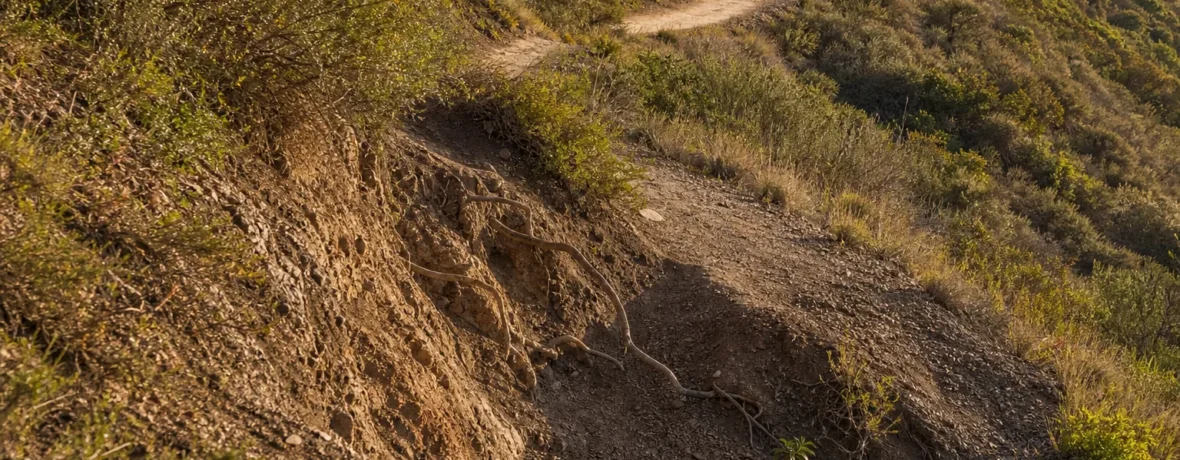
Trail erosion is soil loss from repeated foot traffic and water. Yes, shortcuts matter: a 20-second cut across a switchback can strip vegetation, compact soil, and create a fall-line rut that rain follows downhill. Stay on the built tread, even when muddy, unless an official sign says otherwise.
Here’s the straight answer: shortcutting is not harmless. It is not savvy. It is not “just one person.” On a hillside, a shortcut is often the start of a second trail that nobody designed, nobody armored, and nobody asked volunteers to maintain.
The position is simple: if you care about trails, you do not cut them. You hike the extra bend. You take the wider arc. You let the trail do the job it was built to do.
What is trail erosion?
Trail erosion is the wearing away of trail soil by water, gravity, wind, and traffic.
On a hiking trail, erosion usually starts when bare soil gets loosened by boots, hooves, tires, or flowing water. Once the surface loses its protective cover of plants, roots, duff, rock, or compacted tread, it becomes easier for rain to move the soil downhill. A shallow scuff becomes a groove. A groove becomes a rut. A rut becomes a drainage ditch with footprints.
That is why a trail is more than a line through the woods. A good trail is a drainage system. It sheds water before water gathers speed. It crosses a slope at a manageable grade. It uses turns, dips, rock, steps, and hardened tread to keep feet and runoff in the right places.
Leave No Trace guidance on durable surfaces says hikers should stay within the trail’s width and avoid shortcutting switchbacks because concentrating travel on a designed route reduces the spread of unwanted paths.
How do shortcuts cause trail erosion?
Shortcuts cause trail erosion by turning steep ground into an unplanned water channel.
Most shortcuts run straight down the fall line, which is the direction water naturally wants to flow. A real trail often crosses a slope at an angle. A shortcut ignores that. When hikers cut between two switchback legs, they scrape off plants, crush roots, loosen soil, and give rain a new downhill groove to follow.
Then the feedback loop begins:
- One hiker cuts the corner. The vegetation bends or breaks.
- The next hiker sees a faint line. The shortcut now looks like an option.
- More boots compact the soil. Water soaks in less easily and runs faster.
- Rain follows the scar. The shortcut deepens into a rut.
- Soil washes onto the real trail. Crews must clear sediment, rebuild tread, or close the scar.
The U.S. Forest Service publication Low-Impact Recreational Practices for Wilderness and Backcountry states the blunt field truth: shortcuts between switchbacks usually erode severely. That is not a vague etiquette concern. It is trail damage.
Why is cutting switchbacks bad?
Cutting switchbacks is bad because switchbacks exist to control grade, water, and wear.
A switchback is not there to annoy you. It is there because the hill is too steep for a straight, durable trail. By stretching the climb across the slope, a switchback lowers the grade and gives water chances to drain off the tread instead of ripping straight downhill.
Cut across it and you defeat the design. You also create a visible scar that invites other hikers to follow. The result is a messy braid of tracks, exposed roots, loose stones, and widening bare ground.
The USFS Trail Maintenance and Construction Notebook describes switchbacks as structures used on steep hillside slopes and shows how natural obstacles can discourage shortcutting. That should tell you something: trail builders expect the temptation, and they build against it.
| Choice | What happens on the ground | Best move |
|---|---|---|
| Stay on the switchback | Traffic stays on hardened tread and drainage keeps working. | Do it, even if it adds steps. |
| Cut the corner | Plants get crushed and a steep rut can form. | Skip it. It saves seconds, not effort. |
| Walk around mud | The trail widens and soft edges break down. | Step through the center when safe. |
| Follow a faint side path | A social trail becomes more obvious. | Return to the signed or built trail. |
Is it okay to walk around mud on a trail?
No, not usually; walking around mud widens the trail and damages the edges.
Mud is annoying. Nobody loves a boot full of brown soup. But the edge of a muddy trail is often where plants, roots, moss, and soft soil are still holding the corridor together. When hikers skirt the puddle one by one, the trail grows from 2 feet wide [0.6 m] to 6 feet wide [1.8 m], then wider. The wet spot remains, and now the damage covers more ground.
The better habit is plain: go through the middle when it is safe. Use waterproof footwear, slow your pace, and accept that trails are not sidewalks. If the mud is deep enough to create a safety problem, turn around or choose another trail for the day.
At North Cascades National Park, NPS Leave No Trace guidance tells visitors to protect vegetation and reduce erosion by staying on the trail, avoiding parallel trails, and not cutting switchbacks. That applies perfectly to mud season.
What should you do when you see a shortcut on a hiking trail?
Do not use it, and do not try to rebuild it unless you are part of an approved trail crew.
A shortcut can look official after enough people step on it. That is the trap. Look for the clues: the main trail has a consistent tread, signs, blazes, constructed turns, drainage features, steps, rock work, or a clear corridor. A shortcut often looks steeper, narrower, looser, and more direct than the built route.
Use this quick checklist:
- Stay on the signed trail or the most clearly constructed tread.
- Do not step over logs, rocks, or brush placed across a shortcut.
- Do not remove barriers, even if the line looks convenient.
- Do not create your own “better” path around roots, rocks, snow, or mud.
- If erosion looks severe, report the location to the land manager or local trail association.
Trail work is skilled work. Tossing branches onto a scar may help in some places and fail badly in others. Crews may need drainage, scarification, transplanting, rock, fencing, or a formal reroute. Good intentions do not replace permission.
How can hikers help prevent trail erosion?
You prevent erosion by keeping your feet where the trail was built to handle them.
This is not complicated, which is why excuses sound thin. You can do nearly all of the right things with ordinary trail discipline.
- Stay in the center of the trail. Single file is better than walking shoulder to shoulder on narrow tread.
- Respect switchbacks. If the trail turns, you turn.
- Step through mud when safe. Wear shoes that can get dirty.
- Use durable surfaces off-trail. Rock, gravel, sand, dry grass, and snow handle travel better than wet meadows or fragile plants.
- Follow closures and signs. A closed trail may be protecting new tread, unstable soil, wildlife, or visitors.
- Volunteer or donate. Trail crews fix drainage, rebuild tread, close social trails, and harden weak spots.
There is also a social piece. If someone in your group starts cutting, say something simple: “Let’s stay on the trail.” No lecture. No performance. Just a course correction. Trail culture is built out loud, one small nudge at a time.
Are shortcuts ever acceptable on a trail?
Yes, but only when the shortcut is an official reroute or the land manager clearly directs you that way.
Sometimes a new trail segment replaces an old one. Sometimes a temporary detour avoids a washout, fire area, construction zone, or unsafe bridge. In those cases, follow the posted route. The key word is posted. A dirt line made by impatient feet is not permission.
If you are hiking cross-country in a place where off-trail travel is allowed, the ethic changes. Instead of concentrating footsteps into a new path, spread out on durable surfaces so your group does not grind a fresh trail into the landscape. That is the opposite of switchback cutting, where many hikers hammer the same bad line into steep soil.
Related reading
- Why Is It Called Trail Mix?
- Is the Inca Trail Worth It?
- A Short History of the Appalachian Trail
- Who Pays for Trails?
FAQ
What causes the most trail erosion?
Water moving down exposed soil is the main driver on many hiking trails. Foot traffic makes the problem worse by loosening soil, compacting tread, crushing vegetation, and creating grooves that collect runoff.
Why should you not cut switchbacks?
You should not cut switchbacks because it damages the trail’s drainage design. A shortcut often runs straight downhill, strips vegetation, and can turn into an eroded rut that spreads sediment onto the built trail.
Should I walk through mud or around it?
Walk through the center of the mud when it is safe. Going around widens the trail, damages plants along the edge, and creates more bare soil for future erosion.
What is a social trail?
A social trail is an unofficial path created by repeated use, not by design or approval. Social trails often form near viewpoints, campsites, water sources, and switchbacks, and many are steep, eroded, or unsafe.
Can one hiker really make trail erosion worse?
Yes, one hiker can make it worse by being the first visible track others follow. The bigger damage happens when that single choice becomes a pattern, so your best move is to avoid starting or reinforcing the shortcut.
How do I report a badly eroded trail?
Report it to the agency, park, forest, or trail association that manages the route. Share the trail name, nearest junction or mile point, photos if you have them, and a clear description of the erosion or shortcut.