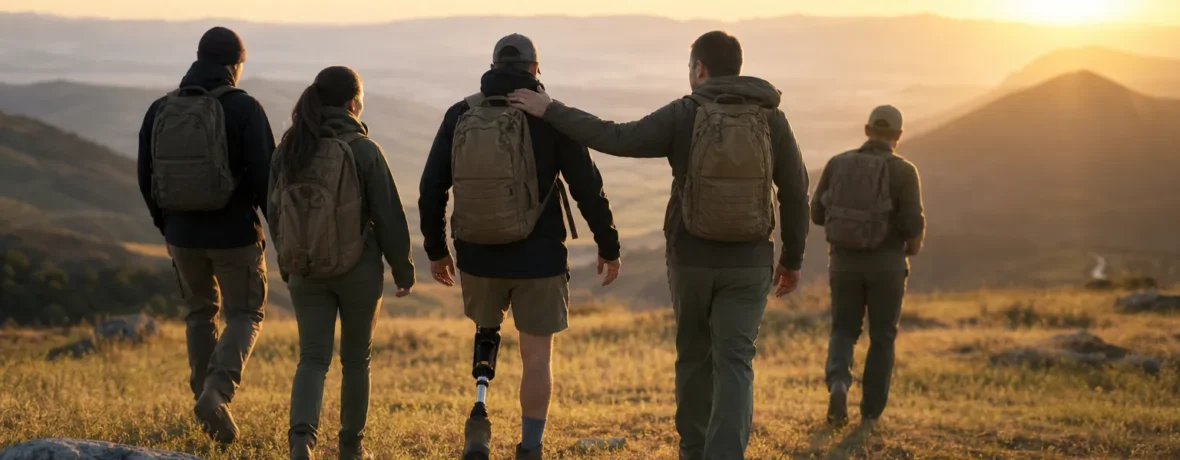
Veterans hiking programs include multi-month thru-hikes, 5- to 7-day backpacking courses, local adaptive outings, and self-guided trips supported by free federal recreation passes. Yes, you can find free options if you qualify: some cover tuition, gear, training, and route support; others only organize the group hike.
Which veterans hiking programs should you look at first?
Start with programs that match your time, body, budget, and need for support.
The best choice is not always the longest trail. A 2,200-mile [3,540 km] Appalachian Trail attempt sounds clean and heroic on paper. Real life is messier. Knees complain. Jobs call. Families need you. Some veterans want a reset measured in months. Others need one solid weekend with people who get it.
Think of the options in four buckets:
- Long-distance expeditions: Best for veterans who can step away for months and want a full trail-life structure.
- Short wilderness courses: Best if you want instruction, group challenge, and a defined start and finish.
- Adaptive sports and local outings: Best if injury, disability, or fitness makes standard backpacking a poor fit right now.
- Self-guided veteran-friendly hiking: Best if you want freedom, low cost, and no application cycle.
If you are newly separated, dealing with a rough transition, or just tired of sitting indoors with your own thoughts, a structured program can help you get moving without having to build the whole plan from scratch.
What is Warrior Expeditions, and who qualifies?
It is a no-cost long-distance outdoor program for honorably discharged combat veterans.
As of November 2026, the official application page says eligible applicants are veterans who served in a combat zone and were honorably discharged. The program provides the equipment, clothing, and supplies needed for an expedition, plus coordinated community support such as transportation, lodging, and food along the route. Applications for the 2027 season are open until December 1, 2026, with selections announced January 7, 2027, according to the official application page.
The hiking track uses the Appalachian Trail, listed by the organization as 2,200 miles [3,540 km] through 14 states from Georgia to Maine, running from March to September. That is not a casual group hike. That is trail life: wet socks, hostel bunks, long climbs, bad weather, small towns, big quiet, and a lot of time with your own head.
The program starts participants together for training and orientation, then hikers move at their own pace. Some stay near each other for company. Some spread out. That matters. If you hate being herded, you are not signing up for a boot-camp-style march. If you need daily supervision, this may not be the right fit.
Are there short backpacking programs for veterans?
Yes, some schools and nonprofits run shorter wilderness trips built for veterans and service members.
Shorter trips are a strong first move if you have never carried a full pack, if your schedule is tight, or if you want a taste of the backcountry before betting a season of your life on a thru-hike. Outward Bound’s veterans courses have been offered for more than 30 years, and as of November 2026 its veterans page describes tuition-free courses for veterans and active-duty service members who deployed to a combat area through the Outward Bound veterans program.
These trips may include backpacking, paddling, climbing, canyoneering, or mixed expedition travel, depending on the school and season. The key advantage is structure. You get instructors, a route, group expectations, and a hard end date. No resupply spreadsheet. No lonely motel room three states from home. Just a tight container where you can work, sweat, talk, or stay quiet while the miles do their job.
| Program type | Best for | Watch for |
|---|---|---|
| Multi-month thru-hike | Veterans with open time, strong commitment, and comfort with uncertainty | Long application windows, physical strain, months away from home |
| 5- to 7-day wilderness course | First-timers, busy parents, working veterans, and anyone rebuilding confidence | Fixed dates, group living, limited personal space |
| Local adaptive outing | Veterans with disabilities, chronic pain, mobility needs, or sport-specific goals | Availability varies by region and season |
| Self-guided hikes | Independent hikers who want low cost and full control | You handle safety, permits, gear, and bailout plans |
Are there hiking programs for disabled veterans?
Yes, but the best place to start is often local, not national.
Adaptive hiking can mean trekking poles and a slower pace. It can mean wheelchair-friendly trails. It can mean a trained guide, modified packs, tandem systems, prosthetic-friendly terrain, or a trip built around pain management and rest. Do not assume “adaptive” means easy. It means designed better.
Start by checking:
- Your VA recreation therapy or adaptive sports contact, if you use VA care.
- Local adaptive sports nonprofits in your state.
- Regional outdoor centers near national forests, state parks, and ski towns.
- Veteran service organizations that partner with outfitters.
- Paralympic-style sport clubs that also run trail days.
If you have a disability rating, a permanent disability, or mobility limits, ask direct questions before applying: What terrain is involved? How many miles per day? How much elevation gain? Who carries group gear? Is there a vehicle bailout? Are medical forms reviewed by someone qualified? Vague answers are a warning sign.
How do you apply for a veterans hiking program?
You apply by matching the program’s eligibility rules first, then proving you can show up prepared.
Most programs are not looking for a superhero. They are looking for a veteran who fits the mission, understands the commitment, and can work safely with the group or route. Do not bluff your fitness. Do not hide a serious injury. The backcountry will find the truth fast.
- Pick your time window. Decide whether you can spare a weekend, a week, a month, or a full season.
- Check eligibility. Read the fine print on discharge status, deployment history, disability status, service era, and required documents.
- Gather paperwork. Programs may ask for proof of service, emergency contacts, medical forms, and references.
- Write plainly. Say why you want the trip, what you hope to gain, and what you can contribute to the group. Skip the polished speech.
- Ask about costs. Confirm what is covered: tuition, gear, food, lodging, travel to the start, travel home, permits, and insurance.
- Train while you wait. Do not wait for acceptance to start walking. A 20-minute walk today beats a perfect plan next month.
How should you train for a veteran hiking program?
Train for steady walking first, then add pack weight and hills.
Hiking fitness is not complicated. It is brutally honest. Your feet, calves, hips, lungs, and lower back need repeated practice. Gym strength helps, but it does not replace time under a pack.
The CDC recommends adults get 150 minutes of moderate-intensity aerobic activity each week plus 2 days of muscle-strengthening activity; that is a solid baseline for building toward trail fitness, according to the CDC adult physical activity guidelines. If you are far from that right now, start smaller. No shame. Just start.
- Weeks 1-2: Walk 20-30 minutes, 4 days per week, no pack or a very light daypack.
- Weeks 3-4: Add one longer walk of 60-90 minutes and carry 5-10 lb [2.3-4.5 kg].
- Weeks 5-6: Find hills or stairs. Carry 10-15 lb [4.5-6.8 kg]. Practice downhill control.
- Weeks 7-8: Do back-to-back walking days. Carry the shoes, socks, and layers you plan to use.
Train your feet like they are mission-critical, because they are. Trim nails. Test socks. Learn where hot spots form. Stop early and tape them. A blister ignored at mile 3 [4.8 km] can wreck mile 10 [16 km].
What gear do you need for a veterans hiking program?
You need the gear the trip requires, not the gear that looks good in a garage photo.
If a program supplies equipment, use its list. If you are hiking on your own, keep it simple and reliable. A lighter pack is usually better, but only if it still keeps you warm, dry, fed, hydrated, and findable.
- Broken-in hiking shoes or trail runners
- Two pairs of hiking socks, plus a dry sleep pair for overnight trips
- Rain jacket and insulating layer
- Backpack that fits your torso and hips
- Water bottles or bladder, plus a treatment method
- Headlamp with backup power
- Map, downloaded offline map, or paper route notes
- First-aid kit sized for the trip
- Sun protection
- Food you will actually eat when tired
Do not buy a pile of premium gear before you know your trail style. Borrow, rent, or use program-provided gear when you can. Spend money first on footwear, socks, rain protection, and a pack that does not chew up your shoulders.
What about permits, passes, and trail rules?
Check every trail before you go, because passes do not replace permits.
As of November 2026, eligible U.S. military veterans and Gold Star Family members can get a free Military Lifetime Pass for entrance or standard amenity day-use fees at participating federal recreation sites, while some camping, reservation, tour, and activity fees may still apply; details are listed on the National Park Service entrance passes page.
That pass is useful. It is not a magic key. A park may still require a timed-entry reservation, wilderness permit, campground reservation, bear canister, shuttle ticket, or route-specific quota. National forests, state parks, tribal lands, and private trail corridors can all have their own rules.
Before any self-guided hike, check:
- Parking rules and overnight parking limits
- Campfire bans and stove restrictions
- Backcountry camping zones
- Food storage rules
- Dog rules, especially for service dogs in rough terrain
- Seasonal closures, hunting seasons, flood damage, and road access
If a program leads the trip, ask which permits it handles and which ones are your responsibility. Get the answer in writing.
How do you choose the right program without wasting your time?
Choose the program that fits your actual life, not your fantasy self.
Here is the straight test. If you have a full-time job, two kids, and a knee that hates descents, a multi-month thru-hike may be a future goal, not next spring’s plan. If you are between jobs, physically ready, and craving a hard reset, a long trail might be exactly the pressure valve you need.
Ask these questions before you apply:
- Time: Can you leave home for the full trip without creating chaos?
- Money: What is covered, and what comes out of your pocket?
- Fitness: Can you walk the required mileage at the required pace?
- Medical needs: Can you manage meds, appointments, sleep, pain, and follow-up care on the route?
- People: Do you want a group, a loose cohort, or solitude?
- Aftercare: What happens when the trip ends and normal life comes roaring back?
That last one matters. A trail can clear your head, but reentry can feel strange. Build a landing plan before you leave: a ride home, clean clothes, food in the fridge, a therapy appointment if you use one, and two people who know when you are due back.
When to see a doctor
See a doctor before training hard if you have chest pain, fainting, severe shortness of breath, uncontrolled chronic disease, or a new injury.
Hiking is physical stress. Usually, that is the point. But some warning signs deserve medical help, not grit. Mayo Clinic advises urgent care for sudden severe shortness of breath, shortness of breath with chest pain or fainting, blue lips or nails, or a change in mental alertness; see its guidance on when to seek care for shortness of breath.
Make an appointment before a strenuous trip if you have worsening shortness of breath, swelling in the feet or ankles, breathing trouble when lying flat, wheezing, high fever with cough, repeated dizziness, a recent surgery, a recent leg cast, or a condition your clinician told you to monitor. This is not about being fragile. It is about staying alive long enough to enjoy the miles.
If you use mental health care, loop your clinician in before a long or remote trip. Ask about sleep disruption, medication storage, panic symptoms, and what to do if things go sideways. Hiking can support wellness; it is not a substitute for prescribed care.
Related reading
- A Walk in the Woods: Bill Bryson's AT Story vs Reality
- Kids' Hiking Boots: How to Size and When to Buy
- Mountain Porters: The People Who Carry Expeditions
- Teaching Leave No Trace to Kids
FAQ
Are veterans hiking programs free?
Some are free if you meet the eligibility rules. As of November 2026, certain long-distance and wilderness-course programs describe no-cost or tuition-free options, but you still need to confirm travel, food, gear, insurance, and permit responsibilities before applying.
Do I need backpacking experience to apply?
Not always. Some programs teach basic skills during orientation, while others expect you to arrive already fit and comfortable outdoors. Be honest about your experience so the staff can place you safely.
Can disabled veterans join hiking programs?
Yes, many veterans with disabilities hike with the right route, pace, equipment, and support. Look for adaptive sports groups, VA recreation therapy contacts, and local programs that can explain terrain, bailout options, and gear modifications clearly.
Can I bring my service dog?
Sometimes, but you must ask the program and check the trail rules. Even when service dogs are allowed, heat, rocks, ladders, wildlife, and long mileage can make a route unsafe for a dog.
What is the best first hike if I am out of shape?
Pick a short, low-consequence trail close to home. Start with 1-3 miles [1.6-4.8 km], carry water, wear comfortable shoes, and repeat that loop until it feels boring before you add distance, weight, or steeper terrain.