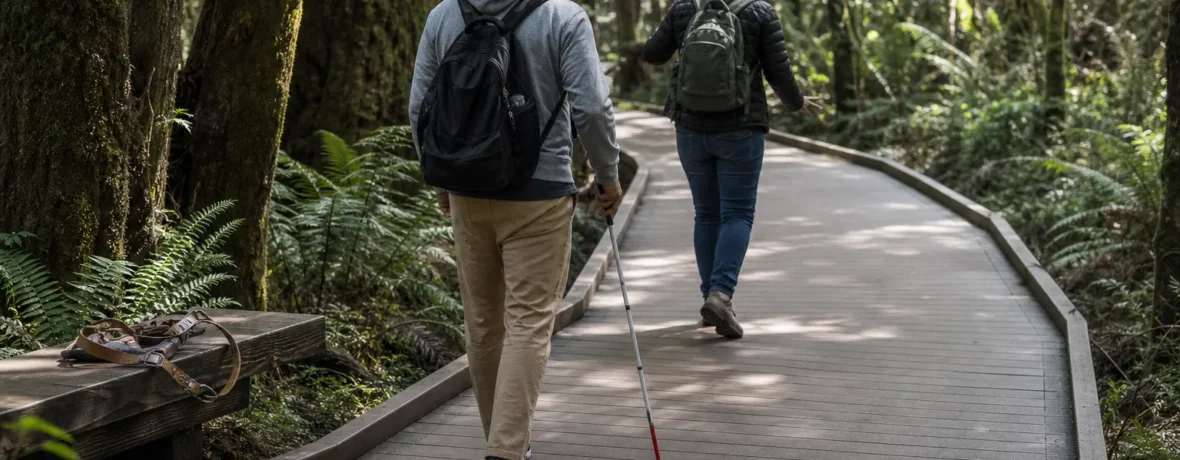
A blind hiker can follow trails by combining orientation and mobility skills, tactile feedback from a cane or trekking poles, verbal cues from a sighted guide, guide dog training, audio directions, and careful route planning. The method changes with terrain, weather, crowding, and the hiker’s own vision, pace, and comfort level.
How does a blind hiker know where to go on a trail?
They build the route before they step onto it. A blind hiker often starts with a plain-language trail description: surface, turns, junctions, bridges, stairs, drop-offs, water crossings, road noise, and landmarks that can be heard or felt.
That prep matters because trail signs and painted blazes are usually visual. So the hiker may use a phone map, GPS audio prompts, a downloaded route, a tactile map, a companion’s description, or all of them together. The National Park Service says many park accessibility pages list options such as braille, large print, digital formats, audio description, tactile maps, and orientation maps for visitors who are blind or have low vision through its Blind/Low Vision accessibility guidance.
On trail, the “map” becomes physical. A packed-dirt tread feels different from gravel. A boardwalk sounds hollow. A climbing grade changes the ankle angle. A creek gives direction. A fence line can act like a handrail without being touched constantly. Good route-finding is not magic. It is pattern reading.
What tools do blind hikers use on trails?
Most blind hikers use a mix of tools, not one perfect device. The right setup depends on the trail, the hiker’s training, and how much usable vision they have.
| Tool | What it does well | Trail limits |
|---|---|---|
| Long white cane | Finds changes in surface, rocks, roots, curbs, steps, and edges before the foot lands. | Can snag in brush, mud, talus, or narrow rocky tread. |
| Trekking poles | Add stability, read slope, test mud, and help with rhythm on climbs and descents. | They do not replace cane skills for every hiker. |
| Guide dog | Helps avoid obstacles and move efficiently through changing environments. | Trail heat, wildlife, crowds, and rough footing can add stress. |
| Sighted guide | Gives real-time terrain information, route choices, and hazard calls. | Works best when both people agree on pace, wording, and signals. |
Orientation and mobility training is the foundation. Perkins School for the Blind describes orientation and mobility as instruction that helps blind and visually impaired people move safely and confidently, using tools such as a human guide, white cane, or dog guide in its orientation and mobility overview.
How does a blind hiker hike with a sighted guide?
A blind hiker and guide work as a two-person trail team. The guide does not drag, steer by force, or narrate every leaf on the ground.
- Ask first. “Would you like a guide?” beats grabbing an elbow every time.
- Set the grip. Many hikers hold the guide’s arm just above the elbow, but preferences vary.
- Walk slightly ahead. The guide’s body movement gives early information about turns, steps, and grade changes.
- Call useful terrain. Say “root at your right foot,” “step down,” “narrow bridge,” or “low branch at face height.” Skip vague warnings like “watch out.”
- Pause before hazards. Stop at water crossings, big steps, blowdowns, slick rock, and junctions.
- Agree on passing language. “Hiker passing left” or “bike back” is short and clear.
- Review after tricky sections. A ten-second reset can fix pace, spacing, or wording before the next obstacle.
The Wisconsin Department of Health Services gives practical sighted guide techniques for safe alignment, grip, stairs, doorways, and narrow spaces. On trail, those basics get adapted to dirt, rocks, roots, and weather.
Can blind people hike alone?
Yes, some blind people hike alone on routes that match their skills. Others prefer a guide, group, or guide dog, especially on unfamiliar or rugged trails.
Solo hiking usually works best when the route has clean edges, few unsigned junctions, reliable cell coverage or offline maps, predictable footing, and a clear turnaround plan. A flat rail trail is different from a loose ridge scramble. A quiet weekday path is different from a bike-heavy corridor on a sunny Saturday.
- Choose a route with a simple shape: out-and-back, loop with few junctions, or corridor trail.
- Study the trail surface before leaving home.
- Download maps and audio directions for offline use.
- Tell someone the route, trailhead, and expected return window.
- Carry a backup battery and a non-phone way to signal.
- Turn around before fatigue makes footwork sloppy.
The answer is personal. Independence on trail is not measured by refusing help. It is measured by making smart choices and owning the pace.
What do blind hikers listen and feel for?
They read the trail with sound, touch, balance, smell, and body position. Vision is only one way to gather outdoor information.
Footing speaks. Gravel crunches. Packed soil thuds. Wet bridges slap under shoes. Leaves hide rocks but also soften sound. Wind can reveal an opening, ridge, lake, or road cut. A creek can confirm direction for half a mile [0.8 km]. Sun warmth on one side of the face can help with orientation when the sky is clear.
Body feel matters too. A downhill grade shortens steps. Sidehill tread pulls one ankle lower than the other. Mud changes pole feedback. Roots have a raised, rounded feel under a cane tip. A practiced hiker collects these clues quickly, then keeps moving.
How should you share a trail with a blind hiker?
Be direct, calm, and useful. Trail courtesy gets easier when you stop guessing and start asking.
- Say hello before passing so the hiker knows you are there.
- Give your position: “Two hikers coming uphill on your left.”
- Do not grab the person, cane, pack, dog harness, or trekking poles.
- Ask, “Would a description help?” before giving directions.
- Keep your dog close and under control.
- Do not pet or distract a working guide dog.
- Use concrete hazard calls: “low branch chest height” is better than “careful.”
If you are leading a mixed-ability group, build in more verbal check-ins at junctions and obstacles. Nobody likes being left to guess where the group went.
How do trail builders make hiking easier for blind and low-vision visitors?
Good design gives information before a problem appears. That can mean tactile maps, audio-described exhibits, clear trail edges, consistent surfaces, logical signs, and staff who can describe route conditions plainly.
Perkins School for the Blind recommends that blind hikers plan ahead, consider a sighted guide on harder trails, and use sensory details as part of the outdoor experience in its guide to hiking while blind. Land managers can support that by publishing trail details that go beyond scenery: grade, surface, stairs, bridges, exposure, crossings, rest points, and junction count.
Even small changes help. A trailhead sign with a tactile map. An online page that says where the gravel starts. A visitor center with a braille map. A downloadable audio description. These are not luxuries. They are route information.
What should blind hikers pack?
Pack for communication, backup direction, and changing trail texture. The list does not need to be fancy, but it should be redundant.
- Primary mobility tool: cane, trekking poles, guide dog gear, or chosen combination.
- Phone with offline maps, audio route notes, and emergency contacts.
- Backup battery and charging cable.
- Whistle or other simple signal.
- Water, snacks, rain layer, and insulation for the season.
- Gloves for rough railings, cold poles, or scrambling with hands.
- Small first-aid kit.
- Trail notes in an accessible format.
- ID, medication if normally carried, and dog supplies if hiking with a guide dog.
The best pack is the one that supports the actual route. A smooth one-mile [1.6 km] nature path and a rocky 8-mile [12.9 km] mountain trail ask for different levels of backup.
Related reading
- Who Are Thru-Hikers? Inside Long-Trail Culture
- What Does "Hiker Trash" Mean?
- How Thru-Hikers Resupply
- A Walk in the Woods: Bill Bryson's AT Story vs Reality
FAQ
Can a blind person hike mountains?
Yes, a blind person can hike mountains with the right skills, partners, route choice, and conditions. Steep grades, loose rock, exposure, snow, and poor signage raise the difficulty, so planning and honest turnaround decisions matter.
Do blind hikers always need a guide?
No, blind hikers do not always need a guide. Some hike independently on familiar or well-suited trails, while others choose a sighted guide for rough terrain, complex junctions, or a more relaxed day outside.
Is a guide dog good for hiking?
Yes, a guide dog can be a strong hiking partner on suitable trails. Heat, sharp rock, wildlife, crowds, and long mileage can make a route harder for the dog, so the handler decides what is fair and safe.
What is the best trail for a blind beginner?
The best beginner trail has a firm surface, clear edges, few junctions, low traffic, and easy bailout options. Short nature trails, rail trails, and wide lakeside paths are often better first choices than rocky singletrack.
How can I give directions to a blind hiker?
Use specific, body-based directions. Say “the bridge starts in three steps,” “the drop is on your right,” or “turn left at the gravel,” instead of pointing or saying “over there.”