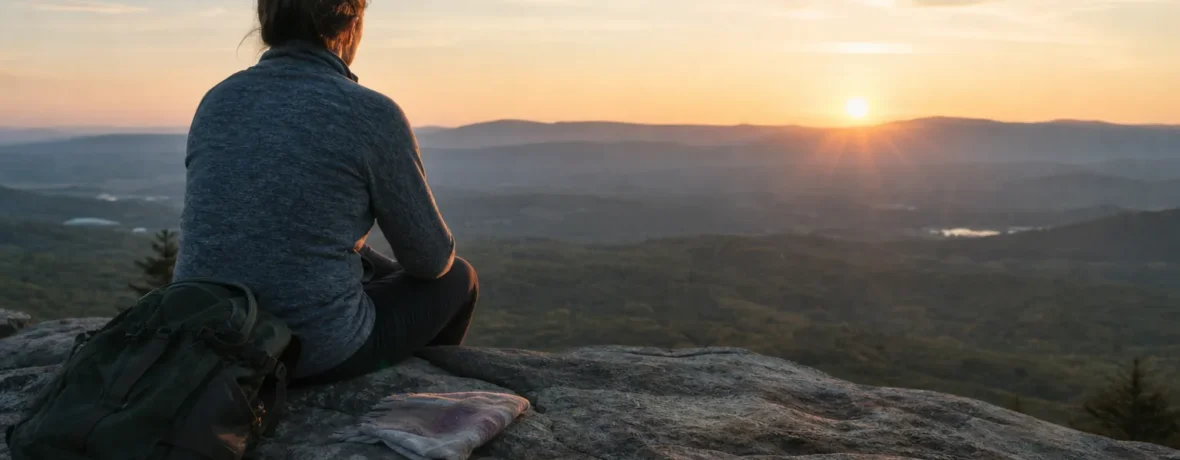
Hiking can help with grief if you keep it modest: start with 20 to 45 minutes, stay within 5 miles [8 km] of home, and bring one trusted person if your focus is shaky. A trail will not cure loss. It can give your body a safe job while your mind catches up.
Can hiking with grief actually help?
Yes, but it helps best when you treat it as support, not a rescue mission.
Here is the clear position: hiking after loss is one of the sanest things you can do, as long as you do not turn the trail into a test of toughness. Grief already takes plenty. It takes sleep, appetite, focus, patience, and sometimes the simple ability to answer a text. You do not need a summit badge on top of that.
The CDC describes grief as a response to loss, and that loss can hit your body as well as your mood. The trail gives you rhythm. Step, breathe, step, breathe. That rhythm matters because grief often has no rhythm at all. One minute you are making coffee. The next, the floor drops.
Hiking gives you a container. Not a cure. A container. A dirt path, a turnaround point, a bottle of water, a sky that does not ask you to explain yourself. That is enough for day one.
How soon after a loss should you go hiking?
Go when you can make basic safety decisions.
That may be the next morning. It may be six weeks later. Do not let anyone sell you a tidy timeline. The right question is not “Am I over it enough to hike?” The right question is “Can I eat something, carry water, read a trail sign, and turn around if I need to?”
If the answer is no, choose a neighborhood walk, a park bench, or a flat loop with cell service. That still counts. A trail does not become more healing because it is remote.
Early grief can make familiar things feel strange. A trail you have hiked 20 times can feel longer. Your pack can feel clumsy. Your brain may skip ordinary steps, like checking the forecast or locking the car. Respect that. Grief is not weakness, but it can make you less sharp for a while.
What kind of hike is best after losing someone?
The best grief hike is short, familiar, and easy to quit.
Pick a route with low stakes. Save the exposed ridge, desert crossing, winter peak, and 15-mile [24 km] sufferfest for another season. The point is not to prove that pain made you stronger. The point is to move through a hard hour without making it harder.
| Good choice | Risky choice | Why it matters |
|---|---|---|
| Flat local trail | Remote backcountry route | Easy exits beat dramatic scenery when your mind is overloaded. |
| 1 to 3 miles [1.6 to 4.8 km] | All-day mileage push | Grief fatigue can hit fast and without warning. |
| Trusted hiking partner | New group or performance crowd | You need room to be quiet, slow, or messy. |
| Known trailhead | New terrain with route-finding | Familiarity lowers decision load. |
There is a stubborn myth in outdoor culture that big pain needs big country. Sometimes it does. More often, big pain needs a 2-mile [3.2 km] loop, dry socks, and permission to turn around after 12 minutes.
How do you hike safely when grief affects focus?
Make the hike almost boring on purpose.
Grief can scatter attention. That matters outdoors, where small mistakes can stack up: missed junction, empty bottle, wrong layer, late start. Build a simple system before you leave the house.
- Choose one easy trail. No improvising at the trailhead.
- Tell one person your plan. Include trail name, start time, and expected return.
- Set a turnaround time. Use your phone alarm, not your mood.
- Pack the basics. Water, snack, warm layer, rain shell, headlamp, map, first aid, and charged phone.
- Lower the pace. Walk at the speed your nervous system can handle.
- End before you are wrecked. A good grief hike leaves something in the tank.
The CDC says physical activity supports adult health, including mental health. That does not mean you should use exercise to outrun sorrow. It means movement can be one useful tool in a larger kit.
Should you hike alone while grieving?
Sometimes, but solo hiking should be earned slowly.
Solitude can be a gift after loss. It can also get too loud. If you are crying hard, dissociating, skipping meals, sleeping badly, or feeling numb enough that road crossings and footing do not register, go with someone or stay on very public trails.
A good partner for a grief hike is not the person with the biggest calves. It is the person who can walk beside you without trying to fix you. They do not need perfect words. They need patience, snacks, and the sense to say, “Let’s head back.”
- Hike alone only on familiar trails with reliable service.
- Avoid cliffs, swift water, avalanche terrain, heat exposure, and night hiking when your focus is poor.
- Leave a written plan with someone who will actually check on you.
- Do not use a solo hike as a way to disappear from people who are worried about you.
What should you bring on a grief hike?
Bring the normal hiking essentials plus a few grief-specific anchors.
You are still a hiker. Pack like one. But add items that help when emotion blindsides you halfway around the loop.
- Water and salty food: grief can flatten appetite, so pack food that is easy to eat.
- Extra layer: crying, fatigue, and sitting still can make you cold fast.
- Paper map or downloaded map: do not rely only on memory.
- Small comfort item: a bandana, photo, note, or object that will not be ruined outdoors.
- Tissues and a trash bag: simple, practical, necessary.
- Exit plan: know the shortest way back before you need it.
Do not bring alcohol. Do not bring the pressure to have a breakthrough. Do not bring a playlist that will gut-punch you on a narrow descent unless you are ready for that. The trail can hold emotion, but it will not hold your hand on slippery rock.
Can hiking become avoidance after a death?
Yes, if every hard feeling gets answered with more miles.
This is where outdoor people need to be honest. Hiking can help you process grief, but it can also become a clean-looking escape. Nobody worries much when you say you are training, chasing sunrises, or spending weekends outside. That makes hiking a socially acceptable way to avoid the house, the paperwork, the empty chair, the conversation, the memorial box in the closet.
The line is not always obvious. Ask yourself: Does hiking make daily life a little more possible, or does it replace daily life? Are you coming home steadier, or only staying gone longer? Are you using the trail to feel your grief, or to make sure you never have to sit still with it?
The National Institute on Aging notes that grief can affect health and encourages support, connection, and self-care after loss. Hiking belongs in that circle. It should not be the whole circle.
When to see a doctor
Get help when grief makes you unsafe, unable to function, or trapped for months.
A doctor or licensed mental health professional can help when grief is not easing, when daily functioning is breaking down, or when you feel stuck in intense longing, guilt, numbness, anger, or despair. The Mayo Clinic advises seeking professional support when intense grief and trouble functioning do not improve over time, especially around a year after the loss.
If you might hurt yourself, call 911 now. In the United States, you can call or text 988 for the Suicide & Crisis Lifeline; the CDC lists 988 as a mental health crisis resource. Do not drive yourself to a trailhead to “walk it off” when you are in danger. That is not a hike. That is an emergency.
What is the right mindset for hiking after loss?
Go to be with what is true.
That is the argument. Hiking after loss should not be sold as therapy with better views. It should not be another productivity hack, another badge, another way to make grief look noble on the outside. The trail is useful because it is plain. Your feet move. Your lungs work. Trees do not ask for a status update.
Some hikes will feel peaceful. Some will feel awful. Some will feel peaceful and awful in the same mile. Let that be normal. You are not failing because the view does not heal you on cue.
Grief changes your hiking, at least for a while. You may move slower. You may stop more. You may cry at a creek crossing because the person you lost would have made a joke there. Fine. Stop. Drink water. Keep walking if walking helps. Turn around if turning around helps.
The outdoors does not erase loss. That is not its job. Its job is older and simpler: to remind you that the world is still here, your body is still here, and the next step does not require you to solve the whole future.
Related reading
- Type 2 Fun: Why Hard Hikes Feel Good Later
- The Seven Summits Explained
- What Is Geocaching?
- What Is Hiking, Really? A Definition Worth Arguing About
FAQ
Is hiking good for grief?
Yes, hiking can support grief by adding movement, routine, and quiet space. It works best as one support among several, not as a replacement for friends, family, counseling, sleep, food, or medical care.
How long should a grief hike be?
Start with 20 to 45 minutes. If you finish steady rather than drained, add distance next time in small steps instead of jumping into a long route.
Is it okay to cry on the trail?
Yes, crying on the trail is okay. Step off the path where you are safe, drink water, add a layer if you get chilled, and give yourself a few minutes before moving again.
Should I visit a trail I shared with the person who died?
Yes, if you feel ready and the route is safe. Go with someone trusted the first time if the place carries heavy memories or if you are not sure how you will react.
Can hiking make grief worse?
Yes, hiking can feel worse if the route is too hard, too isolated, or tied to painful memories before you are ready. Choose a low-pressure trail and treat turning around as a smart decision, not a failure.
When should I get professional help for grief?
Get professional help if grief makes daily life unmanageable, keeps getting more intense, or brings thoughts of self-harm. If you are in immediate danger in the U.S., call 911 or call or text 988 now.