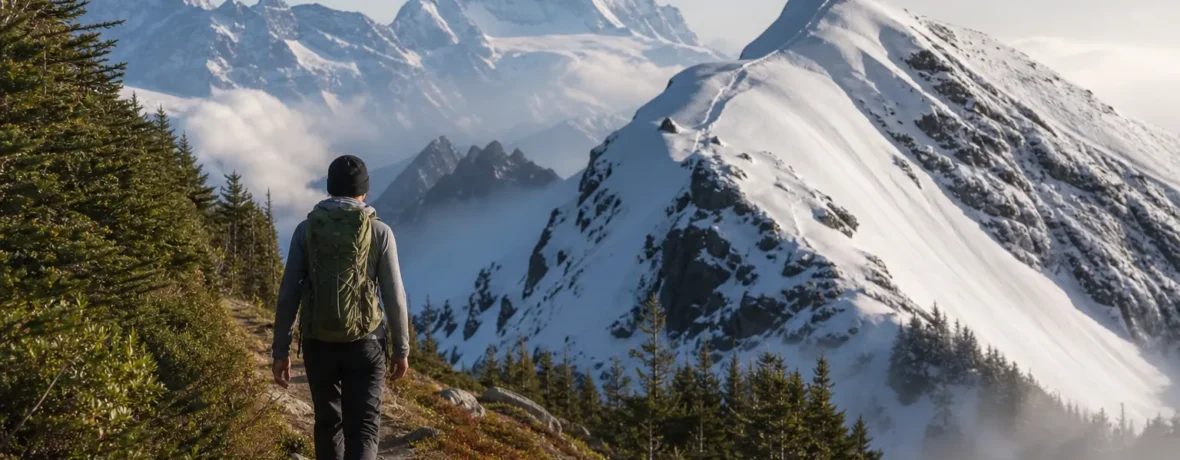
Mountaineering vs hiking comes down to consequence and technique: hiking stays on walkable ground where a fall is usually not expected to be fatal; mountaineering uses climbing skills, ropes, snow or ice tools, and route-finding to move through terrain where mistakes can kill you. The gray zone is scrambling.
Mountaineering vs hiking: where is the line?
The line is where walking stops being enough.
If you can keep moving with trekking poles, trail shoes or boots, normal backpacking judgment, and no need to protect yourself from a fall, you are hiking. The day may be brutal. The grade may be steep. The summit may sit at 14,000 feet [4,267 m]. Still hiking.
If the route asks you to use climbing systems to keep a fall from becoming fatal, you have crossed into mountaineering. That may mean an ice axe and crampons on steep snow, a rope for glacier travel, a belay on exposed rock, anchors, a helmet under loose gullies, or a turnaround call based on avalanche hazard rather than tired legs.
Here is the cleanest way to think about it: hiking is a foot-travel problem. Mountaineering is a terrain-management problem. Hiking asks, “Can you keep walking?” Mountaineering asks, “Can you protect the team if the mountain tries to punish a mistake?”
| Factor | Hiking | Mountaineering |
|---|---|---|
| Main movement | Walking on trail, talus, dirt, sand, or mild off-trail terrain | Climbing, kicking steps, front-pointing, roped travel, scrambling with exposure |
| Typical tools | Footwear, pack, layers, map, headlamp, first aid kit, trekking poles | Helmet, harness, rope, ice axe, crampons, protection, avalanche gear when needed |
| Fall consequence | Usually injury, often self-rescue possible | Potentially fatal, rescue may be slow or impossible in weather |
| Decision point | Fitness, daylight, weather, water, trail conditions | All hiking factors plus snow stability, rockfall, crevasses, anchors, descent hazards |
What is mountaineering?
Mountaineering is climbing mountains where walking alone is not enough.
That definition is blunt because the activity deserves bluntness. A mountain hike can be hard without being mountaineering. A mountaineering route can be short and still serious. Distance does not decide the category. Neither does summit elevation. The deciding factors are terrain, exposure, technical movement, and the equipment needed to manage risk.
Mountaineering may include snow climbing, glacier travel, alpine rock, mixed rock and ice, ridge travel, rappelling, route-finding in whiteout conditions, and moving as a roped team. The National Park Service says climbing and off-trail hiking can involve steep snow, ice, rocks, and other hazards, and that proper equipment plus training are essential for safe use of that equipment on such terrain. You can read that safety guidance in the NPS page on climbing safely in North Cascades National Park.
This is where many strong hikers get fooled. They look at a mountain from the parking lot and see a big hike. The mountain sees something else: a frozen chute at sunrise, rotten snow at noon, loose rock after thaw, a corniced ridge, a glacier with hidden slots, or a descent that is harder than the climb. Mountaineering starts when those hazards demand specific technique, not just grit.
Is mountaineering just hard hiking?
No, hard hiking is still hiking if the movement remains walking.
A 20-mile [32 km] trail day with 6,000 feet [1,829 m] of gain can wreck your calves and still never become mountaineering. A 2-mile [3.2 km] alpine approach can become mountaineering the moment you step onto steep snow where a slip turns into an uncontrolled slide. Difficulty and category are different things.
Think of it like water. A swimmer and a sailor both move across water, but the skill sets split once wind, current, hull, and rescue systems enter the picture. Hiking and mountaineering share fitness, planning, weather sense, layering, hydration, nutrition, and mental toughness. Then mountaineering adds technical systems. Those systems change the whole day.
On a hike, trekking poles help balance. On a mountaineering route, an ice axe may be a brake, a balance point, a step-cutting tool, or part of an anchor. On a hike, a wrong turn may cost time. On a mountaineering route, a wrong gully can put you under rockfall or above terrain you cannot downclimb. On a hike, stopping early is annoying. On a climb, stopping late can trap you on warming snow or in afternoon lightning.
That is the argument: do not flatter a technical route by calling it a hike, and do not inflate a hike by calling it a climb. The labels matter because they tell you what skills to bring.
Hiking vs climbing: what changes under your feet?
The ground stops being just ground.
On a normal hike, the surface may be rough, slick, steep, muddy, snowy, or loose. You still use ordinary walking mechanics. Your hands may brush a boulder. You may step high. You may curse. But your body is upright, your feet are doing most of the work, and a slip does not require a rope system.
In climbing terrain, hands become part of the movement. Your feet may smear on rock, edge on small holds, kick into snow, bite with crampon points, or cross a glacier where the surface hides cracks. The Yosemite Decimal System is one common way U.S. climbers describe that shift: Class 1 is hiking; Class 2 is simple scrambling; Class 3 uses hands for balance; Class 4 is simple climbing where a rope is often used and a fall could be fatal; Class 5 is technical rock climbing with rope, belay, and protection. The University of Utah’s climbing metadata project publishes a clear Yosemite Decimal System table based on standard mountaineering definitions.
That Class 3 and Class 4 middle ground is where egos get loud and judgment needs to get louder. Some hikers call Class 3 “just scrambling.” Some climbers call it casual. Both can be true for the right person on dry rock in stable weather. Neither is true for a tired party descending in rain with one headlamp and no margin.
What skills move you from hiking into mountaineering?
You need skills that prevent small mistakes from becoming accidents.
Fitness is only the cover charge. The real ticket is competence. If a route involves snow, ice, exposed rock, glaciers, or rappels, your skill set needs to expand before your ambition does.
- Read the route, not just the mileage. Study slope angle, aspect, descent options, rockfall zones, snow bridges, water crossings, and where you can turn around without making things worse.
- Learn footwork first. Good movement prevents panic. Practice edging, smearing, plunge-stepping, kicking steps, and moving with three points of contact before you add speed.
- Use the tool before you need the tool. An ice axe carried like a trophy is dead weight. Practice self-arrest, self-belay, and secure transitions in safe terrain with instruction.
- Understand rope systems. A rope does not make terrain safe by magic. It only helps if the team knows spacing, belays, anchors, knots, crevasse rescue basics, and when roping up increases risk.
- Make descent plans early. Many mountain accidents happen after the high point, when people are tired, weather is building, and the “easy way down” is not easy anymore.
- Turn around without drama. The mountain does not care that you trained. If the snow is wrong, the rock is shedding, the team is slow, or the forecast lied, leave.
The National Park Service’s general Hike Smart guidance is still the base layer: carry the essentials, research terrain, check conditions, know your limits, and keep the group together. Mountaineering does not replace those basics. It stacks more responsibility on top of them.
What gear separates hiking from mountaineering?
Mountaineering gear protects against terrain that hiking gear cannot handle.
Do not buy shiny hardware and mistake it for readiness. Gear is only useful when paired with practice. That said, the gear line is real. A hiker packs for comfort, weather, light emergencies, and self-sufficiency. A mountaineer packs for movement protection, falling-object protection, snow and ice travel, and rescue within the team.
- Core hiking kit: map or GPS plus backup, headlamp, extra layers, rain shell, food, water treatment, first aid, fire starter, knife or repair kit, sun protection, emergency shelter.
- Common mountain additions: helmet, ice axe, crampons, mountaineering boots, harness, rope, belay device, carabiners, slings, cord, snow protection, rock protection, glacier kit.
- Winter or avalanche terrain: beacon, shovel, probe, avalanche education, partner practice, and a route plan that avoids suspect slopes when conditions demand it.
- Communication and rescue: satellite messenger or PLB, emergency contacts, trip plan, and enough insulation to survive a long stop.
The trap is carrying mountaineering gear on terrain you do not understand. Crampons can make a hiker feel bold right up to the point they trip over a front point. A rope can pull an entire team into trouble if nobody can arrest or build an anchor. A helmet helps with rockfall, but it does not make a bowling alley gully smart at noon.
Buy training with the gear. Better yet, buy training before the gear.
Is scrambling hiking or mountaineering?
Scrambling is the gray zone.
Scrambling lives between walking and technical climbing. Easy scrambling may feel like spicy hiking: hands on rock, short steps, a little exposure, no rope. Hard scrambling can be mountaineering in plain clothes: loose holds, steep drops, route-finding, no simple retreat, and consequences that do not match the casual label.
Here is the honest test. If you would be badly hurt or killed by a fall, and the route gives you no simple way to protect that fall, stop calling it casual. That does not mean you must rope every exposed step. It does mean you need to judge terrain with adult eyes.
Scrambling gets more serious when:
- Downclimbing is harder than climbing up.
- The rock is wet, icy, loose, or covered in sand.
- The route is hard to reverse.
- You are above cliffs, gullies, moats, or steep snow.
- One person in the group freezes or moves far slower than planned.
- A fall by one person could knock down another.
Many classic “hikes” include scrambling. That does not make the whole route mountaineering, but it does mean the hardest section sets the required skill. Your easiest miles do not cancel your most dangerous 200 feet [61 m].
How do you decide if a route is too much?
Judge the crux before you judge yourself.
Most people plan from the parking lot forward. Strong mountain travelers plan from the hardest point backward. Find the crux, then ask whether the whole team can handle it in both directions, in the actual conditions expected, with the gear carried, after hours of effort.
Use this quick filter before you say yes:
- Terrain: Is there steep snow, ice, glacier travel, exposed Class 3 or Class 4 scrambling, rappelling, or loose alpine rock?
- Protection: If someone slips, what stops them?
- Descent: Can you reverse the route, and will it be worse later in the day?
- Weather: What happens if wind, whiteout, rain, lightning, or heat arrives early?
- Team: Is the least experienced person truly prepared, not just agreeable?
- Time: Do you have a hard turnaround time that leaves daylight for descent?
- Exit: If the route goes wrong, where do you go?
If the answer to “what stops a fall?” is “hopefully nothing happens,” you are not making a hiking decision anymore. You are making a mountaineering decision without mountaineering tools.
When to see a doctor
Get medical help for severe symptoms, worsening altitude illness, or any injury that affects safe movement.
Mountain days can combine exertion, cold, heat, dehydration, altitude, and fear. Do not diagnose yourself on a ridge. If someone has chest pain, trouble breathing at rest, confusion, loss of coordination, fainting, severe headache with worsening symptoms, suspected fracture, head injury, uncontrolled bleeding, or cannot walk safely, treat it as urgent.
Altitude deserves special respect. The CDC says acute mountain sickness symptoms commonly begin 2 to 12 hours after arrival at high altitude or after ascending higher, and worsening symptoms at the same elevation call for descent. CDC guidance also treats high-altitude cerebral edema and high-altitude pulmonary edema as serious conditions requiring urgent action, especially in remote settings. Read the CDC Yellow Book page on high-altitude travel and altitude illness before trips that involve sleeping high or gaining elevation fast.
Before attempting a high-altitude or technical objective, talk with a clinician if you have heart disease, lung disease, sleep apnea, sickle cell trait, a history of severe altitude illness, or any condition that could worsen far from help. This is not paperwork. It is part of the route plan.
Related reading
- Hiking vs Walking: Where One Ends and the Other Begins
- Hiking in Europe vs the US: Huts, Trails and Rules
- Thru-Hiking vs the Camino: Two Different Journeys
- Hiking Shoes vs Hiking Boots: Which Should You Buy?
FAQ
Is mountaineering harder than hiking?
Usually yes, but not always by effort alone. Mountaineering is harder because it adds technical skills, exposure, objective hazards, and team safety systems; a long trail hike may be more tiring than a short climb, but the climb can carry higher consequences.
Can a beginner do mountaineering?
Yes, with instruction and conservative terrain. A beginner should start with a qualified guide, club course, or experienced mentor, then practice snow travel, rope work, self-arrest, and emergency skills before joining serious routes.
Do you need ropes for mountaineering?
Sometimes, not always. Ropes are common for glacier travel, exposed rock, rappels, and protected climbing, but they only help when the team knows how to use them; on some terrain, an unskilled rope team can create more danger.
Are 14ers hiking or mountaineering?
It depends on the route and season. A dry walk-up trail on a 14er can be a hike, while a snow-filled couloir, exposed ridge, glacier approach, or technical face on a lower peak can be mountaineering.
What is the biggest mistake hikers make when trying mountaineering?
They treat technical terrain like a fitness challenge. Strong legs help, but they do not replace rope skills, snow judgment, rockfall awareness, descent planning, or the humility to turn around early.
Where should the line be for most hikers?
The line should be any terrain where a fall is likely to be fatal and you do not have the skill or equipment to manage it. That is the clean rule: if walking skill cannot control the risk, do not pretend it is just another hike.