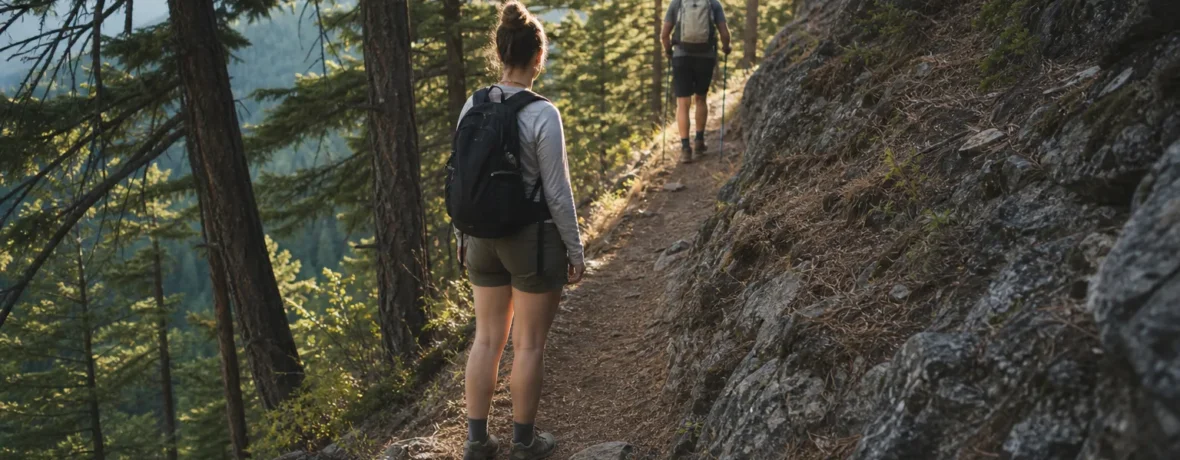
Yes, you should yield to uphill hikers: step aside when you’re descending unless the uphill hiker clearly waves you through. The climber is working harder, has less momentum to spare, and may have fewer safe places to restart. On narrow trails, stop early, move to the durable side, and give at least one hiker’s width.
That’s the rule. Here’s the opinion: it is also the right rule.
Some trail customs feel fussy. This one doesn’t. Giving uphill hikers the right of way is not about status, speed, or who “earned” the mountain. It is about physics, breathing, balance, and not turning a narrow path into a tiny argument with boots.
The National Park Service says that hikers coming uphill have the right of way and descending hikers should step aside and give space, as of November 2026, in its hiking etiquette guidance. American Hiking Society gives the same basic rule in its hiking etiquette advice. That settles the official etiquette question. The better question is why so many hikers ignore it.
Should you yield to uphill hikers?
Yes, if you are hiking downhill, you should yield to uphill hikers.
Do it before the pinch point. Not when your shoulders are already brushing their pack. Not after you’ve charged halfway into the tight section and forced them onto the loose edge. Look ahead. Read the trail. If there is only room for one body, the descending hiker should usually be the one to stop.
Uphill hikers are doing the harder job at that moment. They are managing effort, breath, footing, and rhythm. On a steep trail, stopping can break that rhythm completely. Starting again takes more energy than continuing at a slow, steady pace.
Downhill hikers have their own challenges. Knees take a beating. Loose gravel wants to turn every step into a skid. But gravity is helping you move. That means you can usually stop and restart with less cost than the person climbing.
This rule also prevents the awkward little dominance contest that happens when two parties reach a narrow spot at once. You don’t need a debate. You need a norm. Downhill yields. Uphill goes. Everybody keeps moving.
Why do uphill hikers have the right of way?
Uphill hikers have the right of way because stopping costs them more.
That is the plainest answer. A climber may be holding a pace that lets them breathe without blowing up. Break that pace, and the climb gets harder than it needs to be. On a sustained grade, even a short stop can make the next 50 feet [15 meters] feel clunky.
There’s also sightline and control. Descending hikers can often see farther down the trail and choose a wider place to wait. They can plant their feet, step to the side, and let the uphill hiker pass without forcing a quick decision.
Then there’s trail damage. When people panic-pass, they crush vegetation, widen switchbacks, and kick dirt off the tread. A clean yield at a sturdy spot is better for everyone, including the trail. The NPS also tells hikers to stay on the trail, avoid shortcutting switchbacks, and be mindful of nearby plants and animals when stepping aside in its Hike Smart safety guidance.
| Situation | Who usually yields? | Why? |
|---|---|---|
| One hiker ascending, one descending | Downhill hiker | The uphill hiker has harder momentum to regain. |
| Uphill hiker waves you through | You may continue | They chose to pause; pass calmly and thank them. |
| Horses or pack stock are present | Hikers yield to stock | Large animals need space and calm movement. |
| Exposed ledge or cliffside trail | Safest person yields in the safest place | Safety beats etiquette every time. |
Do uphill hikers always have the right of way?
No, uphill hikers usually have the right of way, but safety comes first.
Trail etiquette is not a courtroom statute. It is a working agreement. If the uphill hiker is standing in a wide turnout catching breath, they may wave you down. If you are descending with a child, a dog, or an unstable footing problem, the safest move might be for the uphill party to pause where they already have room.
Use the rule until the trail tells you otherwise. A steep, eroded chute is not the place for either hiker to perform etiquette theater. Same with ice, mud, blowdowns, and cliffside singletrack. On Grand Canyon corridor trails, the park tells visitors to yield to mules and uphill hikers and to step off on the uphill side away from the edge, as of November 2026, in its trail courtesy guidance. That detail matters: where you step is part of yielding well.
The phrase “right of way” can make people act strange. It can turn a courtesy into a weapon. Don’t do that. If you’re hiking uphill, you are not required to steamroll everyone because etiquette is on your side. If you want a break, take it. Say, “You’re good—come on down.” Clear. Friendly. Done.
What is the proper way to yield on a hiking trail?
Yield early, step aside safely, and communicate before anyone has to guess.
Good yielding is boring. That is the goal. No drama. No last-second shuffle. No balancing with one boot on a root while pretending this is fine.
- Look ahead. Spot oncoming hikers before the trail narrows.
- Pick a durable place to stand. Use rock, gravel, packed dirt, or an already-wide shoulder when possible.
- Step to the side before the meeting point. Give the uphill hiker a clean line.
- Keep your pack, poles, and dog out of the lane. A dangling pole tip can trip someone fast.
- Say what you’re doing. Try “Come on up” or “I’ll step off here.”
- Wait until the whole group passes. Don’t jump back onto the trail between hikers.
- Return to the trail gently. Don’t kick loose dirt or cut a corner to restart.
If you’re hiking with a group, shrink your footprint. Single file means single file, not a drifting parade of elbows, trekking poles, and snack wrappers. If you’re stopped for a break, move off the tread far enough that others can pass without stepping into brush.
- Leash and shorten your dog before hikers meet.
- Pull earbuds out or lower the volume on busy trails.
- Keep trekking pole tips pointed down and close.
- Say thanks when someone yields.
- Do not step on fragile plants to make a wider passing lane.
Who yields to whom on a multi-use trail?
On many shared trails, hikers yield to horses, and bikes yield to hikers and horses.
That’s the common yield triangle. But posted signs rule the day. Local land managers can set different rules because trails are not all built the same. A smooth multi-use path near town is not the same as a rocky alpine traverse or a desert canyon with stock animals.
Horses get special treatment because they are large, powerful, and can spook. If you meet stock, stay calm, speak in a normal voice, and follow the rider’s instructions. Sudden movement is the enemy. So is hiding silently behind a tree like a nervous goblin.
Mountain bikes add speed to the equation. A rider coming downhill should slow down early, announce themselves, and be ready to stop. A hiker should not leap unpredictably across the trail. Everybody wins when the first move is communication instead of surprise.
What if the uphill hiker wants to stop?
If the uphill hiker waves you through, go ahead and pass.
This is where rigid rule-followers get it wrong. The uphill hiker has the right of way, not a legal obligation to keep grinding upward for your benefit. Maybe they want a sip of water. Maybe they want a photo. Maybe they simply hate being rushed with someone hovering below them.
If they stop and clearly invite you through, take the gift. Pass at walking speed. Say thanks. Don’t turn it into a committee meeting.
The key word is clearly. A vague pause is not always an invitation. If you’re unsure, ask: “Do you want us to wait, or should we come down?” Nine words can prevent 30 seconds of awkward trail ballet.
Why downhill hikers should not force the issue
Forcing the issue makes the trail worse for everyone.
A descending hiker often feels faster. That speed can become entitlement. You’re moving well, knees warm, gravity pulling you along, and then someone appears below you moving at half your pace. The temptation is to keep rolling and make them adjust.
Don’t.
That little choice says a lot. It tells the uphill hiker their effort matters less than your flow. It pressures them to stop, step aside, or hurry their line. On narrow trails, it can push them onto loose outside edges or into vegetation. It also teaches newer hikers the wrong norm.
Trail culture is contagious. So is bad behavior. If you want better trail manners, model them loudly enough to be seen and calmly enough not to become the problem.
Related reading
- Should You Hike With Headphones?
- Off-Leash Dogs on Trails: A Debate
- Should National Parks Charge More?
- Should You Geotag Your Hiking Photos?
FAQ
Should you yield to uphill hikers on every trail?
Yes, as the default rule, you should yield to uphill hikers. The exception is when safety, posted signage, stock animals, or a clear wave-through from the uphill hiker changes the situation.
Why does the uphill hiker get priority?
The uphill hiker gets priority because stopping and restarting on a climb takes more effort. A steady uphill rhythm is hard to rebuild, especially on steep or loose terrain.
Should trail runners yield to uphill hikers?
Yes, trail runners should yield to uphill hikers when descending. Speed does not cancel etiquette; slow down early, announce yourself, and pass only when there is room.
Do hikers have to yield to horses?
Yes, hikers generally yield to horses and pack stock. Step aside calmly, speak normally, avoid sudden movements, and follow the rider’s direction.
What should I say when passing another hiker?
Say something short and clear: “Come on up,” “I’ll wait here,” or “Mind if I pass when there’s room?” Friendly words beat guessing, especially on narrow trails.
What if someone refuses to yield?
Let it go if you can do so safely. Hold your position in a safe spot, avoid escalating, and remember that protecting your footing matters more than winning a manners dispute.