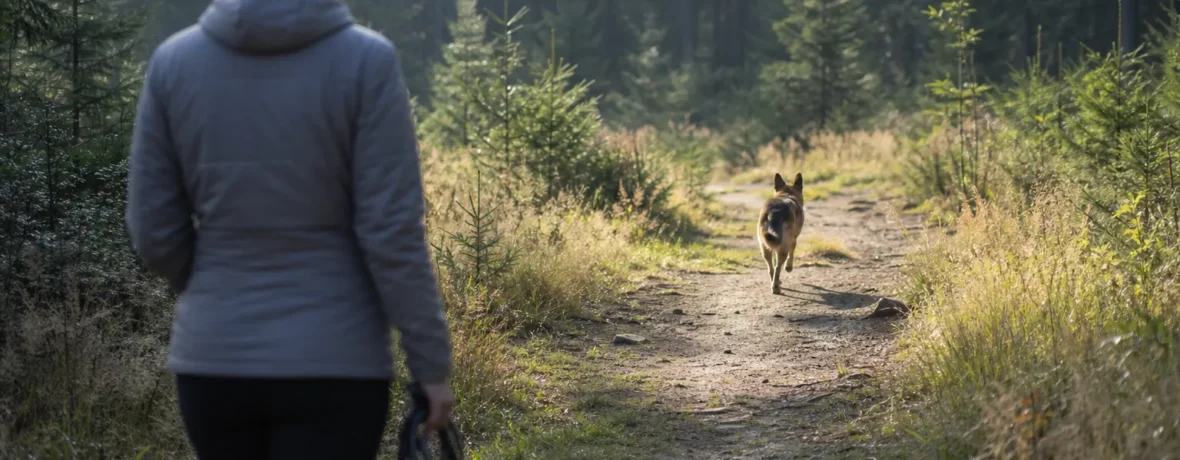
On shared public trails, yes, unless signs clearly allow off-leash use. Use a leash no longer than 6 feet [1.8 m] where required, keep your dog beside you, and yield early to hikers, kids, horses, wildlife, and other dogs.
The off-leash dog debate gets hot because both sides care about the trail. Dog owners want freedom, joy, and exercise for an animal they love. Other hikers want quiet, safety, clean tread, and the right to move through public land without being rushed by a stranger’s pet. Those two desires are not equal when the dog is loose.
Here’s the plain position: your dog’s freedom ends where another hiker’s comfort, safety, or access begins.
Should dogs be on leash on trails?
Yes, dogs should be leashed on shared trails unless the land manager specifically allows off-leash travel.
That answer will annoy some good dog owners. Fine. Good owners are not the whole problem. The trail has to work for everyone, including people who have been bitten, parents with small kids, hikers with reactive dogs, equestrians, runners, older hikers with balance issues, and people who simply do not want a wet nose in their lunch.
On National Park Service lands, the baseline is strict. As of November 2026, the National Park Service hiking-with-pets guidance tells visitors to keep dogs on a 6-foot [1.8 m] leash and warns that many parks do not allow pets on hiking trails or boardwalks. Federal pet regulations also require pets in national parks to be leashed, crated, caged, or physically confined, with the leash not exceeding 6 feet [1.8 m], unless a specific area is managed differently.
National forests, state parks, county open spaces, and city preserves vary. Some allow voice control in certain backcountry areas. Some require leashes at trailheads, campgrounds, and developed sites. Some ban dogs from sensitive trails entirely. That variation is exactly why the default should be simple: leash first, read the sign, then adjust only if off-leash use is clearly allowed.
Why are dogs supposed to be leashed on trails?
Leashes prevent predictable trail problems before they become somebody else’s problem.
The classic off-leash defense is, “Don’t worry, he’s friendly.” That line has done more damage to dog access than almost anything else. Friendly to whom? Friendly to a toddler holding a granola bar? Friendly to a leashed dog recovering from surgery? Friendly to a horse that spooks sideways on a narrow bench cut? Friendly to a deer fawn tucked in brush 20 feet [6 m] off trail?
A leash does several jobs at once:
- It protects other hikers. Nobody has to guess what your dog will do.
- It protects your dog. Loose dogs can run into roads, cliffs, rattlesnakes, porcupines, traps, foxtails, ticks, hot rock, thin ice, or fast water.
- It protects wildlife. Even a short chase burns energy wildlife needs for feeding, breeding, migration, or winter survival.
- It keeps trail access open. Land managers notice conflicts. Enough bad encounters, and dogs lose access altogether.
- It makes waste cleanup possible. You can’t pack out what you never saw happen.
The Leave No Trace guidance on being considerate of other visitors says leashes help keep pets on trail, reduce wildlife encounters, help owners find waste, and keep dogs under control around people and other pets. That is not anti-dog. That is pro-access.
Are off-leash dogs ever okay on hikes?
Yes, but only where off-leash use is legal, posted, and realistic for the dog in front of you.
There are places where a well-trained dog can move off leash without creating much trouble: designated off-leash trails, certain dog-friendly open spaces, private land with permission, or remote areas where the managing agency allows voice control. But “allowed” is not the same as “wise.” A dog that ignores one recall out of ten is not under control. On a trail, that tenth time is the one that matters.
| Situation | Best choice | Why it works |
|---|---|---|
| National park trail where pets are allowed | 6-foot [1.8 m] leash | Matches common NPS rules and reduces conflicts |
| Busy local trail | Short leash | Too many blind corners, kids, dogs, runners, and bikes |
| Posted off-leash area | Off leash only with instant recall | Legal access still requires real control |
| Wildlife closure, nesting area, or dog-restricted trail | Leave the dog home | Access rules exist for resource protection |
A good off-leash dog is boring. It stays close. It comes the first time. It does not approach strangers. It ignores dogs, horses, bikes, backpacks, lunch, and wildlife. It stops at junctions. It does not disappear around bends. If that does not describe your dog every time, use a leash.
What should you do if an off-leash dog approaches on a trail?
Stop, stay calm, and ask the owner to leash the dog before it reaches you.
You should not have to manage someone else’s loose dog, but sometimes you will. Keep your voice firm and low. Do not run. Do not wave trekking poles unless you need to create space. If you have your own dog, shorten the leash without choking up so hard that you add tension and panic.
- Stop moving. Fast movement can trigger chase behavior.
- Put gear between you and the dog. A trekking pole, pack, or bike can create a calm barrier.
- Use clear words. Say, “Please leash your dog,” not “It’s okay,” if it is not okay.
- Avoid direct staring. Face slightly sideways while keeping the dog in view.
- Back away slowly if needed. Give yourself room without turning the moment into a pursuit.
- Report serious incidents. Bites, repeated charges, wildlife harassment, and ignored leash rules should go to the land manager.
If a dog owner brushes you off with “he’s friendly,” repeat the request. You do not owe a debate on the trail. “Please leash your dog” is enough.
How can you hike responsibly with your dog?
Plan your hike around your dog’s limits and everyone else’s right to enjoy the trail.
The best dog hikers are almost invisible. They read the signboard. They leash before the parking lot chaos starts. They step aside early. They pack out waste. They skip trails where dogs are not allowed instead of hunting for loopholes.
Use this checklist before every dog hike:
- Check the official trail or park page before leaving home.
- Bring a non-retractable leash where control matters; retractable lines can stretch across the trail.
- Carry more water than your dog usually drinks.
- Pack waste bags and carry used bags to a trash can.
- Bring a collar or harness with ID.
- Leash up before trailheads, junctions, bridges, blind corners, horses, wildlife, and passing groups.
- Turn around if heat, ice, paw damage, fatigue, or crowding makes the hike unfair to your dog or others.
The U.S. Forest Service visitor guidance says pets must be restrained or leashed in developed recreation sites, and local forest orders may add tighter rules. Translation: do not assume every national forest trail is a free-for-all. The sign at the trailhead and the local ranger district page beat what someone told you in the parking lot.
When to see a doctor
See a doctor promptly for serious dog bites, deep punctures, infection signs, or uncertainty about rabies vaccination.
Most trail dog encounters end with annoyance, not injury. Still, bites happen. The CDC guidance on dog bites and scratches says germs can spread even when a wound does not look serious. Wash minor wounds with soap and water, and seek medical attention right away for deep wounds, uncontrolled bleeding, infection signs, or if you do not know whether the dog is vaccinated against rabies.
Get urgent help if bleeding will not stop, you feel faint or weak, the bite is over a joint, you cannot move normally, muscle or bone is visible, or the animal is acting strangely. Do not diagnose the wound on the tailgate. Let a clinician make that call.
What is the fair compromise for dogs on trails?
The fair compromise is leashed access on most shared trails, designated off-leash access where it can work, and strict closures where dogs harm wildlife or safety.
Dog owners sometimes frame leash rules as punishment. That misses the bigger picture. Leashes are one reason dogs are allowed in so many public places at all. The more owners ignore the bargain, the easier it becomes for agencies to ban dogs from sensitive or crowded trails.
The trail is not your yard. It is shared space. Shared space needs predictable behavior. A leash is not a moral insult to your dog. It is a simple tool that tells everyone else, “You can relax. I’ve got this.”
That is the heart of the debate. Off-leash hiking can be wonderful in the right place with the right dog. But on ordinary shared trails, the leash is the price of admission. Clip it on. Hike happy. Keep the door open for the next dog.
Related reading
- Should You Hike With Headphones?
- Should National Parks Charge More?
- Should You Geotag Your Hiking Photos?
- Why Uphill Hikers Have the Right of Way
FAQ
Do dogs legally have to be on leash on all trails?
No, not on every trail. Rules depend on the land manager, but many national parks and local parks require leashes, often with a 6-foot [1.8 m] maximum, while some areas ban dogs or designate off-leash zones.
Is voice control as good as a leash?
No, not on busy shared trails. Voice control only works if the dog obeys immediately around wildlife, dogs, horses, food, kids, and fast-moving runners, and many dogs do not meet that standard.
Are retractable leashes okay for hiking?
They are legal in some places if kept within the required length, but they are often poor trail tools. A long thin line can trip hikers, tangle dogs, and remove the quick control you need at blind corners.
What should I say to someone with an off-leash dog?
Say, “Please leash your dog,” clearly and early. You do not need to explain your fear, your dog’s reactivity, your child’s comfort level, or your medical history.
Should I let my dog greet other dogs on trail?
No, not unless both handlers clearly agree first. Tight trails, leashes, packs, heat, fatigue, and uneven footing can turn a normal greeting into a snarl fast.
What if my dog hates being on leash?
Train before you hike busier trails. Start with short walks, reward loose-leash behavior, practice recalls and passing, and choose quiet legal areas until your dog can handle shared space calmly.