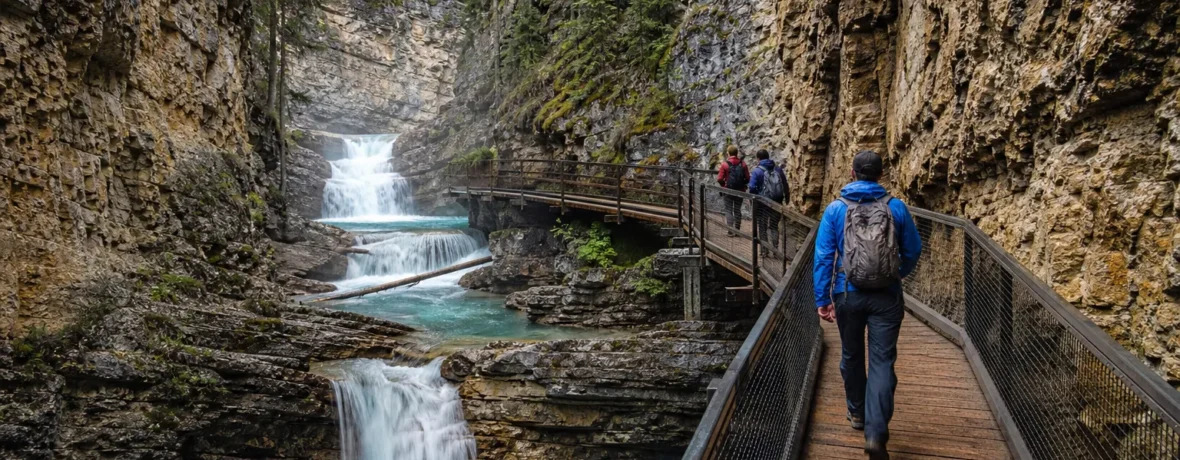
How long is Johnston Canyon hike? The classic hike is 1.4 miles [2.2 km] round trip to Lower Falls or 3.0 miles [4.8 km] round trip to Upper Falls. Most hikers need 1 hour for Lower Falls and 2 hours for Upper Falls, before adding time for photos, crowds, and icy winter footing.
How long is Johnston Canyon hike to Lower and Upper Falls?
The Johnston Canyon hike takes 1 hour to Lower Falls or 2 hours to Upper Falls for most walkers. Those times come from Parks Canada’s official trail listing, which gives the Lower Falls route as 0.7 miles [1.1 km] one way and the Upper Falls route as 1.5 miles [2.4 km] one way on an uneven paved canyon path with railings and catwalks.
Here’s the simple version. If you only want the tight canyon walls, the bridge, and the punchy Lower Falls viewpoint, stop at Lower Falls. If you want the full Johnston Canyon experience, keep climbing to Upper Falls. It adds mileage, elevation, and better payoff.
| Destination | Round-trip distance | Elevation gain | Typical time |
|---|---|---|---|
| Lower Falls | 1.4 miles [2.2 km] | 279 feet [85 m] | 1 hour |
| Upper Falls | 3.0 miles [4.8 km] | 705 feet [215 m] | 2 hours |
| Upper Falls top viewpoint add-on | Add 0.3 miles [530 m] round trip | Additional short climb | Add 15–25 minutes |
Check the official Parks Canada Banff hiking page before you go. As of November 2026, Parks Canada lists the main Johnston Canyon Trail and day-use area as temporarily closed for construction work, with Upper Falls and Ink Pots remaining accessible by the Moose Meadows Trail.
Is Johnston Canyon open right now?
No, the main Johnston Canyon Trail is closed as of November 2026. Parks Canada’s current closure order runs from October 13, 2026, through December 11, 2026, and includes the Johnston Canyon Trail, day-use area, washrooms, and P1 parking lot.
This matters. Do not show up expecting to “just sneak in” for a quick waterfall photo. The closure is in place for worker and public safety during rock slope remediation, and Parks Canada states that violators may be charged under the Canada National Parks Act.
For the current legal status, use the official Parks Canada Johnston Canyon closure bulletin. Conditions in Banff change fast: construction, ice, wildlife activity, and storm damage can all shift access.
Where does the Johnston Canyon hike start?
The regular trail starts at Johnston Canyon Day-use Area on the Bow Valley Parkway. Parks Canada places it 15.5 miles [25 km] northwest of Banff and 20.5 miles [33 km] southeast of Lake Louise.
When the main trail is open, you’ll start from the signed day-use area and walk straight into the canyon on a maintained path. The first stretch is easy to follow. You do not need route-finding skills. You do need patience, because this is one of Banff’s busiest short hikes.
The route moves through forest, then tightens into the canyon. Soon you’re walking beside Johnston Creek, crossing bridges, and using cliff-hugging catwalks with metal railings. The engineered sections are part of the fun. They also create bottlenecks. If someone stops for a photo, everyone behind them stops too.
Is Johnston Canyon hike hard?
Johnston Canyon is easy to moderate, not hard. The trail is short, signed, and partly paved, but it is not flat, and the narrow canyon sections can feel slow when crowds, ice, or wet footing are in play.
Lower Falls is the easier target. The path climbs and dips, but the distance is friendly for many casual walkers. Upper Falls asks for more. You gain more height, spend longer on your feet, and may hit slick sections where spray freezes or water crosses the path.
Strollers are not recommended by Parks Canada. That surprises some visitors because the trail is paved in places, but “paved” does not mean smooth sidewalk. Expect grades, tight turns, narrow bridges, and sections where passing other hikers takes a little dance.
What do you see at Lower Falls?
Lower Falls gives you the fastest waterfall payoff on the Johnston Canyon hike. You reach a bridge, hear the roar, and get a close look at water blasting through a narrow rock slot.
The classic move is to cross the bridge and step through the short rock tunnel to the viewing area. It’s tight. It’s loud. It gets wet. On busy days, expect a line of people waiting for their turn near the tunnel, especially from late morning into mid-afternoon.
Do not climb over railings for a better angle. The rock is wet, polished, and unforgiving. The fenced viewpoints are there because the canyon drops are serious, even where the walk itself feels tame.
Is it worth hiking to Upper Falls?
Yes, Upper Falls is worth it if you have the time and steady footing. The waterfall is taller, the canyon opens up in different ways, and the walk thins the crowd compared with the Lower Falls section.
Parks Canada lists Upper Falls at 98 feet [30 m] high. You’ll first reach the lower viewing area near the base, where the water drops into a deep bowl. If you have extra energy, continue another 0.16 miles [265 m] to the viewpoint at the top of Upper Falls for a different angle into the canyon.
This upper section is where pacing matters. Don’t burn all your steam rushing to Lower Falls. Keep a steady rhythm, let faster hikers pass where the trail widens, and save a few minutes for the upper viewpoint instead of treating it like an afterthought.
What is the best time to hike Johnston Canyon?
The best time to hike Johnston Canyon is early morning or late afternoon when the trail is open. You get fewer bottlenecks, easier parking, better pacing, and a calmer canyon.
Midday can be rough. Tour groups, families, photographers, and casual sightseers all funnel into the same narrow walkway. That doesn’t ruin the hike, but it changes the feel. Instead of a quiet canyon walk, you get a slow-moving parade with waterfall breaks.
For seasons, summer gives you open water and the easiest footing. Fall brings cooler air and a sharper edge to the scenery. Winter turns the falls into ice and makes the canyon feel completely different, but traction becomes non-negotiable. Spring can be messy, with freeze-thaw cycles, lingering ice, and wet patches.
Do you need a pass or permit for Johnston Canyon?
You need a valid Banff National Park entry pass, but Parks Canada does not list a separate Johnston Canyon day-hiking permit for the standard trail as of November 2026. Check current pass details before driving into the park.
Entry fees and pass rules can change, so use the official Parks Canada Banff fees page rather than an old blog post or screenshot. If you are staying in Banff, Lake Louise, or Canmore and using transit, you still need to understand park entry requirements for your trip.
When the trail is open, parking at Johnston Canyon can fill quickly. Parks Canada tells visitors to park only in designated spaces. Don’t improvise along the road shoulder; you can damage vegetation, block traffic, and earn the wrong kind of souvenir.
Can you get to Johnston Canyon without a car?
Yes, transit can serve Johnston Canyon during operating periods. Roam Transit Route 9 is the Johnston Canyon route, with service patterns that vary by season.
As of November 2026, Roam’s route overview lists Route 9 as summer service seven days a week and winter service on weekends and statutory holidays, but route status can change during construction closures. Always check the official Roam Transit schedules and routes before planning your day around a bus.
Transit is a strong play when the canyon is open and parking pressure is high. It also lets you skip the slow roll through full lots. The tradeoff is schedule discipline: miss the bus, and your “quick hike” gets longer in a hurry.
How do you hike Johnston Canyon step by step?
Follow the signed trail from the day-use area to Lower Falls, then continue upstream to Upper Falls. The route is direct, but a simple plan keeps you from getting rushed, cold, or stuck behind your own bad timing.
- Check closures the same day. Look at Parks Canada’s trail and bulletin pages before leaving Banff, Lake Louise, or Canmore.
- Start early if the trail is open. Aim for the first part of the day to beat the thickest crowds and improve your parking odds.
- Use the washroom before hiking. Facilities are at the day-use area when open; there are no bathroom stops tucked into the canyon.
- Walk to Lower Falls first. Take your time on the catwalks and bridges. Let people pass only where it’s safe.
- Decide at Lower Falls. If your group is cold, tired, or moving slowly, turning around here is a complete hike.
- Continue to Upper Falls if conditions are good. The trail climbs more after Lower Falls, but the upper waterfall is the main event for many hikers.
- Add the top viewpoint only if you still feel fresh. It’s a short extra push, not a separate hike, but it does add time.
- Return the same way. Stay right where practical, keep moving through narrow areas, and save snack breaks for wider spots.
What should you bring for Johnston Canyon?
Bring more than city shoes and a phone. Johnston Canyon is short, but it sits in a mountain national park where weather, ice, and crowds can turn a simple walk into a chilly wait.
- Comfortable walking or hiking shoes with solid tread
- Microspikes or ice cleats in winter and shoulder seasons
- Warm layer, even in summer mornings
- Rain shell or wind shell
- Water
- Snacks, especially if hiking to Upper Falls
- Bear spray carried where you can reach it
- Phone with offline map or saved trail info
- Gloves and warm hat in cold months
- Small trash bag so every wrapper leaves with you
Banff is bear country. Parks Canada asks visitors to give wildlife space, keep food secure, and keep pets controlled. Read the official Parks Canada wildlife guidance if you are new to hiking in the Canadian Rockies.
Can dogs hike Johnston Canyon?
Dogs can hike many Banff trails when allowed, but they must be leashed and under control. For Johnston Canyon specifically, check current trail status first, because a closure applies to people and pets alike.
This is not the best trail for nervous dogs. The catwalks are narrow, the crowds can be thick, and the sound of the falls bounces off the canyon walls. If your dog lunges, spooks, or tangles leashes in crowds, choose a quieter walk.
Also, don’t leave a dog in a vehicle while you hike. Mountain sun, crowded parking lots, and changing temperatures are a bad mix.
Can you hike Johnston Canyon in winter?
Yes, Johnston Canyon is a popular winter hike when the trail is open. The waterfalls freeze, the canyon gets quieter in places, and the whole route feels sharper and colder.
Winter is also when casual mistakes show up fast. The paved path can turn into a skating rink. Spray from the creek and falls freezes on walkways, and shaded canyon sections can stay icy long after nearby roads look dry. Bring traction. Not “maybe” traction. Real microspikes or ice cleats.
Dress for standing around, not just walking. If there is a line at the Lower Falls tunnel or a slow group on a catwalk, your body heat drops while you wait. Gloves, hat, and a warm midlayer make the difference between fun and gritted teeth.
What are the biggest mistakes hikers make at Johnston Canyon?
The biggest mistake is treating Johnston Canyon like a roadside photo stop. It is easy by mountain standards, but it still needs timing, footwear, and respect for closures.
- Ignoring current closures. If Parks Canada closes the trail, pick another hike.
- Arriving at peak crowd time. Late morning and early afternoon can feel jammed.
- Wearing slick shoes. Wet rock, ice, and smooth paved sections can all be slippery.
- Stopping in narrow spots. Step aside only where the trail gives you room.
- Climbing railings. The canyon edges are not photo platforms.
- Underestimating winter. Cold shade and frozen spray can linger for months.
Related reading
- Grand Canyon Entrance Fee and Passes
- Is the Grand Canyon Open? Rims, Trails and Seasons
- Grand Canyon Backcountry Permits Explained
- How Long Is the Appalachian Trail? Miles, States and Time
FAQ
How long is Johnston Canyon hike round trip?
Johnston Canyon is 1.4 miles [2.2 km] round trip to Lower Falls and 3.0 miles [4.8 km] round trip to Upper Falls. Plan on 1 hour for Lower Falls and 2 hours for Upper Falls in normal conditions.
Is Johnston Canyon worth it if I only hike to Lower Falls?
Yes, Lower Falls is worth it if you are short on time. You still get canyon walls, bridges, rushing water, and a close waterfall viewpoint in a compact hike.
How far is Johnston Canyon from Banff?
Johnston Canyon Day-use Area is 15.5 miles [25 km] northwest of Banff on the Bow Valley Parkway. Driving time depends on traffic, road conditions, wildlife slowdowns, and parking congestion.
Is Johnston Canyon good for beginners?
Yes, Johnston Canyon is good for beginners when the trail is open and conditions are dry. Beginners should still wear grippy shoes, carry water, and turn around at Lower Falls if the upper trail feels like too much.
Do I need hiking boots for Johnston Canyon?
No, you do not need heavy hiking boots in dry summer conditions, but you do need shoes with good tread. In winter or icy shoulder-season conditions, bring microspikes or ice cleats.
Can I hike to Ink Pots from Johnston Canyon?
Yes, the Ink Pots are normally reached by continuing beyond Upper Falls, but that is a longer hike than the waterfall route. During the November 2026 main trail closure, Parks Canada says Upper Falls and Ink Pots remain accessible by the Moose Meadows Trail instead of the regular Johnston Canyon trailhead.