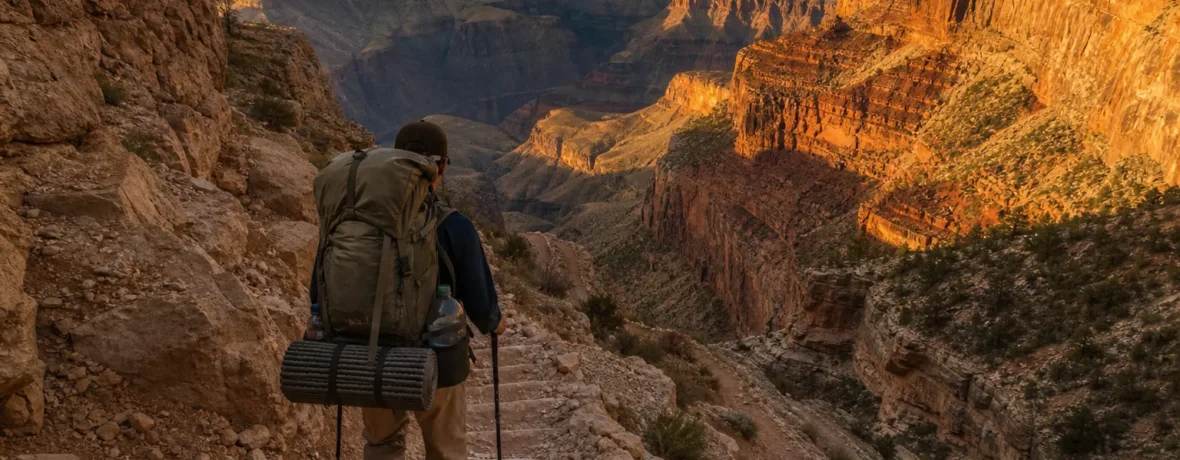
A Grand Canyon backcountry permit is required for overnight backcountry camping inside Grand Canyon National Park, including below-rim backpacking and many rim sites outside developed campgrounds. As of November 2026, permits cost $10 plus nightly charges of $15 per person below the rim or $4 per person above the rim. Grand Canyon National Park backcountry permit page. (nps.gov)
Do you need a permit to backpack the Grand Canyon?
Yes, you need a permit for overnight backpacking in Grand Canyon National Park’s backcountry. As of November 2026, the National Park Service requires a backcountry permit for overnight camping outside Mather Campground, Desert View Campground, and North Rim Campground, plus overnight camping at Tuweep, off-river camping by river trip members, packrafting outside a river permit, and overnight private stock use outside the listed developed campground exceptions. NPS lists the current permit-required trips here. (nps.gov)
You do not need a backcountry permit for a day hike, even if you start before dawn or finish after dark. You also do not use a backcountry permit for developed campground reservations at Mather, Desert View, or the North Rim during their listed seasons, and you do not use one for Phantom Ranch lodging. Those are separate reservation systems. (nps.gov)
Simple rule: if you plan to sleep in the canyon, on a remote rim site, or away from a developed campground, assume you need a permit before your boots leave the trailhead.
How do you get a Grand Canyon backcountry permit?
You apply through Recreation.gov, not by mailing a paper form. As of November 2026, Grand Canyon’s overnight backcountry reservation system is on Recreation.gov, with early access lottery periods for advance trips and regular availability checks for closer-in dates. Recreation.gov’s Grand Canyon Backcountry Permits page is the booking portal. (home.nps.gov)
- Choose your month. Start with the month you want to begin hiking, not the month you want to apply.
- Enter the early access lottery. As of November 2026, lottery applications open on the 16th of the month and close at 5 p.m. Mountain Standard Time on the 1st of the month, four months before the trip month. (home.nps.gov)
- Wait for results. The park runs the lottery on the 2nd of the month and awards early access time slots to up to 750 applicants. (nps.gov)
- Book during your time slot. If you get a time slot, log in, check availability, and reserve an itinerary that still has space.
- Watch for leftovers and cancellations. Space remaining after the early access month opens later to the public, and canceled space is randomly released online within 24 hours. (Recreation.gov)
- Print your permit. As of November 2026, permits can be printed as early as one month before the start date, and you must carry the printed permit in the backcountry. (Recreation.gov)
When should you apply for a Grand Canyon backcountry permit?
Apply during the lottery window if your dates matter. As of November 2026, the early access lottery window starts on the 16th of the month and ends at 5 p.m. MST on the 1st, four months before your trip month. For example, May start dates use the Dec. 16 to Jan. 1 lottery window. NPS explains the lottery schedule and deadlines. (nps.gov)
| Trip start month | Lottery opens | Lottery closes | Public reservations open |
|---|---|---|---|
| March | Oct. 16 | Nov. 1, 5 p.m. MST | Dec. 1, 8 a.m. MST |
| April | Nov. 16 | Dec. 1, 5 p.m. MST | Jan. 1, 8 a.m. MST |
| May | Dec. 16 | Jan. 1, 5 p.m. MST | Feb. 1, 8 a.m. MST |
| October | May 16 | June 1, 5 p.m. MST | July 1, 8 a.m. MST |
The pattern matters more than memorizing every row: count backward from your start month. If your trip starts in October, the lottery opens May 16 and closes June 1. If your trip starts in January, the lottery opens Aug. 16 and closes Sept. 1. (nps.gov)
How much does a Grand Canyon backcountry permit cost?
As of November 2026, the base permit or lottery application charge is $10, below-rim use costs $15 per person or stock animal per night, and above-rim use costs $4 per person or stock animal per night. Permit holders also pay park entrance fees when they arrive. (home.nps.gov)
| Charge | Cost as of November 2026 | Refund status |
|---|---|---|
| Lottery or basic permit charge | $10 | Non-refundable |
| Below-rim nightly charge | $15 per person or stock animal | Refundable until 30 days before the start date if the permit has not been printed |
| Above-rim nightly charge | $4 per person or stock animal | Refundable until 30 days before the start date if the permit has not been printed |
If you win a lottery time slot and book during the early access month, your $10 lottery charge counts as the $10 basic permit charge. You do not pay both charges for the same reservation. (nps.gov)
Where can you camp with a Grand Canyon backcountry permit?
You camp only where your permit says you can camp. As of November 2026, Grand Canyon’s backcountry is divided into use areas, each with an overnight capacity based on available campsites, ecological sensitivity, zoning, and use history. (home.nps.gov)
Popular corridor campgrounds include Havasupai Gardens, Bright Angel, and Cottonwood, but closures can change the map fast. As of November 2026, NPS states that Bright Angel and Cottonwood Campgrounds are closed, along with Phantom Ranch and the full North Kaibab Trail from Phantom Ranch to the North Kaibab Trailhead, because of flash flooding on Aug. 29, 2026. Check the NPS backcountry trails and use areas page and current closure notices before you build an itinerary. (nps.gov)
For designated campsites and campgrounds, as of November 2026, camping is limited to two nights per campsite or campground per hike, consecutive or non-consecutive. The corridor has one off-season exception: from Nov. 15 through Feb. 28, up to four nights per campground per trip are allowed. Outside the listed designated areas, “at-large” camping may be allowed, with a limit of seven nights per use area. (home.nps.gov)
Can you get a last-minute Grand Canyon backcountry permit?
Sometimes, but do not build your whole trip on it. As of November 2026, Recreation.gov allows new reservations as late as five days before the hike start date, and canceled space is randomly released online within 24 hours after cancellation. (Recreation.gov)
There is also a limited in-person last-minute system. As of November 2026, NPS describes one-night last-minute permits for Havasupai Gardens as available only in person at the South Rim Backcountry Information Center, no more than one day before the hike, and only between March 1 and Nov. 30; availability is not guaranteed because of the August 2026 flood impacts. (home.nps.gov)
That means your best backup plan is not “show up and hope.” Your best backup plan is flexibility: different dates, a smaller group, less famous use areas, and a willingness to check cancellations without getting attached.
What rules come with a Grand Canyon backcountry permit?
The permit is a contract with the park, not a loose suggestion. As of November 2026, it is valid only for the trip leader, campsites, dates, and number of people printed on it, and the trip leader must have the permit while in the backcountry. NPS posts the current backcountry rules and regulations here. (nps.gov)
- Carry the printed permit. Once camp is set up, attach it to a pack, tent, or other visible gear so rangers can check it. (nps.gov)
- Stay on your itinerary. The permit is valid only for the named leader, dates, sites or use areas, and group size. (nps.gov)
- Pack out trash and toilet paper. Burning, burying, or leaving trash or toilet paper is prohibited. (nps.gov)
- No wood or charcoal fires. As of November 2026, wood and charcoal fires are prohibited in the backcountry; Sterno or fossil-fuel backpacking stoves are allowed. (nps.gov)
- Do not use soap in creeks. That includes biodegradable soap. (nps.gov)
- No pets below the rim. As of November 2026, NPS prohibits domestic animals or pets below the rim, with separate rules for permitted private stock. (nps.gov)
- No wheels below the rim. Motorized vehicles and wheeled devices such as bicycles, motorcycles, and baby buggies are prohibited on trails below the rim. (nps.gov)
- No shortcutting. Cutting between trail sections or toward adjacent trails is strictly prohibited. (nps.gov)
How big can your group be in the Grand Canyon backcountry?
Keep it small if you want better odds. As of November 2026, Grand Canyon offers more permits for small groups of 1 to 6 people than for large groups of 7 to 11 people, and groups larger than 11 people may not camp in the same campground or use area. (home.nps.gov)
You also cannot dodge the limit by splitting one affiliated group into multiple permits for the same place on the same night. NPS says those permits are void when multiple affiliated groups camp in the same campground or use area on the same night. That rule exists because big groups spread out, create social trails, and change the feel of a wild canyon camp fast. (nps.gov)
What should you check before you apply?
Check closures, water, trail access, and your group’s actual ability before you click reserve. Grand Canyon permits are competitive enough without guessing.
- Current closures: Trails, campgrounds, water sources, roads, and offices can change after storms, rockfall, heat events, fires, or repairs.
- Water status: Do not assume a pipe or creek is usable. Check NPS updates, then carry the capacity and treatment plan your itinerary demands.
- Trailhead logistics: Some trailheads require long drives on rough roads, seasonal access, or extra time.
- Heat and season: Inner canyon conditions can be far hotter than the rim, and summer below-rim travel can be dangerous.
- Group size: A smaller group gives you more permit options.
- Plan B and Plan C: Have alternate dates and camps ready before your lottery time slot opens.
As of November 2026, Grand Canyon National Park’s operations page tells hikers and runners to check Key Hiking Messages for critical updates, trail closures, drinking water availability, inner canyon weather, and heat risk. The same page also states that inner canyon backcountry users may use gas cook stoves, but campfires and other open fires are never allowed below the rim. Check the official Grand Canyon operations update. (nps.gov)
Related reading
- Grand Canyon Entrance Fee and Passes
- Is the Grand Canyon Open? Rims, Trails and Seasons
- North Cascades Backcountry Permits
- Angels Landing Permit Lottery Explained
FAQ
Do I need a Grand Canyon backcountry permit for a day hike?
No, you do not need a backcountry permit for a day hike, including a nighttime day hike. As of November 2026, NPS requires backcountry permits for overnight backcountry use, not standard day hiking. (nps.gov)
Can I camp at Phantom Ranch with a backcountry permit?
No, Phantom Ranch lodging is not booked with a backcountry permit. As of November 2026, NPS says dormitories or cabins at Phantom Ranch require advance reservations with Grand Canyon National Park Lodges. (nps.gov)
How far in advance can I apply for a Grand Canyon backcountry permit?
Use the lottery window four months before your trip month. As of November 2026, applications open on the 16th and close at 5 p.m. MST on the 1st, four months before the desired start month. (home.nps.gov)
Can I change or cancel my Grand Canyon backcountry permit?
Yes, but timing matters. As of November 2026, Recreation.gov gives partial refunds of nightly participant charges for cancellations made at least one month before the permit start date, provided the permit has not been printed; the $10 charge is non-refundable. (Recreation.gov)
Do I need to print my Grand Canyon backcountry permit?
Yes, you need the printed permit with you in the backcountry. As of November 2026, permits can be printed as early as one month before the permit start date, and if you forget, NPS says to stop by the Backcountry Information Center before you hike. (Recreation.gov)