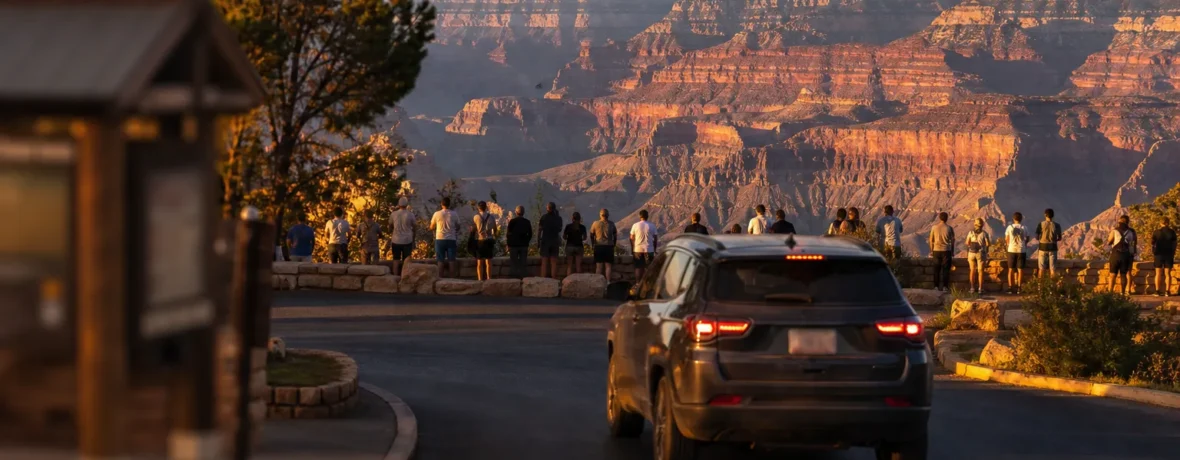
The Grand Canyon entrance fee is $35 per private vehicle, $30 per motorcycle, or $20 per person entering on foot or bike, as of November 2026. Standard passes are valid for 7 days. Non-US residents age 16 and older owe an added $100 fee unless covered by an eligible annual pass.
How much is the Grand Canyon entrance fee?
The standard fee is $35 per private vehicle, as of November 2026. That covers one private, non-commercial vehicle and its passengers, up to a 15-person passenger van, according to the official Grand Canyon National Park fees and passes page.
If you roll in on a motorcycle, the fee is $30. If you enter without a vehicle—on foot, by bicycle, or as a hiker age 16 or older—the fee is $20 per person. Kids under 16 do not need an individual entrance pass when entering without a vehicle, as of November 2026.
| Entrance type | Fee as of November 2026 | What it covers |
|---|---|---|
| Private vehicle | $35 | One private, non-commercial vehicle and passengers |
| Motorcycle | $30 | Up to 2 private, non-commercial motorcycles with up to 4 total passengers |
| Person on foot or bicycle | $20 | One person age 16 or older entering without a vehicle |
| Grand Canyon annual pass | $70 | Unlimited Grand Canyon National Park entry for 1 year from month of purchase |
How long is a Grand Canyon entrance pass good for?
A standard entrance pass is good for 7 days. As of November 2026, Grand Canyon National Park says admission includes the South Rim and the North Rim when the North Rim is open for the season.
That 7-day window is handy. You can enter the South Rim, leave for dinner or lodging outside the park, and come back the next day without buying another standard pass. Keep the receipt or digital pass where you can grab it fast at the booth. No pass, no easy re-entry.
Do you need a reservation to enter Grand Canyon National Park?
No, you do not need an entry reservation or timed-entry ticket, as of November 2026. The park states there is no timed entry at this time on its official permits and reservations page.
That does not mean you can ignore planning. Entrance lines at the South Entrance can stack up during busy seasons, especially spring break, Memorial Day to Labor Day, and major holiday weeks. If you hate sitting in a hot car, aim for early morning or late afternoon.
Can you pay the Grand Canyon entrance fee with cash?
No, park entrance stations do not accept cash, as of November 2026. Grand Canyon entrance stations accept credit cards, debit cards, digital passes, and America the Beautiful passes.
If you only have cash, buy before the gate. The park lists several Tusayan businesses that sell passes with cash or card, including the IMAX Visitor Center, Canyon Plaza Resort, Red Feather Lodge, Pink Jeep Tours inside IMAX, and Westwind Air at Grand Canyon Airport, as of November 2026.
Which Grand Canyon pass should you buy?
Buy the cheapest pass that matches your real trip, not your fantasy road trip. If Grand Canyon is your only national park stop, the $35 vehicle pass usually wins.
If you plan to return to Grand Canyon several times within a year, the $70 Grand Canyon annual pass can make sense. As of November 2026, it is valid for unlimited visits to Grand Canyon National Park only for 1 year from the month of purchase.
If you are visiting multiple national parks or federal recreation sites in the next 12 months, look at the America the Beautiful pass. As of November 2026, the National Park Service entrance passes page lists a $80 Resident Annual Pass for US citizens and residents and a $250 Non-Resident Annual Pass for non-US residents.
- Choose a standard pass if this is one Grand Canyon trip in one week.
- Choose the $70 Grand Canyon annual pass if you will return to this park multiple times within 12 months.
- Choose an America the Beautiful pass if you will visit several national parks, monuments, forests, or other federal recreation sites.
- Check eligibility first if you are a senior, current US military member, veteran, Gold Star Family member, person with a permanent disability, 4th grader, or qualifying federal recreation volunteer.
What does the America the Beautiful pass cover at Grand Canyon?
It covers the standard entrance fee. As of November 2026, NPS says America the Beautiful passes cover entrance fees and standard amenity day-use fees at federal recreation sites, including lands managed by the National Park Service, US Forest Service, Bureau of Land Management, US Fish & Wildlife Service, Bureau of Reclamation, and US Army Corps of Engineers.
At a park like Grand Canyon, the pass generally covers one private vehicle fee or four per-person fees, depending on how the site charges entry. Bring photo ID. NPS says America the Beautiful passes are non-refundable, non-transferable, and cannot be replaced if lost or stolen, as of November 2026.
The big trap: the pass does not magically cover everything. Campgrounds, backcountry permits, tours, lodging, mule rides, river trips, and special-use permits are separate unless the official booking page says otherwise.
Do non-US residents pay extra at Grand Canyon?
Yes, non-US residents age 16 and older pay an extra $100 per person at Grand Canyon, as of November 2026. That fee is in addition to the regular entrance fee unless the visitor is admitted with an eligible Annual or America the Beautiful pass.
This can change the math fast. A non-US resident family or group may be better off with the $250 America the Beautiful Non-Resident Annual Pass if Grand Canyon is one stop on a bigger national park route. Run the numbers before you reach the booth.
Are there free entrance days at Grand Canyon?
Yes, but the 2026 free entrance days apply to US citizens and residents. As of November 2026, NPS lists these 2026 fee-free dates for National Park Service sites that charge entrance fees: February 16, May 25, June 14, July 3–5, August 25, September 17, October 27, and November 11.
Free entrance means the entrance fee is waived. It does not erase camping fees, timed-entry or reservation fees where those exist, permit charges, tours, or other paid services. For non-US residents, NPS says regular entrance and applicable nonresident fees still apply on free entrance days, as of November 2026.
Do you need a separate permit for hiking or camping below the rim?
Day hiking does not require a backcountry permit, but overnight backcountry use does. As of November 2026, Grand Canyon requires backcountry permits for overnight hiking, overnight horseback riding, overnight cross-country ski trips, off-river overnight hikes by river trip members, and overnight camping at rim sites outside developed campgrounds.
Backcountry permits are handled through Recreation.gov’s Grand Canyon Backcountry Permits page. As of November 2026, the posted charges are a $10 basic permit charge, plus $15 per person or stock animal per night for below-rim use or $4 per person or stock animal per night for above-rim use. Permit holders still pay park entrance fees when they arrive.
Read that twice if you are planning a rim-to-river backpacking trip. Your entrance pass gets you through the gate. Your backcountry permit lets you sleep in the backcountry. They are not the same thing.
How do you buy a Grand Canyon entrance pass?
You can buy a pass before you go or when you arrive. Buying ahead will not let you skip a backed-up entrance line, but it can make the booth stop cleaner and faster.
- Decide whether you need a standard pass, Grand Canyon annual pass, or America the Beautiful pass.
- Check whether anyone in your group qualifies for a free or discounted federal pass.
- Buy online if you want a digital option, or bring a credit/debit card for the entrance station.
- If paying cash, stop at an approved Tusayan seller before the South Entrance.
- Save the pass, receipt, or digital file where you can show it during your 7-day visit.
What should you have ready at the entrance station?
Have your pass and ID ready before you reach the window. Small move. Big difference.
- Credit card, debit card, or accepted pass
- Photo ID for annual or lifetime pass holders
- Digital pass saved offline in case cell service drops
- Backcountry permit if you are starting an overnight backcountry trip
- Patience during peak travel windows
Related reading
- Is the Grand Canyon Open? Rims, Trails and Seasons
- Grand Canyon Backcountry Permits Explained
- Zion National Park Entrance Fee
- National Park Entrance Fees: What You Pay and Why
FAQ
How much does it cost to enter Grand Canyon National Park by car?
It costs $35 per private vehicle, as of November 2026. The pass covers one private, non-commercial vehicle and its passengers for 7 days.
Is the Grand Canyon entrance fee per person or per car?
It is usually per car if you enter in a private vehicle. The per-person $20 fee applies to people age 16 or older entering without a vehicle, such as hikers and cyclists, as of November 2026.
Can I use an America the Beautiful pass at Grand Canyon?
Yes, Grand Canyon accepts America the Beautiful passes for standard entrance, as of November 2026. Bring photo ID because passholders must show valid identification with the pass.
Does the entrance fee include the North Rim and South Rim?
Yes, a Grand Canyon entrance pass includes the South Rim and the North Rim when the North Rim is open for the season. The North Rim is seasonal, so check current park conditions before building a trip around it.
Do I need a permit for a Grand Canyon day hike?
No, a normal day hike does not require a backcountry permit. Overnight backcountry trips do require a permit, and that permit is separate from the park entrance fee.
Can I pay cash at the Grand Canyon entrance gate?
No, entrance stations do not accept cash, as of November 2026. Use a credit card, debit card, digital pass, or accepted annual pass at the gate, or buy with cash at a listed Tusayan seller before you enter.