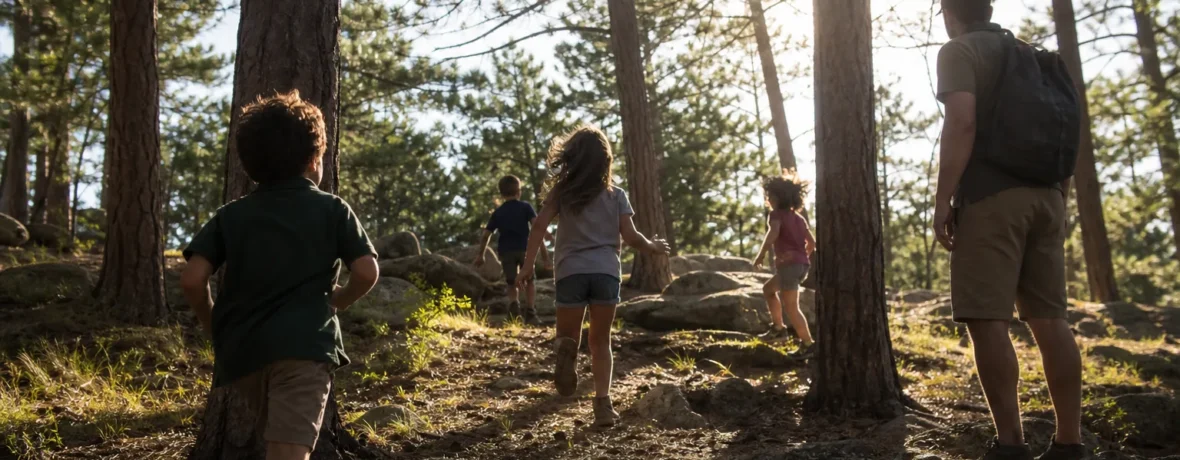
The best hiking games for kids are simple, repeatable, and playable without gear: scavenger hunts, animal tracking, color hunts, story games, trail bingo, map jobs, and short challenges. Use 3 to 5 games per hike, switch every 10 to 20 minutes, and keep rules light so kids keep walking.
Kids do better on trails when the hike has a job, a mystery, or a tiny mission. Not a lecture. Not a forced march. A game gives them something to notice right now: a pinecone shaped like a mouse, a bird call, a bend in the trail, a blaze on a tree, a cloud that looks like a dragon with bad teeth.
The trick is choosing games that match the trail, the age of the child, and the energy level in front of you. A tired 6-year-old does not need a complicated points system. A 10-year-old may want a challenge. A toddler may only need permission to find “three round things.”
What are the best hiking games for kids?
The best games are the ones that keep kids walking while paying attention to the trail.
Start with games that require zero setup. If a game needs cards, pencils, prizes, and a referee, save it for a picnic table. On the move, simple wins.
1. Trail Scavenger Hunt
Give kids a short list of things to find. Keep it to 5 items for younger kids and 10 items for older kids.
- A heart-shaped rock
- A leaf bigger than your hand
- A bird sound
- A fallen log
- Something yellow
- Animal tracks or scat, viewed without touching
Use “find” instead of “collect” in fragile areas. Many parks ask visitors to leave natural objects where they are, and the National Park Service hiking safety guidance also encourages planning ahead and respecting conditions on the trail.
2. I Spy: Trail Edition
This classic works because it fills a slow stretch without stopping the group.
Use trail-specific clues: “I spy something with bark,” “I spy something moving,” or “I spy something made by people.” For younger kids, use colors. For older kids, use textures, sounds, and shapes.
3. Animal Detective
Kids look for signs that animals have been nearby.
- Tracks in mud or sand
- Holes in trees
- Chewed leaves
- Feathers
- Scat
- Burrows
The rule is simple: look closely, do not touch, and never put fingers into holes, logs, or rock gaps.
4. Twenty Questions: Nature Version
One person thinks of something seen on the hike. Everyone else asks yes-or-no questions.
Good answers include “mushroom,” “squirrel,” “stream,” “bridge,” “fern,” or “hawk.” Keep the chosen object trail-related so the game strengthens observation instead of turning into a random guessing slog.
5. Follow the Leader, Trail Style
One child leads with safe movements: big steps over roots, quiet steps, slow-motion steps, or “walk like a fox.”
Set limits first. No running on steep ground. No jumping from rocks. No leaving the trail. Then let the leader change every few minutes.
6. Sound Safari
Stop for 30 seconds and count every sound.
You might hear wind, water, insects, shoes on gravel, birds, dogs, leaves, or distant traffic. This is a strong reset game when kids get loud, tired, or cranky. It brings the group back to the place they are actually in.
How do you keep kids entertained on a hike?
You keep kids entertained by changing the focus before boredom takes over.
Do not wait for the meltdown. Rotate games through the hike like snacks: one active game, one quiet game, one challenge, one silly game. Keep each round short. A game that lasts 8 good minutes is better than one that drags for 30.
| Trail moment | Best game type | Why it works |
|---|---|---|
| First 10 minutes | Scavenger hunt | Gives kids a mission right away |
| Long flat stretch | I Spy or 20 Questions | Keeps minds busy while feet move |
| Steep climb | Step-count challenge | Breaks the hill into small wins |
| Rest stop | Sketch, snack, or sound safari | Lets bodies recover without chaos |
7. Step-Count Challenge
Pick a number, then count steps to a visible landmark.
Try “50 steps to that big tree” or “100 steps to the bend.” This turns a climb into chunks. For little legs, use 20 steps. For bigger kids, use 100 to 200 steps.
8. Guess the Distance
Choose a landmark and have everyone guess how many steps away it is.
Then count together. The winner gets to choose the next landmark. No prizes needed. The reward is control, and kids love control.
9. Trail Bingo
Make a 3-by-3 bingo grid before the hike or draw one at the trailhead.
Fill squares with things kids can see without disturbing anything: bridge, bird, moss, acorn, bench, puddle, trail sign, mushroom, smooth rock. For older kids, make the squares harder: “three kinds of bark,” “evidence of erosion,” or “two different bird calls.”
10. The Alphabet Game
Find trail things from A to Z.
Acorn, bark, creek, dirt, evergreen. Some letters will be hard. That is fine. Let kids get creative, but keep the answers tied to the hike.
11. Snack Math
Turn snack breaks into tiny math games.
Ask, “If you have 8 raisins and eat 3, how many are left?” For older kids, use trail mix fractions or divide crackers evenly. Keep it playful. Nobody came outside for a worksheet.
12. Pick the Next Landmark
Let kids choose the next mini-destination.
“We hike to that boulder, then we stop.” This works especially well for reluctant hikers because the goal is visible. A summit may feel impossible. A boulder 150 ft [46 m] away feels doable.
What trail games work for toddlers and preschoolers?
Toddlers and preschoolers need short, sensory games with almost no rules.
For ages 2 to 5, skip winning and losing. Focus on finding, touching safe textures, listening, copying, and naming. Keep the pace slow. A toddler may spend 5 minutes with one stick. That is not failure. That is the hike.
13. Find Three Things
Ask for three simple finds.
- Three brown things
- Three soft things
- Three tiny things
- Three things that make noise
Use “point to” when collecting is not appropriate. This teaches attention without filling pockets with half the forest.
14. Tiny Ranger Jobs
Give a toddler a pretend trail job.
They can be the puddle spotter, bridge checker, snack captain, or blaze finder. Jobs work because they make the child part of the team instead of cargo being moved down the trail.
15. Color Walk
Pick one color and hunt for it for 5 minutes.
Green is easy. Red and purple are harder. In fall, orange and yellow can carry a whole hike. Change colors before the game gets stale.
16. Copycat Animals
Call out an animal and let kids move like it on safe, flat ground.
Try bear steps, deer steps, turtle steps, owl eyes, or fox ears. Keep movements controlled. This is not a sprint game.
17. Texture Hunt
Look for rough, smooth, bumpy, soft, and prickly textures.
Make the rule clear: touch only what an adult says is safe. Bark, smooth stones, and dry leaves are usually better choices than unknown plants, mushrooms, or anything sharp.
What hiking games are good for older kids?
Older kids usually want harder challenges, more independence, and less baby talk.
Give them responsibility. Let them read the map, estimate time, identify trail markers, or run a photo challenge. Older kids can smell fake enthusiasm from 60 ft [18 m] away, so keep it real.
18. Map Boss
Hand over the map at junctions and ask, “Which way now?”
Stay in charge of safety, but let the child think through the route. The National Park Service guide to hiking with kids recommends involving children and keeping hikes positive, which fits perfectly with giving them age-appropriate trail jobs.
19. Timekeeper Challenge
Ask older kids to estimate how long it will take to reach the next trail sign.
Then compare the guess with the actual time. This builds trail sense: grade, footing, heat, group pace, and snack stops all matter.
20. Leave No Trace Spotter
Challenge kids to spot good and bad trail behavior.
- Good: staying on trail
- Good: packing out wrappers
- Good: giving wildlife space
- Bad: carving bark
- Bad: cutting switchbacks
- Bad: feeding animals
Keep the tone practical, not preachy. The goal is awareness, not scolding strangers.
21. Photo Mission
Give older kids a short shot list if they carry a phone or camera.
Try “three patterns,” “one tiny thing,” “one wide view,” and “one sign of water.” Avoid asking for risky poses. No cliff-edge shots. No climbing onto unstable logs. The best trail photo is never worth a fall.
22. Survival Priorities
Ask, “If we had to stop here, what would we need first?”
Good answers include staying together, staying warm or cool, water, shelter from weather, and signaling for help. Keep it calm and hypothetical. This is a thinking game, not a fear game.
23. Name That Tree Shape
Kids do not need exact species names to study trees.
Ask them to compare shapes: umbrella, cone, vase, crooked, twisted, flat-top. Then look closer at bark, needles, leaves, cones, and seeds. If you use an ID app, treat it as a clue, not a final answer.
What games help kids learn nature while hiking?
The best nature-learning games make kids observe first and name things second.
Start with what they can see, hear, smell, and compare. A child who notices “this bark peels like paper” is building real outdoor knowledge, even without knowing the species yet.
24. Same and Different
Pick two leaves, rocks, trees, or cones and compare them.
Ask: What is the same? What is different? Which is heavier? Which has sharper edges? Which looks newer? This game works from preschool through middle school because the answers can get more detailed with age.
25. Cloud Stories
At a viewpoint or meadow, look up and invent stories from cloud shapes.
This is a good rest-stop game because kids can lie back, drink water, and calm down. Add a time limit if the group needs to move: “Three cloud stories, then packs on.”
26. Micro-Hike
Choose a 3 ft [1 m] stretch of trail edge and inspect it closely without stepping off the trail.
Kids look for tiny plants, ants, grains of sand, cracks, seeds, and shadows. This is excellent for slowing down fast hikers who charge ahead and miss everything.
27. Bird Call Copy
Listen to a bird call, then try to copy its rhythm.
Do not chase birds or play recorded calls loudly on the trail. Just listen, copy softly, and move on. The goal is attention, not disturbance.
28. Rock Museum
Create a pretend museum without taking rocks home.
Kids choose “exhibits” along the trail: sparkliest rock, flattest rock, weirdest rock, best skipping-shape rock, most boring rock. The “most boring” category usually gets the biggest laugh.
How do you make hiking games safe?
Make games safe by setting boundaries before play starts.
Games should support the hike, not override trail sense. Before any challenge, give kids the non-negotiables: stay on the trail, stay where an adult can see you, stop at junctions, no throwing rocks or sticks, and no touching wildlife, scat, mushrooms, or unknown plants.
- Pick a visible boundary. Use a trail sign, bend, bridge, or big tree as the turnaround or waiting point.
- Explain the stop rule. At every junction, kids stop and wait for the group.
- Match the game to the terrain. Use quiet observation games near drop-offs, water, loose rock, or steep slopes.
- Keep wildlife wild. Watch animals from a distance and never feed them.
- Check bodies after brushy hikes. The CDC tick prevention guidance recommends checking children in common tick hiding spots such as hair, ears, underarms, belly button, waist, between the legs, and behind the knees.
29. Red Light, Green Light: Trail Version
Use this only on wide, flat, low-risk sections.
Green means walk. Yellow means slow. Red means freeze. Skip this game near cliffs, roads, slippery bridges, crowded trails, or water.
30. Junction Captain
One child gets the job of stopping the group at every trail junction.
This turns a major safety rule into a game. The captain does not choose the route alone. They simply stop, point out the sign, and wait for the adult decision.
31. Weather Watcher
Ask kids to watch for changes in sky, wind, temperature, and clouds.
Weather awareness is a real trail skill. If heat is part of the day, watch behavior closely. The CDC heat illness page lists warning signs such as confusion, altered mental status, slurred speech, heavy sweating, weakness, dizziness, headache, nausea, and fainting for different heat-related illnesses.
What should you pack for hiking games with kids?
Pack light game supplies that also help with comfort and safety.
You do not need much. Most hiking games for kids should work with eyes, ears, feet, and imagination. Still, a few small items can save the day.
- Small notebook and pencil: For bingo, sketches, leaf rubbings, or trail scores.
- Bandana: For shade, sweat, pretend flags, or sorting trail finds.
- Magnifying glass: For close looking at bark, sand, leaves, and insects without touching.
- Printed map: Better for kid navigation jobs than handing over your phone all day.
- Whistle: For emergency use, not casual play.
- Snacks: Use small snack breaks as natural game resets.
- Water: Bring enough for the conditions, and drink before kids are dragging.
- Sun and bug protection: Choose products appropriate for the child’s age and the local conditions.
Also pack patience. That sounds soft, but it is practical. A kid may care more about a beetle crossing the path than the overlook you planned around. If time allows, let the beetle win.
How do you choose the right hiking game by age?
Choose the game based on attention span, trail difficulty, and how much independence the child can handle.
| Age range | Best games | Keep in mind |
|---|---|---|
| 2 to 4 | Color Walk, Find Three Things, Copycat Animals | Use simple prompts and frequent stops |
| 5 to 7 | Scavenger Hunt, I Spy, Trail Bingo | Keep rounds short and rules clear |
| 8 to 10 | Animal Detective, Step-Count Challenge, Alphabet Game | Add harder clues and let them lead small moments |
| 11 and up | Map Boss, Timekeeper Challenge, Photo Mission | Give real responsibility, not pretend busywork |
Mixed-age groups need flexible rules. A 4-year-old can find “something green” while a 10-year-old finds “three different leaf shapes.” Same trail. Same game. Different challenge.
When to see a doctor
See a doctor when symptoms are severe, unusual, or do not improve with rest, cooling, food, or fluids.
Trail games should never distract you from how a child is doing physically. Stop the hike and seek medical help if a child has confusion, fainting, trouble breathing, severe headache, repeated vomiting, symptoms of heat illness, signs of severe dehydration, or an injury that prevents normal walking.
For dehydration concerns, Mayo Clinic advises watching children for warning signs such as dry mouth and tongue, no tears when crying, sunken eyes or cheeks, listlessness, irritability, and reduced urination; get medical care quickly if symptoms are serious or you are worried. See Mayo Clinic’s dehydration overview for general guidance.
After tick exposure, follow CDC prevention and removal guidance, monitor the bite area, and contact a healthcare professional if symptoms such as rash, fever, aches, or other concerning signs develop after a bite. Do not diagnose a trail rash yourself.
Related reading
- Kids' Hiking Boots: How to Size and When to Buy
- Teaching Leave No Trace to Kids
- Hiking With Kids: Distances, Games and Gear
- Hiking as a Family: Kids’ Boots, Realistic Distances and Keeping It Fun
FAQ
What is the easiest hiking game for kids?
The easiest hiking game is I Spy. It needs no gear, works while walking, and can be adjusted for any age by using colors, shapes, sounds, or trail objects.
How many hiking games should I plan for one hike?
Plan 3 to 5 games for a short family hike. You may only use two, but having backups helps when energy drops, the trail gets repetitive, or kids need a reset.
Should hiking games have prizes?
Most hiking games do not need prizes. Let kids choose the next game, lead to the next landmark, or pick the snack spot instead.
How do I keep kids from running ahead during games?
Use visible boundaries and a strict junction rule. Kids can lead to the next tree, sign, or bend, but they must stop there and wait until the whole group catches up.
Can hiking games teach outdoor safety?
Yes, the right games can teach real trail skills. Map reading, weather watching, junction stops, Leave No Trace spotting, and animal sign games all build awareness while keeping the mood light.
What if my child still says hiking is boring?
Shorten the goal and give them more control. Let them choose a game, set the next landmark, carry the map, or decide when to stop for a snack within your safety limits.