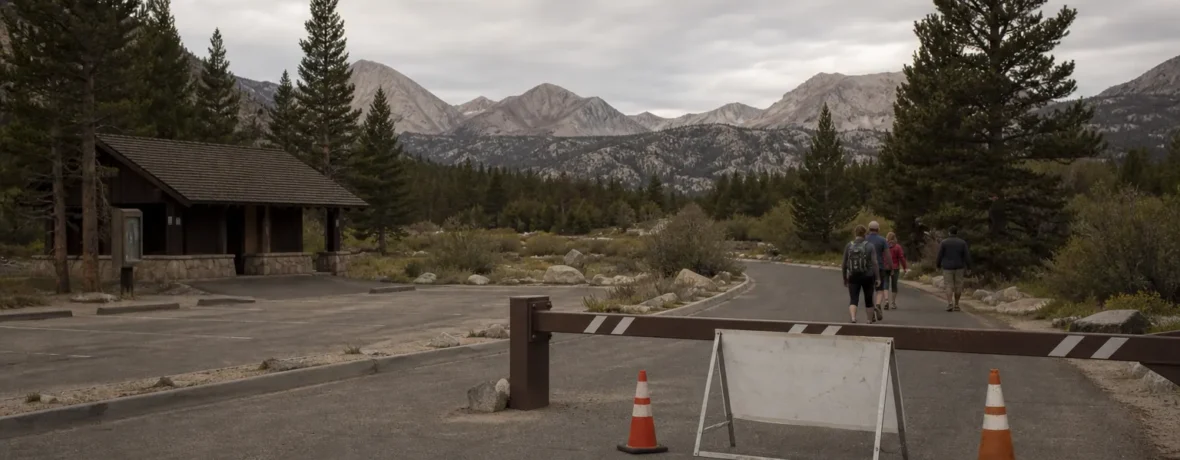
During a government shutdown, plan for reduced national park access, not a normal visit. Some roads, trails, campgrounds, overlooks, and open-air memorials may remain physically accessible when they can’t be practically closed, but visitor centers, locked or gated areas, most programs, regular updates, and many services stop. The 2025 NPS lapse plan estimated 9,296 furloughed employees. National Park Service Contingency Plan. (doi.gov)
Are national parks open during government shutdown?
Sometimes, but not in the normal way.
During a lapse in annual appropriations, the Department of the Interior says NPS sites are closed, and that the majority of national parks may be closed completely to public access; areas that are physically hard or impractical to close may remain accessible with sharply reduced services, as of November 2026. Think park roads, overlooks, trails, campgrounds, and open-air memorials. Think less help, fewer updates, and more locked doors. Department of the Interior shutdown access guidance. (doi.gov)
The clean hiking answer: if a gate, building, road, parking lot, or trailhead is locked, signed closed, or barricaded, you don’t go in. If an area remains physically accessible and no closure is posted, you may be able to enter, but you should treat the trip as self-supported.
Government shutdown national parks: what changes first?
Visitor services are usually the first thing you feel.
The NPS contingency plan says staffing during a lapse is based on the assumption that NPS is conducting no park operations and providing no visitor services, with excepted staffing limited to protection of life, property, public health, and safety, as of November 2026. That means the ranger desk may be dark even if the trailhead pavement is still open. (doi.gov)
Here’s the practical split:
| Park feature | What usually happens during a shutdown | What you should do |
|---|---|---|
| Visitor centers and staffed desks | Closed or unavailable | Download maps before you leave home |
| Locked gates, buildings, and secured areas | Locked or secured for the lapse | Do not enter or bypass closures |
| Open roads, overlooks, trails, and memorials | May remain physically accessible | Expect little to no routine service |
| Emergency response, law enforcement, fire, utilities | May continue as excepted activities | Do not treat that as a safety net for poor planning |
What services close in national parks during a shutdown?
If it needs regular NPS staffing, expect it to be closed, reduced, or delayed.
The DOI says visitors should expect many services and facilities to be closed or largely unavailable during a shutdown. Regular road and trail condition updates may stop. Restroom and sanitation maintenance, trash collection, road maintenance, campground operations, and emergency operations can vary and are not guaranteed, as of November 2026. (doi.gov)
For hikers, the biggest pain points are simple:
- No reliable ranger counter for route questions.
- No regular trail condition updates.
- Closed visitor centers, museums, historic structures, and many bathrooms.
- Reduced trash pickup, which means you pack out everything.
- Possible campground service cuts, even where access remains possible.
- More uncertainty around shuttles, entrance stations, timed-entry systems, and permit desks.
Can you hike in a national park during a government shutdown?
You can hike only where access remains legal and physically open.
That’s the line. Not vibes. Not “I drove all this way.” Not “the gate was only partly closed.” If a trail, road, lot, canyon, beach, ruin, overlook, or campground is closed, it’s closed.
If you do hike in an accessible area, keep the plan conservative. Choose shorter routes. Stay on durable surfaces and signed trails. Skip exposed scrambles, technical terrain, flood-prone canyons, and snow travel unless conditions are clearly within your skill set. During a shutdown, the missing piece is not just a locked visitor center. It’s the whole daily machinery that helps a park run clean and safe.
Use this quick checklist before you commit:
- Check the specific park’s NPS page and current alerts before leaving.
- Download offline maps in the NPS App or your mapping app.
- Carry printed or saved directions to the trailhead.
- Bring extra water, food, layers, headlamp, first aid, and a full gas tank or EV charge.
- Have a backup hike outside the national park.
- Pack out trash, toilet paper, pet waste, and food scraps.
- Turn around early if the scene feels unmanaged or sketchy.
Do entrance fees, permits, and reservations still apply?
Do not assume a reservation guarantees access.
Entrance fees and passes are normally handled by each park’s standard fee system; the NPS says only one-fourth of national parks charge entrance fees, as of November 2026. NPS frequently asked questions. (nps.gov) During a shutdown, however, fee booths, permit desks, and in-person pass sales may not operate normally.
For Recreation.gov bookings, the official policy says customers may submit refund requests through their Recreation.gov profile within 7 calendar days of the reservation end date, and that in an emergency closure, Recreation.gov or the facility manager will refund all fees and attempt to notify the customer using account contact information, as of November 2026. Some reservation-related fees are listed as non-refundable, so read the specific booking rules before canceling on your own. Recreation.gov rules and reservation policies. (Recreation.gov)
What should you do if you already have a trip booked?
Slow down, verify, then decide.
- Check the park’s official NPS page. Use the park website, not a social post or old forum thread.
- Open the park alerts page. Look for closures, road status, campground notices, and permit office updates.
- Check your Recreation.gov account. Look for messages tied to your campground, timed entry, tour, or permit.
- Call only if a phone line is listed as active. Many lines may not be staffed during a shutdown.
- Build a Plan B. State parks, local open-space preserves, city trails, and some national forests may be better bets, depending on their own rules and staffing.
- Cancel carefully. If you cancel before an official closure is posted, normal cancellation penalties may apply.
Are concession businesses open during a shutdown?
Some may be, but only under limits.
The DOI says concessions in areas accessible to the public may continue during a lapse if no NPS resources are required beyond excepted services and critical health, safety, and protection services, as of November 2026. That could mean a lodge, store, shuttle, or tour operator behaves differently from the park itself. It could also mean closures with little warning. (doi.gov)
Don’t build your whole day around one concession staying open. Carry your own food and water. If lodging is involved, check directly with the operator and keep screenshots of cancellation terms.
Can volunteers or partners keep parks running?
Only within strict limits.
The NPS volunteer manual says that during a government lapse in appropriations, NPS will close all operations except activities expressly authorized; volunteers may serve only when NPS staff are still working and supervision and protections are in place, as of November 2026. If NPS staff are not working, volunteers follow the same restrictions as furloughed employees and may not access closed federal buildings or use federal equipment. NPS volunteer closure guidance. (nps.gov)
Translation for hikers: don’t expect a friends group, volunteer crew, or local partner to magically replace the park staff you’re used to seeing.
When do national parks reopen after a government shutdown?
They reopen in stages, and the timing can vary by park.
The NPS contingency plan says furloughed employees are expected to return to regular duty on the next workday immediately after the lapse ends, as of November 2026. But a giant desert park, a mountain park with snow gates, and a busy urban memorial do not restart the same way. Roads need checks. Bathrooms need service. Campgrounds need staff. Permits may need sorting. (doi.gov)
Give the park a little breathing room. If Congress funds the government on a Monday night, that does not mean every trail, campground, shuttle, cave tour, and permit office is normal at sunrise Tuesday.
Related reading
- How Many National Parks Are There in the US?
- Are Drones Allowed in National Parks?
- Are Dogs Allowed in National Parks?
- Who Is the Father of National Parks?
FAQ
Are national parks open during a government shutdown?
Some areas may be physically accessible, but national parks do not operate normally during a shutdown. Locked, gated, secured, or signed-closed areas are off limits, while some open roads, trails, campgrounds, overlooks, and memorials may remain accessible with reduced services.
Can I camp in a national park during a shutdown?
Maybe, but don’t count on it. Campgrounds may be closed, unstaffed, or open with reduced services, and Recreation.gov reservations do not override official closures or on-the-ground restrictions.
Will bathrooms and trash pickup be available?
Not reliably. DOI guidance says restroom maintenance, sanitation, trash collection, road maintenance, campground operations, and emergency operations can vary and are not guaranteed during a shutdown.
Do I get a refund if my reservation is canceled?
If there is an emergency closure, Recreation.gov policy says the team or facility manager will refund all fees and try to notify you through your account contact information. If you cancel before an official closure, regular cancellation rules may apply.
Is it legal to enter a park if nobody is at the entrance station?
Only if the area is open and accessible. An unstaffed entrance is not permission to enter closed roads, bypass gates, ignore signs, or use closed facilities.
Where should I check before I go?
Start with the specific park’s official NPS website and alerts page, then check your Recreation.gov account if you have a reservation. Save maps and alerts offline before driving into areas with weak cell service.