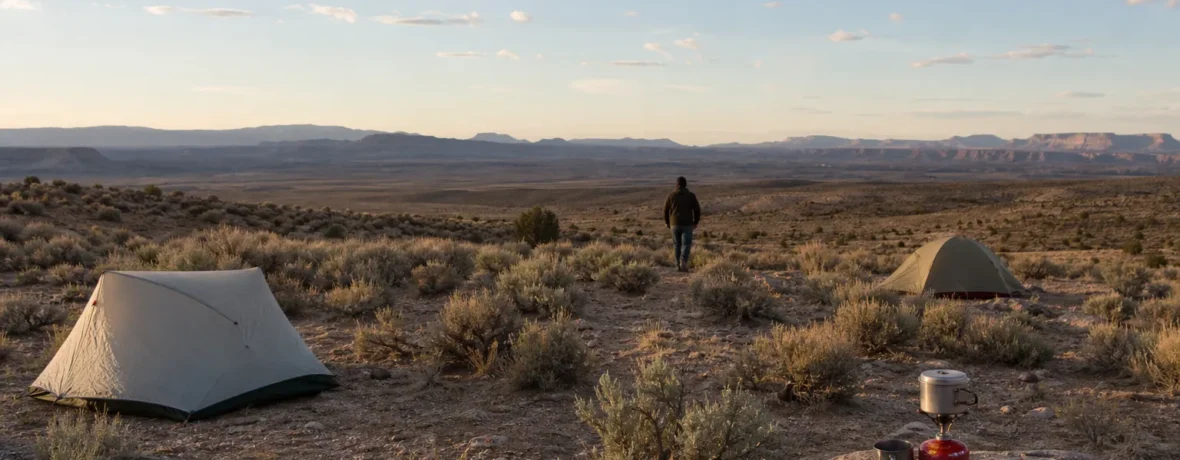
Can you camp anywhere on BLM land? No. Most BLM-managed public land allows dispersed camping unless an area is posted closed, restricted for resource protection, or governed by local rules. As of November 2026, BLM says dispersed camping is generally limited to 14 days within any 28-day period.
Can you camp anywhere on BLM land?
No—you can camp on many BLM lands, not anywhere you feel like stopping. The Bureau of Land Management says most BLM lands allow dispersed camping unless an area is posted “Closed to Camping” or has specific restrictions for land use or conservation, as of November 2026. Check the official BLM camping rules page before you roll in.
That means the big open desert two-track may be fair game, while the riparian zone, archaeological site, crowded trailhead, wildlife water source, or signed restoration area may be off-limits. Signs on the ground win. So do local field-office orders.
What is BLM dispersed camping?
BLM dispersed camping is camping away from developed recreation facilities. No picnic table. No host. No trash can. No guaranteed toilet. You bring the whole system and leave the place clean.
As of November 2026, BLM describes dispersed camping as camping on public lands away from developed recreation facilities, and says most areas do not require permits or reservations. Some places still require permits for large groups or campfires, and some high-use areas have designated sites only.
Here’s the plain difference:
| Camping type | What you usually get | What to check |
|---|---|---|
| Dispersed BLM camping | Open land, primitive sites, no services | Closures, stay limits, fire rules, road rules |
| Developed BLM campground | May include toilets, tables, fire rings, water, or trash service | Fees, reservations, season, site rules |
| Long-Term Visitor Area | Seasonal long-stay camping in specific Arizona and California areas | Permit rules and local field-office guidance |
How long can you camp on BLM land?
Usually, 14 days within a 28-day period. As of November 2026, BLM says dispersed camping is generally limited to 14 days within any 28-day period, though state and field-office rules can vary.
After you hit the local stay limit, BLM says campers must move to a new location, often at least 25 to 30 miles away. New Mexico’s BLM recreation page gives a concrete example: dispersed camping is generally allowed for no more than 14 days within 28 consecutive days, then you must relocate at least 25 miles away, as of November 2026.
Don’t try to reset the clock by moving your chair across the wash. The point is to prevent one spot from turning into a semi-permanent camp.
Do you need a permit to camp on BLM land?
Often, no permit is needed for casual dispersed camping. As of November 2026, BLM says most dispersed areas do not require permits or reservations, but some regions may require permits for large groups or campfires.
Developed sites are different. Some BLM campgrounds charge fees, and some accept reservations through Recreation.gov. BLM says developed campgrounds may use fee envelopes, visitor centers, electronic payment, or online reservation systems depending on the site. Check the official BLM permits and fees page before assuming a site is free.
Where are you not allowed to camp on BLM land?
You cannot camp where BLM has closed or restricted camping. That can include signed restoration zones, sensitive wildlife habitat, cultural sites, certain recreation areas, or crowded zones managed under a local plan.
BLM also lists several best practices, as of November 2026, that keep you out of trouble and off fragile ground:
- Use existing disturbed sites instead of creating a new one.
- Camp within 150 feet [46 m] of designated routes where that guidance applies.
- Stay at least 200 feet [61 m] from lakes, rivers, and streams.
- Avoid camping within 1 mile [1.6 km] of campgrounds, trailheads, and picnic areas.
- Keep vehicles on designated roads and trails unless the area is specifically open to off-road travel.
- Pack out trash, food scraps, toilet paper, and broken gear.
Can you have a campfire while camping on BLM land?
Sometimes, but never assume. Fire rules change by place and season.
As of November 2026, BLM says fire restrictions vary throughout the year and campers must check current rules before going. In California, BLM lists statewide year-round fire criteria for campfires outside developed campgrounds, including a valid California Campfire Permit, a cleared 5-foot [1.5 m] diameter area, and a shovel at least 35 inches [89 cm] long. Other BLM field offices may have stricter orders, including bans on open flames during fire danger. Check the current BLM fire restrictions for your state.
If fires are allowed, use an existing ring or fire pan, keep it small, and drown it until it is cold to the touch. If you’re not willing to do that, use a stove.
How do you find legal BLM camping spots?
Start with the land manager, not a social media pin. Apps can help, but BLM maps and local offices are the source you want when rules matter.
- Open the official BLM maps page and confirm the land is actually BLM-managed.
- Check the local field office page for camping rules, seasonal closures, fire restrictions, and road limits.
- Look for existing disturbed sites near open roads, not fresh tracks through plants or crust.
- Read every sign at the turnoff, trailhead, kiosk, and site entrance.
- Have a backup plan in case the road is gated, the area is signed closed, or fire restrictions changed overnight.
Is camping on BLM land the same as camping in a national park?
No. National parks usually have tighter camping rules. BLM lands often allow dispersed camping; national parks commonly require you to camp in designated campgrounds or permitted backcountry zones.
The National Park Service says many park campgrounds require reservations through Recreation.gov, and park websites or the NPS app are the best sources for park-specific camping information, as of November 2026. For example, Sequoia and Kings Canyon National Parks state that dispersed camping is not allowed in the parks except for overnight backpacking in the backcountry with a valid wilderness permit. Check the official NPS campground guidance before treating park land like open BLM land.
What should you bring for BLM dispersed camping?
Bring everything you need to camp without services. If there’s no water, toilet, table, shade, trash can, or cell signal, you’re not surprised.
- Water for drinking, cooking, cleaning, and emergencies
- Paper map or downloaded offline map
- Portable toilet system or proper waste kit
- Trash bags, including one for micro-trash
- Stove and fuel, especially during fire restrictions
- Shovel, water, and fire extinguisher where fire rules require or conditions demand
- Tire repair kit, spare tire, and enough fuel to turn around
- Warm layers, sun protection, and a first-aid kit
Related reading
- How to Train for the Everest Base Camp Trek
- America the Beautiful Pass: Price, Coverage and Where to Buy
- Machu Picchu Tickets: Circuits and Entry Rules
- How Many National Parks Are There in the US?
FAQ
Can you sleep in your car on BLM land?
Yes, if overnight camping is allowed in that specific BLM area. Your vehicle must stay on roads and routes where motorized travel is allowed, and you still have to follow stay limits, closures, and fire rules.
Is BLM camping free?
Dispersed camping is often free, but not every BLM camping option is free. Developed campgrounds may charge fees, and some sites use reservations or electronic payment systems, as verified by BLM as of November 2026.
Can you leave a tent unattended on BLM land?
Only for limited periods, and local rules matter. As of November 2026, BLM says personal property should not be left unattended for more than 10 days in dispersed areas, with different limits in some states, while developed campground limits may be shorter or posted on-site.
Can you camp on BLM land near Moab?
Yes, but not everywhere near Moab. High-use areas around Moab include closures, designated camping zones, and campground-only areas, so check current BLM Moab Field Office rules before choosing a spot.
What is the safest rule of thumb for BLM camping?
Use an existing site on land you have confirmed is BLM-managed and open to camping. Stay within the local stay limit, keep at least 200 feet [61 m] from water when that guidance applies, obey fire restrictions, and leave nothing behind.