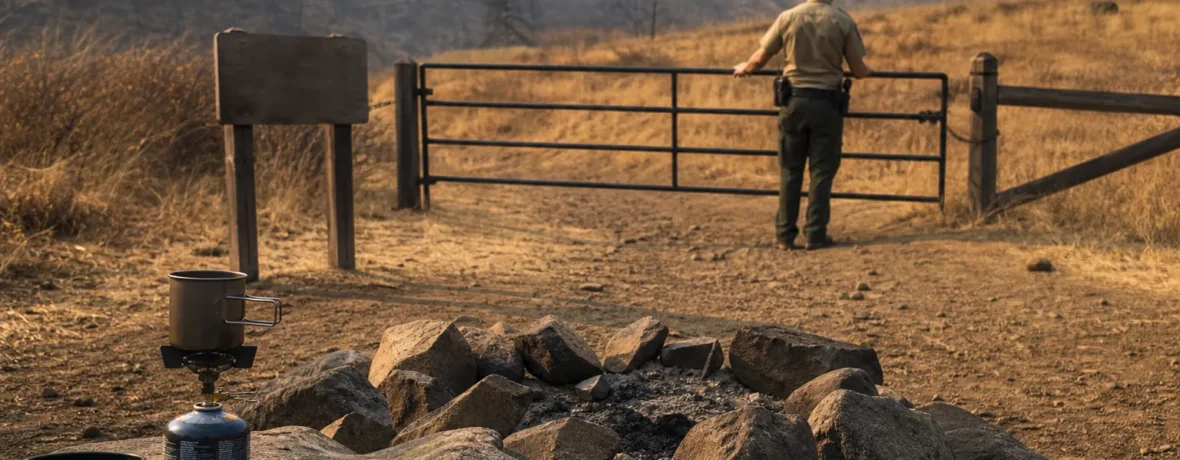
Fire restrictions hiking rules usually run in 3 stages as of November 2026: Stage 1 allows campfires only in approved metal rings at developed sites; Stage 2 bans fires of any kind; Stage 3 closes the forest or area to visitors. Gas stoves may still be allowed only when the current order says yes. USDA Forest Service FAQ (fs.usda.gov)
What do fire restrictions hiking rules mean for your trip?
They tell you what kinds of flame, smoke, sparks, and access are allowed on that specific public land right now.
Fire restrictions are not trail etiquette. They are legal orders set by the agency that manages the land: Forest Service, BLM, National Park Service, state land, county land, tribal land, or a mix of those on one route. The same valley can have different rules on opposite sides of a road.
As of November 2026, the BLM says it uses restrictions and temporary public land closures to reduce wildfire risk and protect the public, often targeting human-caused activities such as campfires, off-road driving, equipment use, and recreational target shooting. Check the managing agency before you drive to the trailhead, not after you smell smoke. BLM fire restrictions page (blm.gov)
| Stage | What it usually means | Hiking takeaway |
|---|---|---|
| Stage 1 | Campfires limited to approved rings or grates in developed sites. | Do not build a fire ring in the backcountry. |
| Stage 2 | Open fires are generally banned; stove rules depend on the order. | Plan no-cook meals unless your stove is clearly allowed. |
| Stage 3 | The area may close to public entry. | Pick another trail. Do not try to sneak in. |
What is a Stage 1 fire restriction?
Stage 1 is the lowest common restriction level.
On Forest Service land covered by the official FAQ above, Stage 1 means visitors may have campfires only in Forest Service-installed metal fire rings. On BLM Colorado land, as of November 2026, Stage 1 means campfires are allowed only within designated fire grates in developed campgrounds; fire pans and rock campfire rings do not qualify. BLM Colorado fire restrictions (blm.gov)
For you, that means a pretty simple rule: if the fire ring is something you or another camper made from rocks, treat it as a no. A blackened circle in the dirt is not permission. A developed campground grate installed by the agency is closer, but you still need to confirm the current order.
What is a Stage 2 fire restriction?
Stage 2 usually means no open fires.
The Forest Service FAQ says Stage 2 does not allow fires of any kind. BLM California’s current restriction page, as of November 2026, lists Stage II areas with “no open fires of any kind,” while allowing portable stoves and lanterns with shut-off valves where a valid California Campfire Permit is required. BLM California fire restrictions (blm.gov)
That difference matters. One agency may write a Stage 2 order that allows a canister stove. Another may tighten the order during extreme conditions. Read the actual order for your trail, not a social post, not an old sign photo, not a campsite rumor.
- No twig stoves unless the order clearly allows them.
- No charcoal grills unless the order clearly allows them.
- No candles, tiki torches, or improvised flame sources unless the order clearly allows them.
- No smoking while walking a trail if local rules ban it.
What is a Stage 3 fire restriction?
Stage 3 is the stop sign.
The Forest Service FAQ describes Stage 3 as the highest restriction, resulting in closure of the forest to all visitors. That does not mean “hike fast and stay away from flames.” It means the agency has closed the area because conditions or fire activity make public access unsafe or unmanageable.
If your trailhead sits inside a Stage 3 closure, your trip is off. Move to another open area, change dates, or switch to a town walk. A closed forest is not a challenge. It is a boundary.
Can you use a backpacking stove during fire restrictions?
Sometimes yes, but only when the current order allows that exact stove.
Stove rules are where hikers get burned. A canister stove with an on-off valve is often treated differently from a wood-burning stove because it can be shut down fast and does not throw embers. But “often” is not a permit.
As of October 2026, Yosemite says portable stoves using pressurized gas, liquid fuel, propane, or alcohol are always allowed, including tablet and cube stoves, while other fire rules still apply in the park. Rocky Mountain National Park says, as of November 2026, it always has Stage 1 restrictions in place and allows propane/butane-fueled gas stoves, with a permit required for petroleum-fueled stove use in designated wilderness sites. Yosemite fire restrictions Rocky Mountain National Park fire regulations (nps.gov)
Read that again: two national parks, two rule sets. Same hiker. Different land. Different answer.
How do you check current fire restrictions before hiking?
Check the official source for the exact land you will enter.
- Find out who manages the trailhead, trail corridor, campsite, and exit route.
- Open that agency’s current fire restrictions page.
- Look for the specific district, forest, park, field office, wilderness, or closure order.
- Check the date. Old PDFs and cached maps can linger online.
- Read stove, smoking, campfire, charcoal, and closure language separately.
- Check again the morning you leave.
For active fire information, the National Interagency Fire Center points visitors to current maps and InciWeb for incident-specific updates, but incident maps do not replace a local closure order. Use them as a warning light, then confirm with the land manager. NIFC fire information (nifc.gov)
What should you pack when campfires are restricted?
Pack as if you will not have a campfire at all.
- A legal stove only if the current order allows it.
- No-cook food in case stove rules tighten.
- A headlamp with spare power so you are not tempted to use flame for light.
- Warm layers for camp. Fire is not your insulation plan.
- A hard-sided container or sealable bag for cigarette butts if smoking is allowed only in cleared spots.
- Extra water for cooking and emergency cooling of gear.
- A backup trail outside the restricted or closed area.
What if park, forest, and county fire rules are different?
Follow the rule for the land you are standing on.
County burn bans, state restrictions, and federal orders can overlap. The stricter rule may control your activity, and a city or county rule does not automatically make a national forest campfire legal. The Forest Service FAQ tells visitors to check the current restrictions for the forest, not just city or county restrictions.
When a trail crosses boundaries, treat the trip like a patchwork. Your map should show land ownership, not just contour lines. If the first 2 miles [3.2 km] are BLM, the next 6 miles [9.7 km] are national forest, and your campsite is in a national park, check all three.
Related reading
- How to Become a Fire Lookout
- Fire Lookouts: Who Works Them and How to Visit
- America the Beautiful Pass: Price, Coverage and Where to Buy
- Machu Picchu Tickets: Circuits and Entry Rules
FAQ
Are fire restrictions the same as a fire ban?
No. A fire ban is a common phrase, while fire restrictions are the official rules for a place and time. The order may ban campfires, smoking, charcoal, target shooting, or public entry depending on the stage.
Can I have a campfire during Stage 1 restrictions?
Sometimes yes, but only in approved developed-site fire rings or grates if the local order allows it. Do not use rock rings, ash pits, or backcountry fire scars unless the agency specifically says they are legal.
Can I use a propane stove during Stage 2 restrictions?
Often yes, but not always. Many orders allow gas or propane devices with shut-off valves, but you must read the current order for your park, forest, or BLM field office.
Does Stage 3 mean trails are closed?
Usually yes for the affected area. Stage 3 is the highest level in the Forest Service FAQ and can close the forest to visitors, so choose a different destination.
Do fire restrictions apply if there is no smoke nearby?
Yes. Restrictions are based on fuels, weather, firefighting capacity, and local risk, not just visible smoke. A blue-sky morning can still be under Stage 2 rules.
Where should I check fire restrictions before a hike?
Start with the official page for the agency managing your route. Then check current incident information through NIFC or InciWeb, and recheck the local order before leaving home.