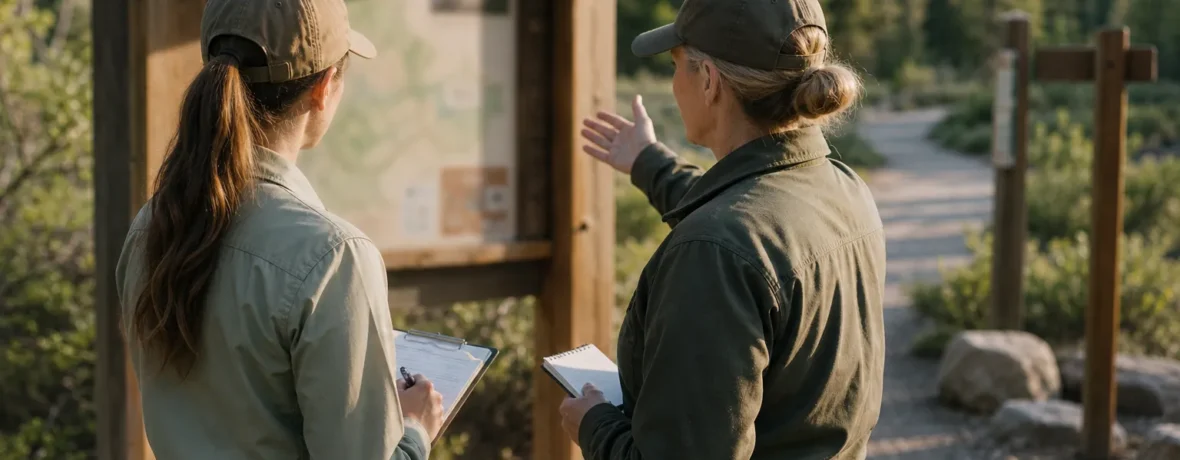
To become a park ranger, pick a track, build field or visitor-service experience, meet education or experience requirements, then apply through USAJOBS or state/local park systems. Expect 1 to 2 seasons for entry-level seasonal work and 2 to 6 years for permanent or law enforcement roles.
How to become a park ranger: what are the steps?
Start with the job you want, then build proof that you can do it outdoors, with people, under pressure.
Park ranger is not one single job. Some rangers give talks and lead walks. Some protect wildlife habitat. Some patrol roads, respond to emergencies, and enforce laws. The U.S. Office of Personnel Management defines the federal Park Ranger Series, GS-0025, as work tied to conservation and use of federal park resources, including interpretation, resource management, visitor services, protection, law enforcement, search and rescue, and related park operations. See the OPM Park Ranger Series standard. (opm.gov)
- Pick a ranger track. Choose interpretation/education, resource management, visitor use, fees, backcountry, maintenance-adjacent operations, or law enforcement.
- Get outside work on your resume. Trail crew, campground host, conservation corps, museum guide, youth educator, ski patrol, search-and-rescue volunteer, outdoor retail, and customer-service jobs can all help when they match the posting.
- Study a useful field. Strong majors include natural resources, park and recreation management, biology, geology, history, anthropology, environmental education, public administration, and law enforcement.
- Learn to talk to strangers. Rangers spend plenty of time answering the same question with a smile while a line forms behind the visitor desk.
- Build medical and field basics. First aid, CPR, radio use, map reading, defensive driving, public speaking, and incident documentation all translate well.
- Apply for seasonal jobs early. Seasonal jobs are often the front door. You may work 3 to 8 months, then apply again with stronger experience.
- Tailor every federal resume. Use the language in the announcement. If the posting asks for resource education, show programs you built, groups you taught, and audiences served.
- Keep applying widely. Big-name parks get heavy competition. Smaller sites can be a cleaner shot at your first uniform.
How do you become a park ranger if you are starting from zero?
You become competitive by stacking experience before you chase the dream posting.
If you have no park background yet, aim for a first step that puts you in public service outdoors. Think seasonal fee booth, visitor center desk, camp host, city parks aide, conservation corps, AmeriCorps, trail crew, outdoor education, wildlife refuge volunteer, or museum interpretation. None of those are throwaway jobs. They teach the daily ranger muscles: staying calm, explaining rules without sounding like a robot, reading a crowd, writing clean notes, and working in bad weather.
Federal postings can credit unpaid work when it fits the job. A current USAJOBS Park Ranger GS-0025 announcement states that qualifying experience can include paid and unpaid experience, including volunteer work through National Service programs and other organizations. Review a current USAJOBS Park Ranger announcement. (usajobs.gov)
Do not wait until you feel “official.” Apply for internships, seasonal roles, and park-adjacent jobs while you are still learning. The green-and-gray uniform usually comes after a string of smaller yeses.
What does a park ranger actually do?
A park ranger protects the place, serves the visitor, and keeps the day from sliding sideways.
The work changes by agency, park, season, and title. A desert ranger in July has a different day than a battlefield interpreter in October or a lake patrol ranger on a holiday weekend. Still, most ranger jobs fall into a few lanes.
| Ranger path | Main work | Best fit if you like | Common prep |
|---|---|---|---|
| Interpretation and education | Programs, talks, walks, visitor centers, school groups, exhibits | Storytelling, teaching, history, ecology, people | Public speaking, education, natural/cultural history |
| Visitor use and fees | Entrance stations, permits, campground questions, crowd flow, rule education | Fast public contact and practical problem solving | Cash handling, customer service, local park knowledge |
| Resource management | Habitat projects, monitoring, restoration, wildlife work, cultural resource support | Science, data, field days, quiet focus | Biology, GIS, botany, archaeology, field methods |
| Law enforcement | Patrol, emergency response, investigations, public safety, resource protection | High-responsibility field work and clear authority | Fitness, academy training, judgment, report writing |
What education do you need to become a park ranger?
A bachelor’s degree helps, but some ranger jobs allow experience, education, or a mix of both.
For a current federal GS-05 Park Ranger announcement, applicants could qualify through one year of specialized experience; or a four-year course of study leading to a bachelor’s degree with 24 semester hours of related coursework; or a qualifying mix of education and experience, as of November 2026. Listed related fields included natural resource management, natural sciences, earth sciences, history, archaeology, anthropology, park and recreation management, law enforcement/police science, social sciences, museum sciences, public administration, and closely related subjects. Check the USAJOBS qualification language. (usajobs.gov)
For GS-07, the same announcement listed options such as one year of specialized experience, one full year of graduate education in a related field, superior academic achievement, or a qualifying combination. For GS-09, it listed specialized experience, a master’s degree or equivalent graduate degree, two full years of progressively higher graduate education, or a qualifying mix. (usajobs.gov)
Translation: read every announcement like a map. Do not assume your degree qualifies you. Do not assume you are out because you lack a degree. The posting decides.
How to become a park ranger without a degree?
Yes, you can become a ranger without a degree when the job allows experience in place of education.
This route is usually slower and more hands-on. You need strong, specific experience: visitor services, outdoor leadership, fee collection, conservation work, emergency response, law enforcement, historical interpretation, forestry, fire, recreation management, or similar park operations.
Your goal is to make the hiring official think, “This person already does half the job.” A vague love of hiking will not carry you. A season handling campground conflicts, writing incident notes, giving safety briefings, and opening a visitor center at 7 a.m. will.
- Volunteer at a national park, state park, wildlife refuge, or local open-space district.
- Apply for park guide, visitor use assistant, fee technician, recreation technician, or conservation crew roles.
- Keep a running document of duties, hours, tools used, trainings completed, and visitor contacts.
- Ask supervisors for permission to list them as references before the season ends.
- Save position descriptions. They help when you rewrite your resume later.
How long does it take to become a park ranger?
Most people need 1 to 6 years, depending on the track and how flexible they are on location.
If you want a summer seasonal job and already have visitor-service or outdoor experience, you may land one within a hiring cycle. If you want a permanent federal law enforcement job at a famous national park, plan for a longer road.
| Starting point | Likely target | Practical timeline |
|---|---|---|
| High school student | Seasonal aide, intern, conservation corps, then ranger | 3 to 6 years |
| College student in a related major | Seasonal interpretation or resource role | 1 to 3 years |
| Recent graduate with strong experience | GS-05 or GS-07 seasonal/permanent opening | 6 months to 2 years |
| Career changer | Seasonal role, state park job, or federal entry role | 1 to 4 years |
| Law enforcement candidate | NPS permanent or seasonal commission path | 2 to 6 years |
Location flexibility can cut the timeline. If you apply only to Yosemite, Yellowstone, Grand Canyon, Acadia, and Zion, you are lining up with everyone else. If you apply to lesser-known historic sites, reservoirs, monuments, seashores, and state parks, you give yourself more trailheads.
How to be a park ranger with the National Park Service?
Use USAJOBS, apply during the right season, and follow the announcement exactly.
The National Park Service says it posts long-term vacancies on USAJOBS and hires seasonal employees for work such as visitor education, research, resource protection, and park operations. As of November 2026, NPS states that summer seasons generally run March through September and winter seasons generally run October through February; it also says summer seasonal applications are accepted between October and February, while winter seasonal applications are accepted between July and August. Read the NPS job application guidance. (nps.gov)
That means your “summer job” search may start while you are still raking leaves. Set up saved searches on USAJOBS for terms like “Park Ranger,” “Park Guide,” “Visitor Use Assistant,” “Recreation Technician,” and “National Park Service.” Filter for temporary if you want seasonal work.
Openings can close fast when they hit an applicant cap. Have your resume, transcripts, veteran documents if applicable, references, and cover-letter base ready before the posting opens.
Do park rangers have to go to law enforcement academy?
Only law enforcement rangers need law enforcement training.
If your goal is interpretation, education, fees, or resource management, you do not need a police academy. You need the education, experience, and training listed in that specific posting.
For National Park Service law enforcement, the path is stricter. As of November 2026, NPS says prior attendance at a Park Ranger Law Enforcement Academy, also called PRLEA or Seasonal Academy, is not a prerequisite for permanent law enforcement consideration, and prior NPS experience is not required. NPS also says permanent law enforcement ranger jobs are posted roughly two times per year across multiple locations. See the NPS law enforcement ranger hiring page. (nps.gov)
For seasonal law enforcement, NPS describes PRLEA as a route that provides eligibility for a Type II Law Enforcement Commission. NPS also states that U.S. law enforcement park ranger work is physically demanding and that prospective rangers must be able to pass a fitness test and medical exam before employment. Review the NPS law enforcement training process. (nps.gov)
What skills should you build before you apply?
Build the skills that make a supervisor trust you with visitors, resources, and radios.
- Public speaking: Practice short talks, guided walks, safety briefings, and clear directions.
- Writing: Rangers write reports, emails, program outlines, visitor notes, and incident summaries.
- Conflict control: Learn how to stay calm when someone is tired, hot, lost, angry, or wrong.
- Outdoor judgment: Weather, terrain, heat, cold, wildlife, water, and altitude can all change the day.
- Local knowledge: Know the park’s plants, animals, geology, history, hazards, and neighboring communities.
- Fitness: You do not need to look like a movie ranger, but you need to work long shifts on your feet.
- Team habits: Show up early, take notes, ask clean questions, and do the unglamorous task without drama.
What should your park ranger resume show?
Your resume should prove you meet every required qualification in the job announcement.
Federal resumes are longer than private-sector resumes. Give dates, hours per week, employer names, supervisor contact details if requested, and specific duties. If you led 20 campfire programs, say that. If you processed permits, handled cash, used a radio, monitored nesting areas, patrolled 5 miles [8 km] of trail, or taught 4th graders, say that too.
Match your resume to the posting without copying empty phrases. If the announcement asks for “recreation management,” show campground operations, visitor flow, permit checks, trailhead contacts, or boat ramp work. If it asks for “natural resource education,” show lesson plans, guided hikes, exhibit work, citizen science, or species monitoring.
Before you hit submit, check this list:
- You meet citizenship, driver’s license, age, education, training, and availability requirements.
- Your resume shows the exact qualifying experience requested.
- Your transcripts are attached if you are using education to qualify.
- Your dates and hours per week are clear.
- You answered the questionnaire honestly and consistently with your resume.
- You submitted before the deadline or applicant cap closed.
Related reading
- How to Become a National Park Ranger (NPS)
- What Does a Park Ranger Do? A Day in the Job
- The Park Ranger Hat: History of the Flat Hat
- How to Become a Forest Ranger
FAQ
Is being a park ranger hard to get into?
Yes, permanent ranger jobs can be competitive. Seasonal jobs, smaller parks, state parks, local parks, and less famous federal sites are often the smartest first move.
Do park rangers carry guns?
Some do. Commissioned law enforcement rangers may carry firearms as part of their duties, while interpretation, education, resource, fee, and many visitor-service rangers do not.
What is the best degree for becoming a park ranger?
The best degree matches the ranger path you want. Natural resources, biology, geology, history, anthropology, education, park and recreation management, public administration, and law enforcement can all fit different postings.
Can you be a park ranger if you only like hiking?
Not for long. Hiking helps, but the job is public service first: teaching, cleaning up problems, answering questions, enforcing rules, writing notes, and protecting resources.
Should I start with national parks or state parks?
Start wherever you can get solid experience. State parks, city parks, conservation corps, and local nature centers can build the same core skills that later help with National Park Service applications.
How early should I apply for seasonal ranger jobs?
Apply months before the season you want. For NPS seasonal work, the agency’s guidance as of November 2026 says summer applications are accepted between October and February, and winter applications between July and August. (nps.gov)