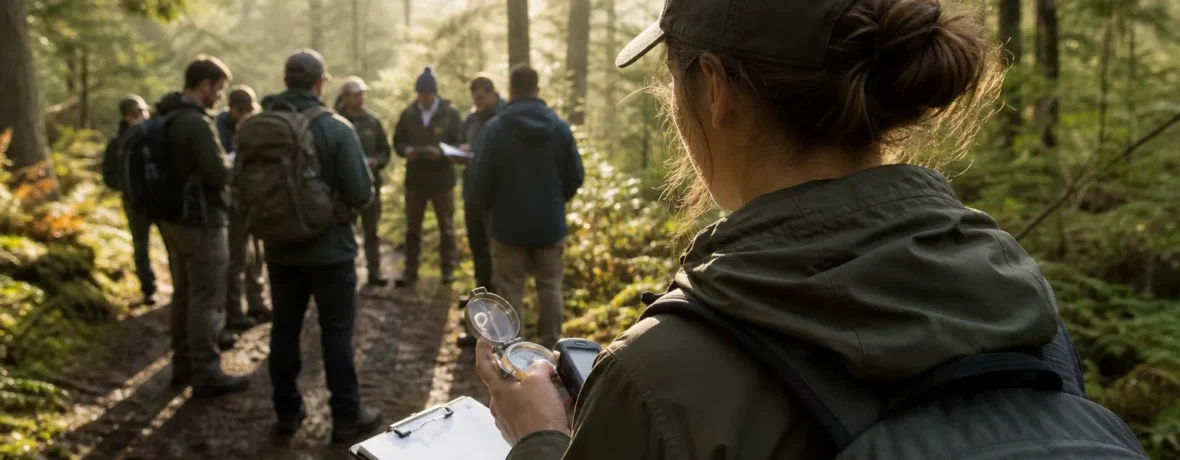
To become a forest ranger, start by picking a track: park ranger, forestry technician, forester, or law-enforcement ranger. Yes, you can qualify if you meet that series’ education or experience rules. Most entry routes take 1 to 4 years through seasonal work, college coursework, conservation corps jobs, or military/public-safety experience.
What does a forest ranger do?
A forest ranger protects public land, helps visitors, supports conservation work, and keeps outdoor areas running safely.
The exact job depends on the agency and the title on the posting. A ranger at a national forest campground may check sites, answer visitor questions, patrol trailheads, inspect toilets, report hazards, and coordinate with fire crews. A forestry technician may mark timber, collect field data, maintain trails, assist with prescribed fire, or map invasive plants. A professional forester may write management plans, supervise thinning projects, plan reforestation, and monitor forest health.
The U.S. Bureau of Labor Statistics describes forest and conservation workers as people who improve forests, rangelands, and wetlands through tasks like planting seedlings, clearing brush, counting and measuring trees, maintaining equipment, and helping prevent or suppress fires. That’s the dirt-under-your-boots side of the work.
Then there’s law enforcement. A commissioned ranger may carry a firearm, make arrests, investigate crimes, respond to rescues, and enforce federal regulations. Same woods. Different badge.
In plain trail language: you are part educator, part land steward, part problem-solver, and sometimes part emergency responder.
What kinds of forest ranger jobs are there?
There is no single “forest ranger” job.
That phrase gets used for several career paths, and mixing them up is how people apply for the wrong openings. Read the title, series, grade, duties, and qualification section before you spend two hours building an application.
| Track | Common federal title | Best fit if you like | Typical entry path |
|---|---|---|---|
| Visitor and interpretation | Park Ranger, GS-0025 | Talking with visitors, education, permits, patrols, public contact | College coursework, visitor services, guiding, seasonal ranger jobs |
| Field forestry | Forestry Technician, GS-0462 | Timber, trails, fire, restoration, field data, tools | Seasonal field work, natural resources classes, conservation corps |
| Professional forestry | Forester | Forest planning, silviculture, inventory, land management | Bachelor’s degree in forestry, natural resources, or related study |
| Law enforcement | Law Enforcement Ranger | Patrol, investigations, public safety, resource protection | Federal hiring process, screening, academy training, field training |
How to become a forest ranger: what steps should you take?
Start with the job you want, then build the proof that says you can do it.
-
Pick your track before you pick your school. If you want to teach visitors and patrol trailheads, look at park ranger and recreation jobs. If you want timber, prescribed fire, restoration, and forest inventory, look at forestry technician and forester jobs. If you want to enforce laws, look at law-enforcement ranger roles.
-
Read real job announcements. Search current postings on USAJOBS using terms like “park ranger,” “forestry technician,” “forester,” “recreation technician,” “wilderness ranger,” and “law enforcement ranger.” Don’t skim. The qualification section tells you what counts.
-
Get field experience early. Trail crew, conservation corps, campground host work, AmeriCorps, volunteer patrols, wildlife surveys, fuels crews, and seasonal technician jobs all help. Hiring managers trust people who have already worked outside in heat, rain, smoke, mud, mosquitoes, and awkward visitor conversations.
-
Take useful coursework. Strong classes include forestry, ecology, dendrology, botany, wildlife management, soil science, recreation management, GIS, public speaking, criminal justice, and wildland fire science. Match the classes to your track.
-
Build a field-ready resume. Federal resumes are longer than private resumes. Use dates, hours per week, tools used, acreage, crew size, software, certifications, and clear duties. “Maintained trails” is weak. “Cleared drainage, brushed corridor, logged hazards, and used hand tools on a 5-person trail crew” is stronger.
-
Apply for seasonal jobs first. Many permanent rangers started with temporary summer work. Seasonal jobs teach the rhythm of public land work: morning briefings, radios, paperwork, weather calls, visitor contact, vehicle checks, and long days on your feet.
-
Stay flexible on location. The dream forest may not hire entry-level staff this year. A remote district, desert monument, fire lookout, or busy campground can get your foot in the door faster.
Do you need a degree to be a forest ranger?
Sometimes yes, sometimes no.
For federal park ranger jobs, the official OPM Park Ranger Series 0025 standard allows education, experience, or a combination, depending on grade. As of November 2026, the GS-5 level can be met by a 4-year course of study leading to a bachelor’s degree with 24 semester hours of related coursework, or by specialized experience at the next lower level.
For forestry technician jobs, the official OPM Forestry Technician Series 0462 standard accepts certain seasonal experience and specific education routes. As of November 2026, GS-5 education can be met through a full 4-year course of study leading to a bachelor’s degree with a qualifying forestry or natural resources focus.
For professional forester roles, a forestry or closely related degree is the cleanest route. Agencies often want coursework in subjects like silviculture, forest ecology, forest measurements, watershed management, wildlife habitat, and forest soils.
No degree? You still have options. Look hard at seasonal recreation, trail crew, fire, campground, maintenance, conservation corps, and technician work. You may not qualify for every professional forestry job, but you can build real field experience and move toward higher grades.
What skills should you build before applying?
Build the skills that make you useful on day one.
Forest work rewards people who can move, observe, communicate, and stay calm when the plan changes. The best resume is not a list of outdoor hobbies. It is proof that you can work safely, follow instructions, document conditions, and deal with the public without turning a small problem into a radio call circus.
- Navigation: map reading, compass work, GPS, offline mapping apps, and basic route planning.
- Plant and tree ID: common local trees, invasive plants, poison oak, poison ivy, and sensitive species.
- Public contact: answering questions, explaining closures, calming frustrated visitors, and staying professional.
- Field documentation: clear notes, photos, coordinates, forms, and incident reports.
- Tools: hand tools, radios, trucks, trailers, basic maintenance, and safe lifting.
- GIS and data: ArcGIS, Survey123, Field Maps, spreadsheets, and clean data entry.
- Outdoor judgment: heat, lightning, river crossings, wildlife, dead trees, smoke, and changing weather.
If you can only choose three skills to start, choose first aid, navigation, and public communication. Those show up everywhere.
How fit do you need to be?
You need enough fitness to work safely for long days on uneven ground.
This is not gym-poster fitness. This is practical durability. You may walk several miles with tools, carry water, climb over blowdowns, dig in rocky soil, haul signs, stand in the sun, or spend a full shift in boots. Your knees, back, shoulders, and feet matter.
For wildland fire assignments, the fitness bar can be formal. As of November 2026, the National Wildfire Coordinating Group’s Work Capacity Test describes the arduous “Pack Test” as a 3-mile [4.8 km] walk over level terrain in 45 minutes or less while carrying a 45-pound [20 kg] pack. Not every ranger job requires that test, but many fire-related roles do.
For National Park Service law-enforcement ranger positions, fitness is also tested. As of November 2026, the NPS law enforcement ranger training process includes pre-employment screening, a physical fitness test, medical evaluation, drug screen, and background investigation for candidates in the final stage.
Train like the job is outside, because it is. Walk hills. Carry weight gradually. Strengthen your legs and core. Break in boots before the season starts. Learn how your body handles heat. Field work has a way of exposing weak preparation by 2 p.m.
Where do you apply for forest ranger jobs?
For federal jobs, apply through USAJOBS.
That includes many openings with the U.S. Forest Service, National Park Service, Bureau of Land Management, U.S. Fish and Wildlife Service, and other federal agencies. State agencies, county parks, tribal governments, universities, nonprofits, and private forestry companies post jobs on their own sites.
Search by both dream title and working title. “Forest ranger” may not appear in the posting. Try these terms:
- Park Ranger
- Forestry Technician
- Recreation Technician
- Wilderness Ranger
- Visitor Services Assistant
- Biological Science Technician
- Forester
- Wildland Firefighter
- Law Enforcement Ranger
Check postings early. Seasonal hiring can happen months before summer. Some federal announcements open for short windows, and some close once they receive enough applications. Have your resume, transcripts, references, driver’s license details, certifications, and veteran or hiring authority documents ready before the job drops.
How do you make your application stand out?
Match your resume to the announcement without fluff.
Federal hiring is literal. If the announcement asks for trail maintenance, visitor contact, radio use, data collection, chainsaw work, GIS, fee collection, or fire experience, your resume should show where you did that work, how long you did it, and what tools or systems you used.
Use strong, specific bullets:
- Led volunteer trail crew of 8 people during weekly maintenance days.
- Collected GPS points for damaged signs, blocked drains, and hazard trees.
- Explained fire restrictions and food-storage rules to campground visitors.
- Maintained pit toilets, picnic areas, trailheads, and vehicle-access sites.
- Entered field observations into GIS-based forms after daily patrols.
Do not bury outdoor experience under vague language. If you worked in heat, snow, remote locations, steep terrain, or busy public areas, say so. If you handled angry visitors without escalating the situation, say so. If you used a radio, drove a government vehicle, maintained equipment, or followed safety briefings, say so.
Transcripts matter for education-based qualification. Upload them. If the posting asks for specific semester hours, make that easy for the reviewer to see. Don’t make a stranger hunt through your documents at 4:45 p.m.
What is the fastest route into the job?
The fastest route is usually seasonal field work plus smart applications.
If you are starting from zero, apply for seasonal recreation, trail, campground, conservation corps, or forestry technician jobs while taking relevant classes. You can build experience in one season that beats years of vague “outdoor passion.” Agencies hire people to do work, not to admire trees from a distance.
If you are in college, choose summer jobs that put you on public land. If you already have a degree, add field skills fast: GIS, first aid, chainsaw safety where available, plant ID, trail maintenance, and public-facing work. If you have military, EMS, search-and-rescue, firefighting, teaching, or law-enforcement experience, translate that experience into ranger language.
For law enforcement, the road is more formal. Expect background screening, medical and fitness standards, academy training, and field training. The payoff is a serious public-safety role in wild places, but the bar is higher and the process is longer.
What should you expect once you get hired?
Expect real work, not a permanent scenic overlook.
A day may start with a radio check and end with a toilet plunger, a lost hiker report, a broken gate, or a visitor who wants to know why the trail is closed. You may spend the morning talking to families and the afternoon hauling brush. You may write reports after dark. You may work weekends, holidays, and smoky days when everyone else is trying to escape to the woods.
You also get a front-row seat to the life of a forest: green-up, runoff, lightning, elk tracks, prescribed fire, beetle kill, mushroom flushes, visitor rushes, and the quiet weeks after the crowds leave. If you like useful work, changing conditions, and a job that keeps you moving, the career can fit.
The strongest rangers are not the loudest outdoor people. They are steady. They listen. They learn their district. They know when to speak, when to call for backup, and when to pick up trash without making a speech about it.
Related reading
- How to Become a Park Ranger: Education, Steps and Timeline
- How to Become a National Park Ranger (NPS)
- Park Ranger vs Forest Ranger: What's the Difference?
- How to Become a Wilderness Ranger
FAQ
Can you become a forest ranger without a college degree?
Yes, for some ranger and technician jobs. You can qualify through seasonal work, related experience, or a mix of experience and coursework, but professional forester jobs commonly require a forestry or natural resources degree.
How long does it take to become a forest ranger?
Plan on 1 to 4 years for many entry routes. A seasonal job can get you started in one hiring cycle, while degree-based forester or higher-grade ranger paths take longer.
Is a forest ranger the same as a park ranger?
No, not always. “Park ranger” is a formal job title in many agencies, while “forest ranger” is often a broad public term for people who work in forests, recreation, conservation, fire, or enforcement.
Do forest rangers carry guns?
Only commissioned law-enforcement rangers typically carry guns as part of the job. Recreation, interpretation, forestry, trail, and conservation staff usually do not have law-enforcement authority.
What should I study to become a forest ranger?
Study forestry, natural resources, ecology, recreation management, GIS, wildlife management, public administration, communications, or criminal justice, depending on your track. For field forestry, add tree ID, soils, silviculture, fire science, and mapping.
Are forest ranger jobs hard to get?
Permanent jobs can be competitive. Your odds improve when you apply widely, take seasonal roles, accept less-famous locations, build field skills, and write a resume that mirrors the job announcement.