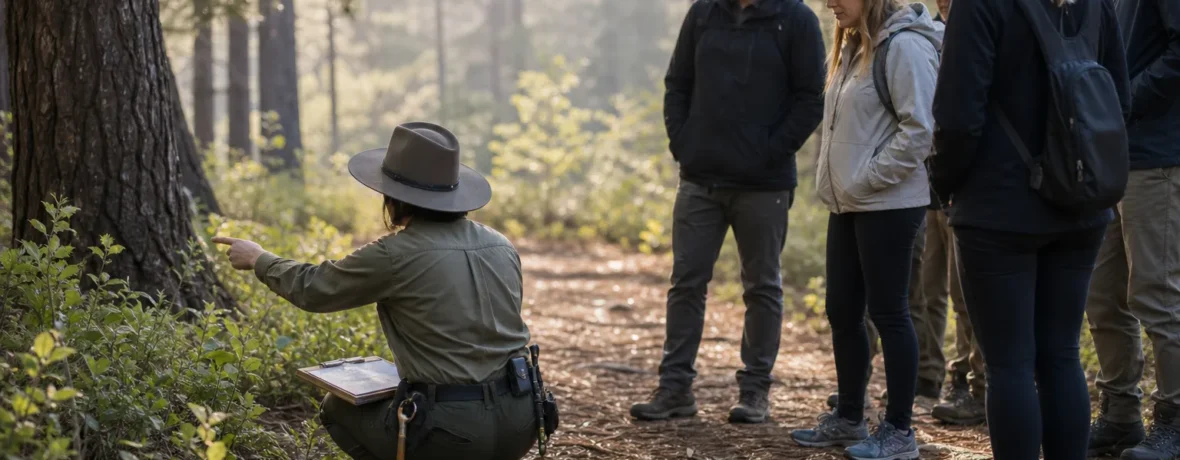
What does a park ranger do? A park ranger protects parks and helps visitors use them safely. In one shift, that can mean answering trail questions, giving programs, checking permits or regulations, responding to injuries, assisting search and rescue, documenting resource damage, and keeping watch over wildlife, water, roads, and historic sites.
What is a park ranger?
A park ranger is a public-facing steward of a park, forest, historic site, recreation area, or protected landscape. The job blends people skills with resource protection, outdoor judgment, education, and sometimes emergency response.
In the National Park Service, ranger work sits inside a bigger team that can include interpreters, law enforcement officers, scientists, maintenance crews, dispatchers, firefighters, mechanics, historians, and administrative staff. The National Park Service careers page puts it plainly: park employees fill many roles, not just the classic flat-hat image most visitors picture.
At a small historic site, a ranger may spend much of the day answering questions, leading talks, and protecting artifacts. At a huge mountain park, a ranger may be coordinating with trail crews, checking backcountry conditions, responding to a medical call, and explaining why a meadow is closed to foot traffic.
What does a park ranger do in a typical day?
A park ranger’s day changes with the park, season, weather, and visitor traffic. Still, most shifts revolve around safety, information, resource protection, and problem-solving.
Here’s a realistic day in the job:
- Check the morning brief. Rangers start with road status, trail reports, weather, fire danger, closures, staffing, radio channels, and any overnight incidents.
- Open visitor contact points. That may mean a visitor center desk, entrance station, campground office, patrol vehicle, trailhead kiosk, or backcountry permit counter.
- Answer the same vital questions. “Is this trail icy?” “Can my dog go there?” “Where can I camp?” “How much water should I carry?” These answers prevent real trouble.
- Patrol high-use areas. Rangers walk trails, drive park roads, check overlooks, monitor campgrounds, and look for unsafe behavior or resource damage.
- Lead programs or talks. Interpretive rangers connect visitors with geology, wildlife, Indigenous history, battlefields, night skies, watersheds, and old buildings.
- Respond to incidents. A lost hiker, heat illness, a fender bender, a bear jam, a wildfire report, or a twisted ankle can reset the whole day.
- Write reports. Rangers document accidents, warnings, citations, wildlife encounters, trail issues, visitor contacts, and resource concerns.
- Close the loop. Before the shift ends, they brief the next crew, update signs or alerts, restock supplies, and pass along unresolved issues.
What are the main types of park rangers?
Park ranger jobs split into specialties, and one ranger may cover more than one lane in a smaller park. The title sounds simple; the work is not.
| Ranger type | What they do | Where hikers notice them |
|---|---|---|
| Interpretive ranger | Leads talks, guided walks, school programs, and visitor center education. | Trailhead talks, evening programs, overlooks, museums. |
| Law enforcement ranger | Enforces park rules, responds to emergencies, investigates incidents, and protects visitors and resources. | Road patrols, campgrounds, closures, accident scenes. |
| Backcountry or wilderness ranger | Patrols remote trails, checks permits where required, monitors campsites, and helps with rescues. | Backcountry camps, passes, ranger stations, long trails. |
| Resource or science-focused ranger | Monitors wildlife, plants, water, cultural sites, and restoration projects. | Meadow closures, wildlife areas, research zones, restoration sites. |
USAJOBS describes the federal Park Ranger 0025 series as work tied to conserving and using federal park resources, including visitor information, law enforcement, traffic control, search and rescue, fire control, and management of wildlife, forests, historic buildings, and recreation areas through the Park Ranger career series.
Do park rangers enforce laws?
Some park rangers enforce laws, and some do not. Law enforcement rangers are commissioned officers; interpretive, education, science, and visitor-use rangers usually are not.
Law enforcement rangers handle the serious side of public lands: illegal camping, impaired driving, wildlife harassment, theft, vandalism, disorderly conduct, permit violations, traffic crashes, missing persons, and emergency scenes. The NPS law enforcement ranger page describes them as rangers trusted to protect both park resources and visitors.
That does not mean every ranger you meet is there to write tickets. Many are trying to keep small mistakes from turning into big problems. If a ranger asks you to stay on trail, leash your dog, store food properly, or avoid a closed area, the goal is simple: protect the place and keep people from getting hurt.
How do park rangers help hikers?
Park rangers help hikers make better decisions before and during a trip. Good advice from a ranger can save you wasted miles, a rough night, or a rescue.
Ask a ranger the questions you cannot answer from a pretty map screenshot:
- Which trails are icy, washed out, flooded, smoky, or exposed?
- How much water is reliable on the route right now?
- Where are current wildlife closures or nesting areas?
- Which trailheads fill first?
- What time does weather usually turn?
- Are there stream crossings, snowfields, loose rock, or route-finding sections?
- Do you need a permit, bear canister, shuttle, or timed entry for a specific area?
Rangers also set the tone for trail ethics. They explain why cutting switchbacks wrecks slopes, why feeding wildlife is a bad deal for the animal, why cryptobiotic soil needs to be avoided in desert parks, and why “just one photo” beyond a closure still counts.
How do you become a park ranger?
You become a park ranger by matching your experience to a specific ranger track, then applying through the agency that manages the land. Federal jobs usually run through USAJOBS; state, county, and city parks use their own hiring systems.
For National Park Service jobs, the NPS application guidance points applicants to USAJOBS for vacancies. As of November 2026, NPS says seasonal employment varies by park, with summer seasons generally running March through September and winter seasons generally running October through February.
A practical path looks like this:
- Pick a track. Interpretation, law enforcement, wilderness, natural resources, cultural resources, visitor services, fire, or maintenance-adjacent work.
- Build outdoor and people experience. Guiding, teaching, volunteering, trail work, customer service, search and rescue, biology fieldwork, and youth conservation corps work can all help.
- Learn the hiring language. Federal listings are specific. Your resume needs to show the required experience clearly, not hide it in vague outdoor enthusiasm.
- Start seasonal if needed. Seasonal ranger roles are common entry points, especially for people still building experience.
- Get required training. Law enforcement, emergency medical response, wildland fire, interpretation, and resource work each have different training demands.
What skills make a good park ranger?
A good park ranger stays calm, explains clearly, and makes sound calls with incomplete information. The best rangers are both friendly and firm.
Useful ranger skills include:
- Clear communication: turning complex rules, hazards, and natural history into language visitors can use.
- Outdoor judgment: reading weather, terrain, water, heat, cold, and visitor ability.
- Conflict control: correcting behavior without escalating every contact.
- Physical stamina: standing, walking, lifting, patrolling, and working in heat, cold, wind, rain, or snow.
- Documentation: writing clean reports after incidents, patrols, and visitor contacts.
- Teamwork: coordinating with dispatch, EMS, trail crews, scientists, volunteers, and nearby agencies.
- Curiosity: learning the plants, animals, rocks, stories, and hazards of one specific place in depth.
The job rewards people who can talk to a family at a picnic table, then switch gears fast when a radio call comes in from 6 miles [9.7 km] up a trail.
Is being a park ranger mostly an outdoor job?
Not always. Some ranger jobs spend large parts of the day outside, while others spend many hours at desks, counters, radios, computers, classrooms, and visitor centers.
A wilderness ranger may hike long distances, clear minor trail obstacles, check backcountry permits, and camp in remote zones. An interpretive ranger may split time between indoor exhibits and outdoor talks. A supervisory ranger may spend more time on schedules, budgets, hiring, reports, and meetings than on trails.
That is the trade. The uniform may come with jaw-dropping scenery, but it also comes with paperwork, hard conversations, crowded parking lots, bathroom problems, and long days of saying the same safety message with patience.
Related reading
- How to Become a Park Ranger: Education, Steps and Timeline
- The Park Ranger Hat: History of the Flat Hat
- How to Become a National Park Ranger (NPS)
- How Much Does a Park Ranger Make?
FAQ
What does a park ranger do every day?
A park ranger helps visitors, protects resources, and responds to problems. Daily work may include answering questions, patrolling trails or roads, giving programs, checking conditions, handling incidents, and writing reports.
Are all park rangers police officers?
No, all park rangers are not police officers. Law enforcement rangers have specific authority and training, while interpretive, education, science, and visitor services rangers focus on information, programs, stewardship, and park operations.
Can park rangers rescue hikers?
Yes, park rangers can be involved in hiker rescues, depending on their role and training. Search and rescue often involves rangers, dispatchers, EMS, volunteers, helicopters, and partner agencies working together.
Do park rangers live in the park?
Some park rangers live in or near the park, especially in remote areas with limited housing. Others commute from nearby towns, and housing depends on the agency, park location, season, and position.
Is a park ranger job hard to get?
Yes, many park ranger jobs are competitive. Seasonal work, volunteering, conservation corps experience, outdoor education, emergency training, and a strong USAJOBS resume can improve your chances.
What should hikers ask a park ranger before a hike?
Ask about current trail conditions, water sources, weather, wildlife activity, closures, permits, road access, and turnaround times. A ranger’s local update is often more useful than an old trip report.