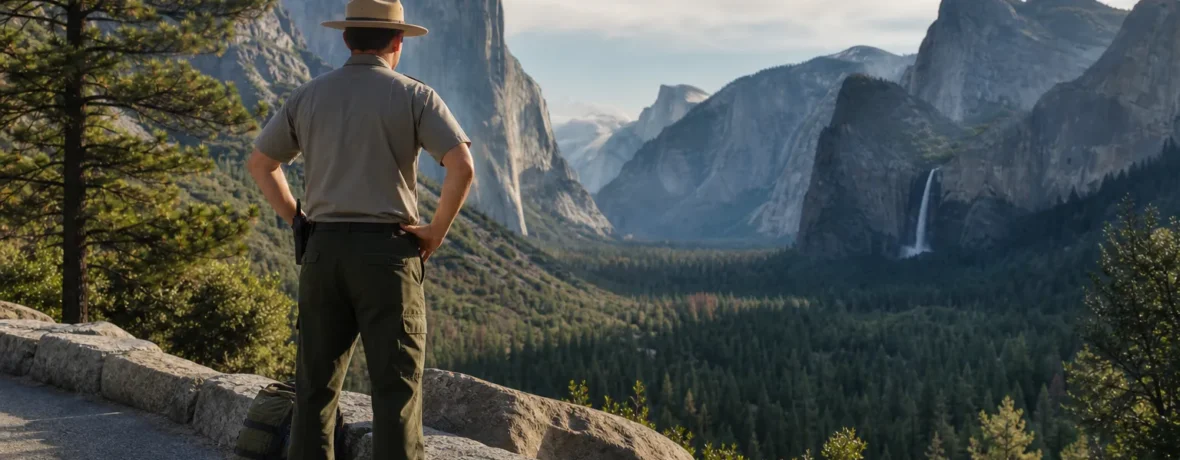
How to become a national park ranger: meet the education or experience requirements, build field and visitor-service skills, apply on USAJOBS, and start with seasonal, intern, volunteer, or permanent openings. For law enforcement ranger jobs, expect federal screening, academy training, and field training; permanent hires must meet age and fitness rules.
How to become a national park ranger: what are the steps?
Start by choosing the ranger track you want, then build a resume that proves you can do the work outdoors and with people.
“Park ranger” sounds like one job. It is not. In the National Park Service, rangers work in interpretation, visitor services, resource protection, wilderness, fees, education, dispatch, fire, search and rescue, and law enforcement. Some wear the flat hat at a visitor center. Some patrol trails. Some teach school groups, write permits, protect archeological sites, respond to medical calls, or work a snowy entrance station before sunrise.
Here is the clean path.
- Pick a lane. Decide whether you want interpretation, natural or cultural resources, visitor services, wilderness, fees, or law enforcement.
- Check the official qualification standard. The federal Park Ranger series is GS-0025. The OPM Park Ranger Series 0025 standard lists qualifying education and experience, as of November 2026.
- Get relevant experience. Visitor contact, guiding, teaching, conservation work, trail crews, history work, EMS, search and rescue, firefighting, fee collection, and volunteer work can all help when they match the posting.
- Build a federal resume. USAJOBS resumes need dates, hours per week, duties, supervisors, and proof that you did the exact work named in the vacancy.
- Apply on USAJOBS. NPS states that permanent and seasonal federal jobs are posted on USAJOBS. Start with the NPS job application guide, as of November 2026.
- Apply broadly. Famous parks get slammed with applicants. Smaller units, historic sites, recreation areas, and remote parks can be better entry points.
- Take seasonal work seriously. Many rangers stack several seasons before landing permanent work. Each season gives you duties, references, and park-specific skills.
- Keep improving your packet. Add certifications, stronger experience, and clearer resume language before each hiring cycle.
What does a national park ranger actually do?
A ranger helps protect park resources and helps visitors use the park safely and respectfully.
That can mean talking with hikers at a trailhead, giving a program on Civil War history, checking wilderness permits, staffing a campground, protecting nesting wildlife, managing traffic after a bear jam, joining a search and rescue response, or enforcing federal regulations. The exact job depends on the division and the park.
Think of it this way: the badge and uniform are the visible part. The real work is judgment. You need to read people fast, stay calm when plans go sideways, communicate clearly, and care enough about a place to protect it when nobody is clapping.
| Ranger track | Common work | Good background |
|---|---|---|
| Interpretation | Talks, walks, visitor center work, education programs | Teaching, public speaking, history, natural sciences |
| Visitor services or fees | Entrance stations, permits, trip planning, visitor questions | Customer service, cash handling, recreation knowledge |
| Resource or wilderness | Patrols, permits, monitoring, backcountry contacts | Field biology, trail work, GIS, Leave No Trace |
| Law enforcement | Patrol, emergency response, investigations, protection | Law enforcement, EMS, SAR, military, public safety |
Do you need a degree to become a national park ranger?
No, not always, but a degree can help you qualify faster for many GS-0025 park ranger postings.
For the Park Ranger GS-0025 series, OPM lists education, experience, and combinations of both as qualification routes. As of November 2026, a GS-5 park ranger position can be reached with a 4-year course of study leading to a bachelor’s degree with 24 semester hours of related coursework, or with qualifying specialized experience equivalent to at least GS-4. Related fields can include natural resource management, natural sciences, earth sciences, history, archeology, anthropology, park and recreation management, law enforcement or police science, social sciences, museum sciences, public administration, and other subjects tied to managing and protecting natural and cultural resources.
No degree? Then your experience has to do more work. A summer as a kayak guide, a year as an outdoor educator, several seasons on a trail crew, volunteer shifts at a historic site, wildland fire assignments, or public-facing conservation work may help if you describe it in the language of the announcement.
Do not hide the gritty stuff. If you handled angry visitors, opened and closed facilities, wrote incident reports, gave safety briefings, used radios, worked in heat, snow, or darkness, or carried responsibility for groups outdoors, put that in the resume.
What experience helps you get hired by the NPS?
The strongest experience matches the exact duties in the job announcement.
NPS hiring is not a vibe check. A human resources specialist reviews whether your resume proves you meet the minimum requirements. Then a hiring manager looks for fit. You need both.
Useful experience can include:
- Working as a park guide, campground host, visitor center assistant, fee technician, or guide
- Teaching outdoor education, history, science, or youth programs
- Leading hikes, paddling trips, climbing programs, or field classes
- Trail crew, conservation corps, habitat restoration, or invasive plant work
- Search and rescue, EMS, ski patrol, lifeguarding, or wildland fire
- Military, police, dispatch, corrections, or other public safety work
- Research, museum, archeology, GIS, biological monitoring, or archives work
- Volunteer work with parks, refuges, forests, land trusts, or historic sites
Internships and volunteer roles matter, especially early. The NPS says it offers seasonal, internship, volunteer, student, and permanent paths through its Work for Us page, as of November 2026. If you are still in school, do not wait until graduation. Get dirt on your boots now.
How do you apply for National Park Service ranger jobs?
You apply through USAJOBS, not by handing a resume to a ranger at the visitor center.
Every announcement is its own competition. There is no single “keep my resume on file” application that covers the whole NPS. You create a USAJOBS profile, search National Park Service openings, read each announcement closely, upload required documents, answer the questionnaire honestly, and submit before the closing date.
For seasonal jobs, timing matters. NPS says summer seasonal positions are generally for seasons between March and September, with applications accepted between October and February; winter seasons generally run between October and February, with applications accepted between July and August, as of November 2026.
Before you apply, build this checklist:
- Federal resume with month/year dates and hours per week for every job
- Transcripts, if using education to qualify
- Veterans’ preference documents, if applicable
- Certifications named in the announcement, such as CPR, EMT, wildland fire, or law enforcement documents
- Driver’s license details, if required
- Clear examples of visitor contact, resource protection, safety work, and outdoor judgment
Use the announcement’s words when they are true. If it asks for “interpretive programs,” do not only write “gave talks.” Write the audience size, subject, frequency, and setting. If it asks for “resource protection,” name the resource, your role, the tools, and the result.
How do you become an NPS law enforcement ranger?
You apply for law enforcement ranger announcements and complete the required federal screening, academy training, and field training.
This is the protection side of NPS. Law enforcement rangers handle patrol, emergency response, investigations, traffic, resource protection, and public safety. The work can be physical and tense. You may be first on scene for crashes, medical calls, domestic disputes, illegal hunting, cliff rescues, missing hikers, and resource crimes.
As of November 2026, NPS says prior NPS experience is not required for permanent law enforcement ranger hiring, and prior attendance at a Park Ranger Law Enforcement Academy is not a prerequisite for consideration. NPS also says permanent law enforcement ranger jobs are typically posted on USAJOBS approximately twice per year through its Become a Law Enforcement Ranger page.
Permanent law enforcement hires attend training at the Federal Law Enforcement Training Center in Glynco, Georgia. NPS states that Land Management Police Training and Ranger-Specific Basic Training are expected to take 18 weeks, followed by an 11-week Field Training and Evaluation Program, as of November 2026. The NPS law enforcement training process also lists the age rules: applicants must be at least 21 and must not have reached their 37th birthday upon appointment, with exceptions for certain prior federal service and qualified veterans’ preference eligibles.
There is also a seasonal route. NPS-approved Park Ranger Law Enforcement Academy programs prepare graduates for seasonal law enforcement positions. As of November 2026, the NPS Park Ranger Law Enforcement Academy page says approved programs require at least 650 classroom hours and that graduates must still pass drug, medical, background, and physical fitness screening.
How long does it take to become a national park ranger?
It can take one hiring cycle, but many people need several seasons to become competitive.
If you already meet the qualifications, have a strong federal resume, and apply to the right opening, you may be hired into a seasonal or entry-level job in the next cycle. If you are starting from zero, plan on building experience for one to three years through volunteering, conservation corps work, internships, seasonal jobs, guiding, teaching, or public safety roles.
Permanent NPS jobs are more competitive. Seasonal work is often the proving ground. It gives you federal hiring experience, real park references, and stories that sound like the job because they are the job.
For law enforcement, add the training timeline. Permanent hires can expect academy training and field training after selection. Seasonal law enforcement candidates who choose the PRLEA route must finish the academy before they can compete for seasonal commissioned positions.
What skills make a strong ranger candidate?
The best ranger candidates combine outdoor competence with calm, direct communication.
You do not need to be the fastest hiker on the ridge. You do need to be steady. Rangers spend long days on their feet, answer the same question 70 times without snapping, handle radios and paperwork, and make safety calls when visitors are tired, scared, angry, or lost.
Build these skills before you apply:
- Public speaking: Practice short, clear talks. Interpretation is not lecturing; it is helping people care.
- Writing: Incident notes, reports, emails, signs, and program outlines all need clean writing.
- Map and terrain sense: Know how to read topo maps, explain trail distances, and spot realistic turnaround times.
- First aid: CPR, wilderness first aid, Wilderness First Responder, or EMT training can help, depending on the job.
- Conflict management: You will talk to people who are breaking rules, late, hot, drunk, lost, or embarrassed.
- Resource knowledge: Learn the plants, wildlife, geology, history, and cultural stories of the places where you apply.
- Reliability: Parks run on small crews. Showing up ready matters.
What should your ranger resume say?
Your resume should prove eligibility first and personality second.
A private-sector one-page resume is usually too thin for federal hiring. USAJOBS resumes are longer because they need evidence. If you worked 40 hours per week as a guide for six months, say that. If you led 3-mile [4.8 km] hikes for 15 visitors at 8,000 feet [2,438 m], say that. If you used a radio, handled cash, wrote reports, checked permits, worked alone, or gave safety briefings, say that.
For each role, include:
- Employer, location, job title, start and end month/year
- Hours worked per week
- Pay grade, if it was a federal job
- Supervisor contact information, if requested
- Specific duties that match the announcement
- Tools, certifications, audiences, terrain, and conditions
- Measurable details when honest and relevant
Do not make HR guess. If the announcement says “one year of specialized experience,” your resume must show one year. If you worked part time, hours matter. If you are using transcripts, upload them. A great candidate can still get screened out for a vague resume.
Related reading
- How to Become a Park Ranger: Education, Steps and Timeline
- What Does a Park Ranger Do? A Day in the Job
- The Park Ranger Hat: History of the Flat Hat
- How to Become a Forest Ranger
FAQ
Is it hard to become a national park ranger?
Yes, permanent NPS ranger jobs are competitive. You can improve your odds by applying widely, taking seasonal work, building public-facing outdoor experience, and writing a federal resume that mirrors each announcement.
Can you become a park ranger without law enforcement training?
Yes. Many NPS ranger jobs are not law enforcement jobs, including interpretation, education, visitor services, wilderness, and resource work. Law enforcement ranger positions have separate screening and training requirements.
What is the best degree for becoming a national park ranger?
The best degree is one that matches the work you want: natural resources, park and recreation management, history, archeology, biology, education, public administration, or law enforcement can all fit. OPM’s GS-0025 standard allows several related fields, so match your coursework to the vacancy.
Where are NPS ranger jobs posted?
NPS ranger jobs are posted on USAJOBS. Search for “National Park Service” and job titles such as park ranger, park guide, visitor services assistant, fee technician, biological science technician, or law enforcement ranger.
Should you start with a seasonal ranger job?
Yes, seasonal work is one of the most practical entry points. It gives you NPS experience, references, and proof that you can handle the pace, people, weather, and odd hours of park work.
Do national park rangers hike every day?
No. Some rangers hike or patrol trails often, while others spend more time at visitor centers, entrance stations, offices, archives, campgrounds, or in vehicles. If you want field time, target wilderness, backcountry, resources, trail, or protection roles.